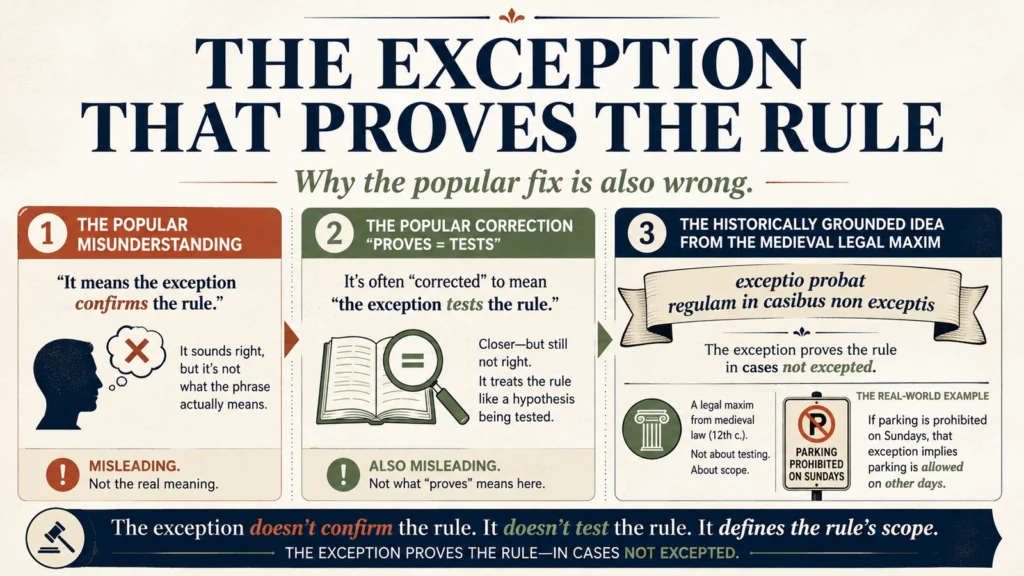
Almost every explanation of this phrase you will find says the same thing: "proves" here is the old sense meaning "tests", so the phrase means the exception tests the rule. That correction is repeated so widely that it has become the sophisticated answer, the one you give to show you have looked into it.
Michael Quinion, writing at World Wide Words, rejects it. His position, stated directly, is that the phrase is indeed used in that sense but that this "is not where it comes from or what it strictly means." The problem, he argues, is not the word "proves" at all. It is the word "exception."
That makes this one of the more unusual pages on this site: a phrase where the popular explanation is wrong and the popular correction is wrong too. Both of them can be traced, which is what the method behind every origin page here exists to do.
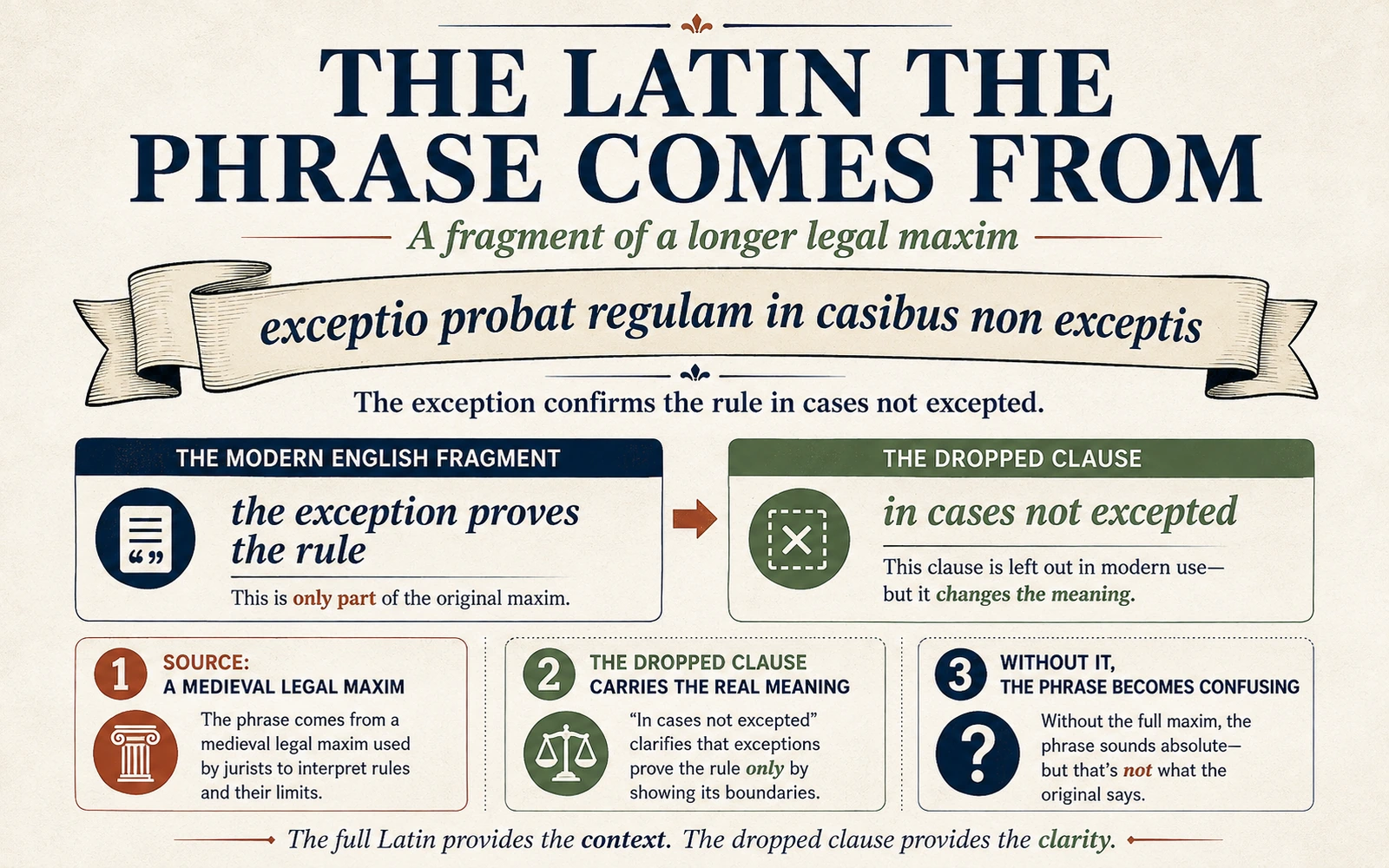
The Latin the phrase comes from
The source is a medieval legal maxim: exceptio probat regulam in casibus non exceptis, which Quinion renders as "the exception confirms the rule in the cases not excepted."
Read the whole maxim and the confusion dissolves. The English phrase in circulation is a fragment of it. The clause that does the real work, "in the cases not excepted", is the part that got dropped, and once it was gone the remaining words could be made to mean almost anything.
What the maxim actually claims
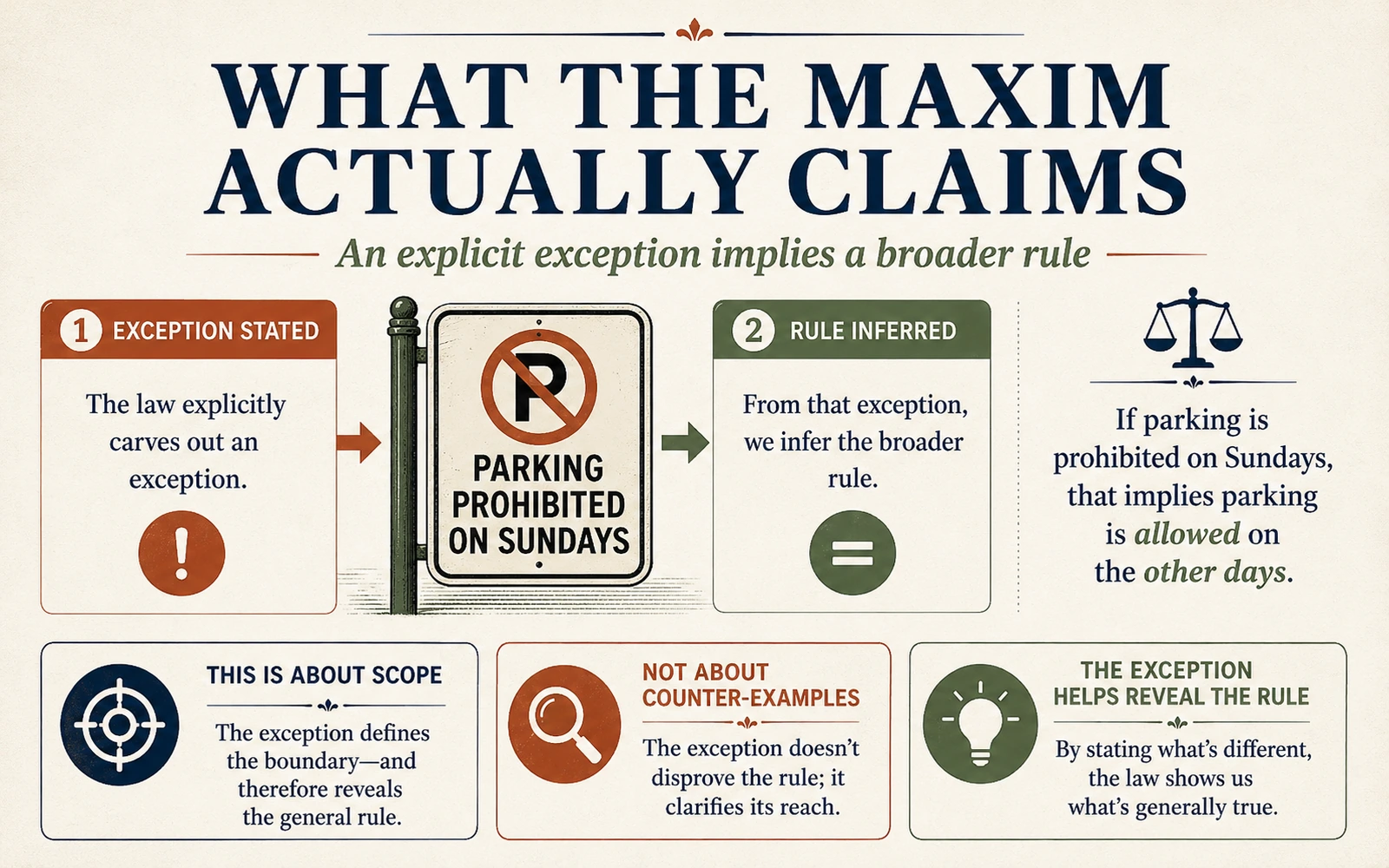
Quinion's reading, and the one the full Latin supports, is that an "exception" here is not an awkward case that breaks a pattern. It is a stated permission not to follow a rule that otherwise applies, and its existence is evidence that the rule exists.
The example that makes this concrete is a sign. If a sign says parking prohibited on Sundays, you may reasonably infer that parking is permitted on the other six days. The Sunday prohibition is the exception, and it tells you there is a rule about the rest of the week even though nobody has written that rule down anywhere. The exception has proved, in the sense of established, the existence of the general rule.
That is a real and useful piece of reasoning. It is also nothing like the way the phrase is used in ordinary conversation.
Where "proves means tests" comes from, and why it spreads
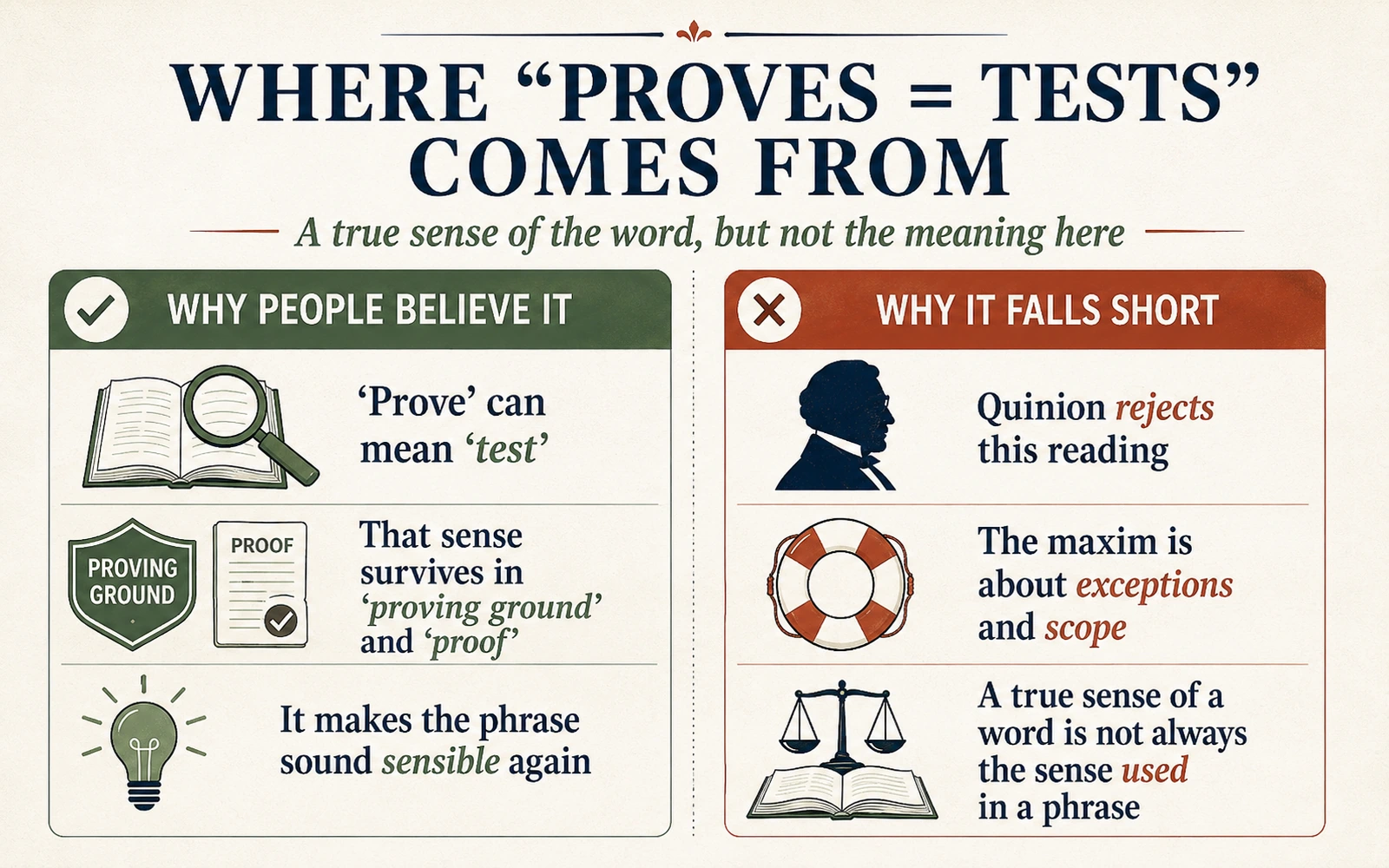
The tests reading is not invented out of nothing. The verb "prove" genuinely does carry a sense of testing, and Merriam-Webster's entry for the verb includes "to test the worth or quality of." That sense survives in ordinary English in a proving ground, in proofing bread, and in the alcohol sense of proof.
So the ingredients are all real. What is not established is that this is the sense operating in the maxim. Quinion says it is not. A true sense of a word is not the same thing as the sense a particular phrase is using, and the slide between those two is how a great many plausible etymologies are made.
The tests reading also spreads for a reason that has nothing to do with evidence: it rescues the phrase. Taken at face value, "the exception proves the rule" sounds like an argument that evidence against a claim supports the claim, which is obviously broken reasoning, and readers who notice that reach gratefully for any explanation that makes the sentence sensible again. This is the same rescue instinct that keeps the false story behind "rule of thumb" alive: a phrase that has stopped explaining itself will pull in whatever explanation is offered.
How the phrase is actually used
Honesty about usage matters here as much as honesty about origins.
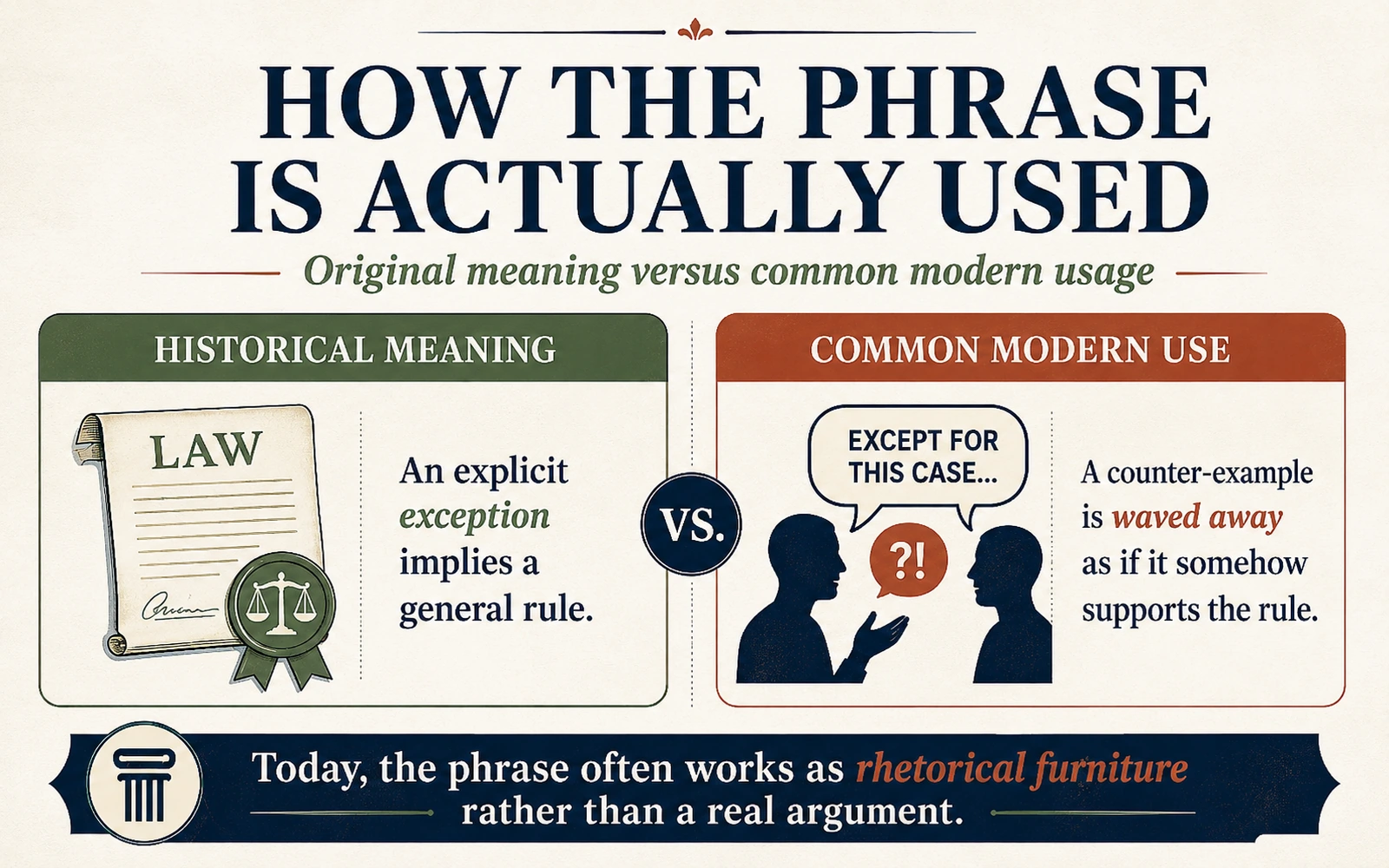
In everyday speech, "the exception that proves the rule" is most often used to wave away a counter-example. Someone points out a case that does not fit, and the phrase is deployed to say that the case does not count. Under either historical reading, this use does not follow. It is nonetheless the dominant use, and it is what most readers who search for this phrase have just heard someone say.
You can say two things at once without contradiction. The phrase has a coherent original meaning that most speakers no longer use, and the common modern use is a piece of rhetorical furniture rather than an argument. Pointing that out is more useful to a reader than a correction that swaps one shaky story for another.
What to do with it in writing
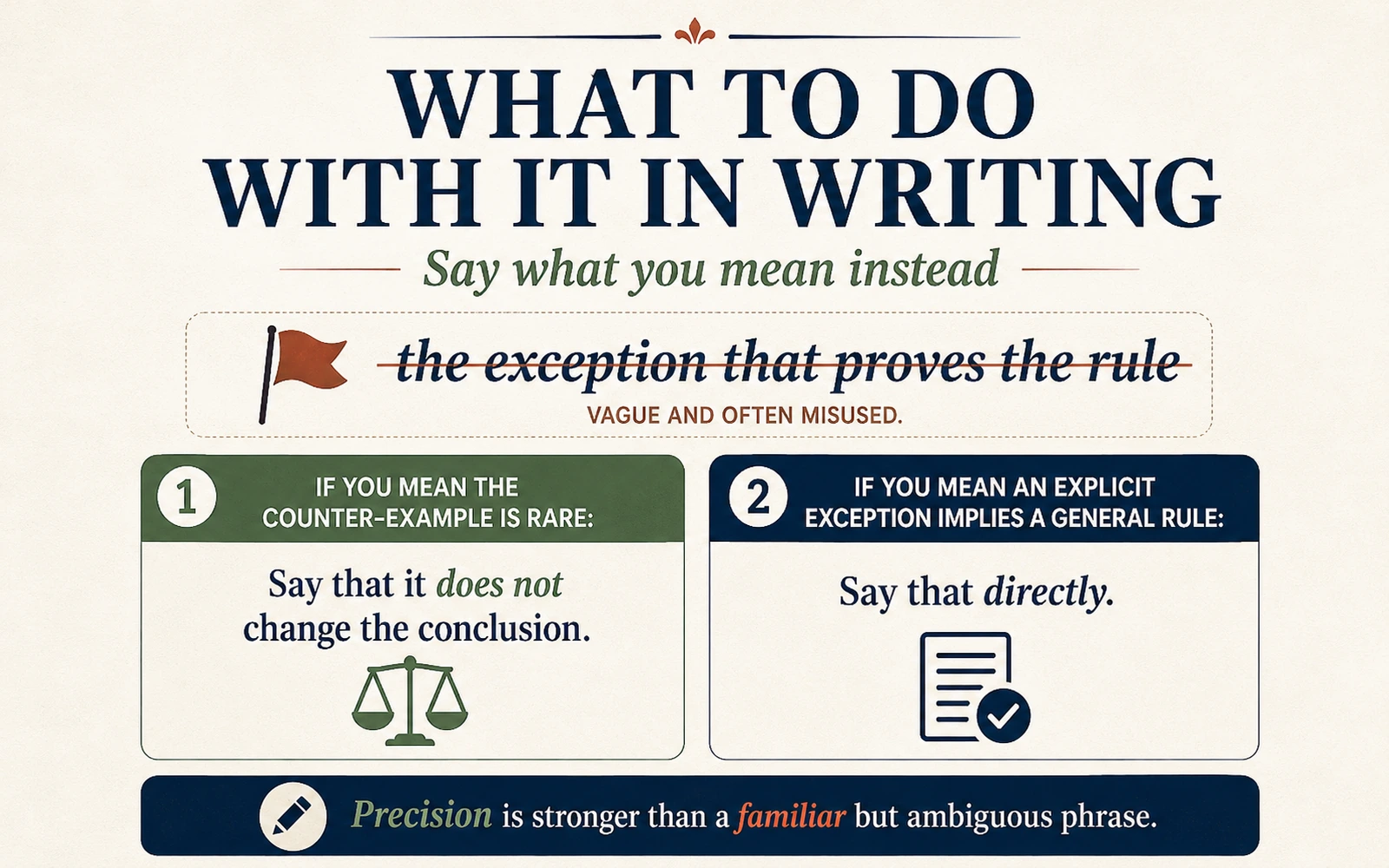
If you are writing an argument and you find yourself reaching for this phrase, the honest move is usually to say what you mean instead. If you mean the counter-example is rare enough not to change the conclusion, say that, because that is a claim a reader can check. If you mean the exception is explicitly carved out and therefore implies the general rule, say that too, since it is precise and the phrase is not.
This is the same practical test applied throughout the misused-phrases cluster on this site: when a fixed phrase has drifted far enough that two readers will take it two different ways, the phrase has stopped doing the job that fixed phrases exist to do.
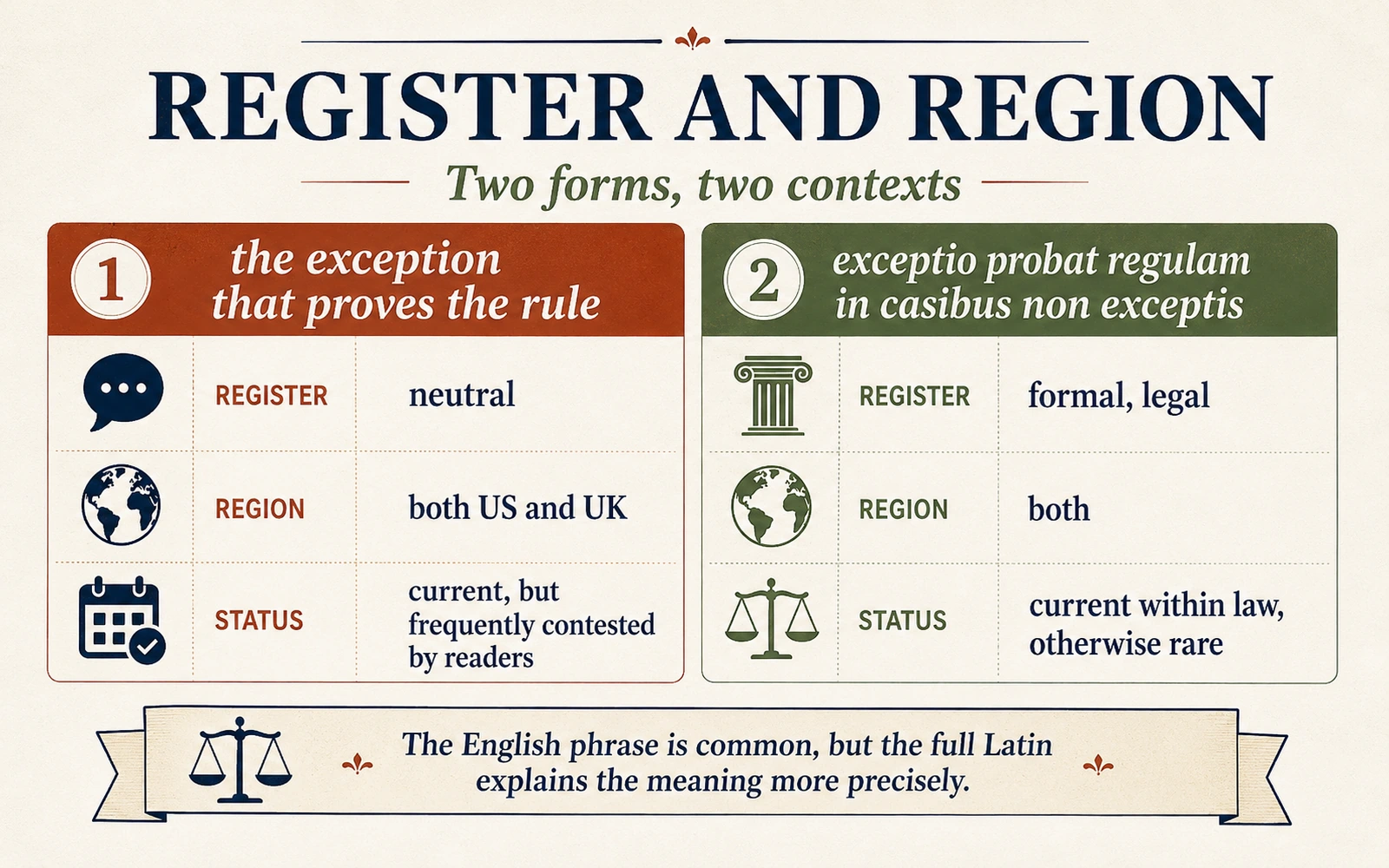
Register and region
| Register | Region | Status | |
|---|---|---|---|
| the exception that proves the rule | neutral. Common in speech and in writing, but weak in argument | both US and UK | current, and frequently contested by readers |
| exceptio probat regulam in casibus non exceptis | formal, legal | both, as a legal maxim | current within law, otherwise rare |
What is genuinely unresolved
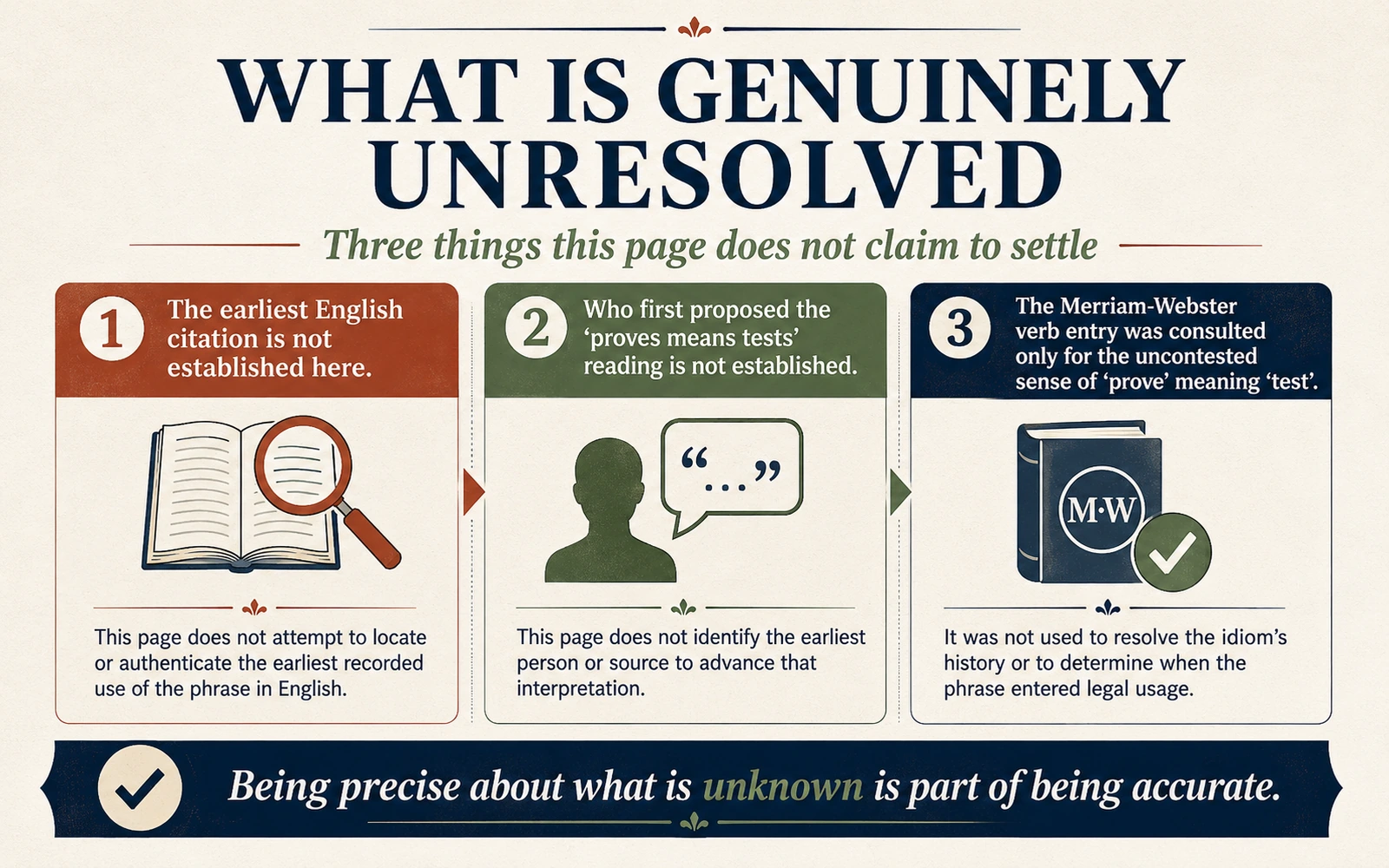
The date the English phrase entered use is not given on this page. Quinion's article traces the Latin maxim rather than dating the English fragment, and we have not established an earliest English citation.
Who first proposed the "proves means tests" reading is not established. It is everywhere now. Finding the point at which it entered circulation would be a genuinely valuable piece of work and this page has not done it.
Merriam-Webster's verb entry was read through search results rather than by loading the page. It is cited here only for the uncontested dictionary sense of "prove" as "test", and for nothing more.