Most lists of misused idioms are alphabetical, which is the least useful order they could be in. You read forty entries, agree with all of them, and remember none, because there is nothing holding them together.
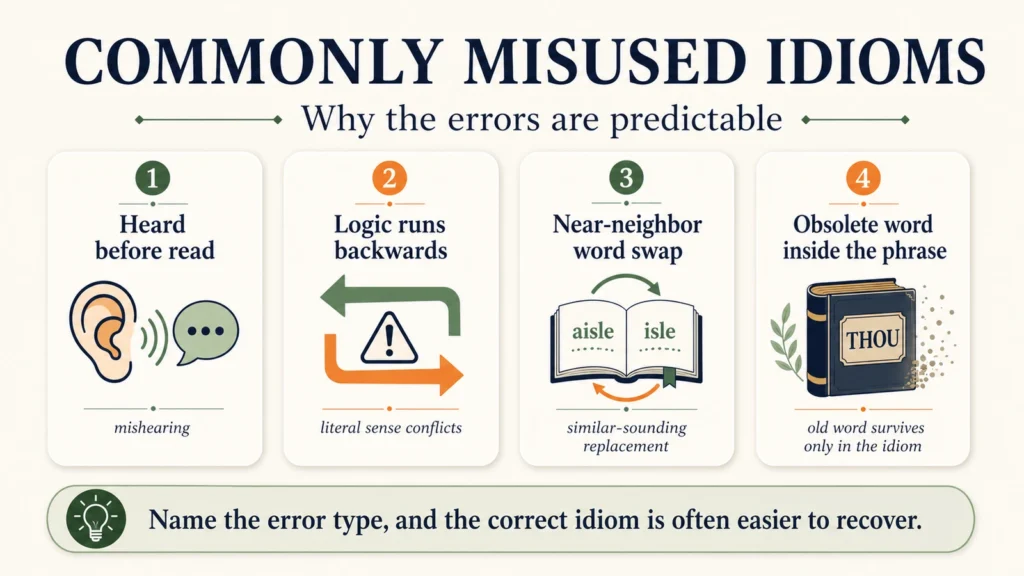
The errors are not random. Almost every misused idiom in English fails in one of four ways, and once you can name the way it failed, you can usually work out the correct form without having memorized it. That is what this page is for. The individual phrases each have their own history and their own citation trail, and those get their own pages.
Here are the four.
Error type 1: you heard it before you read it
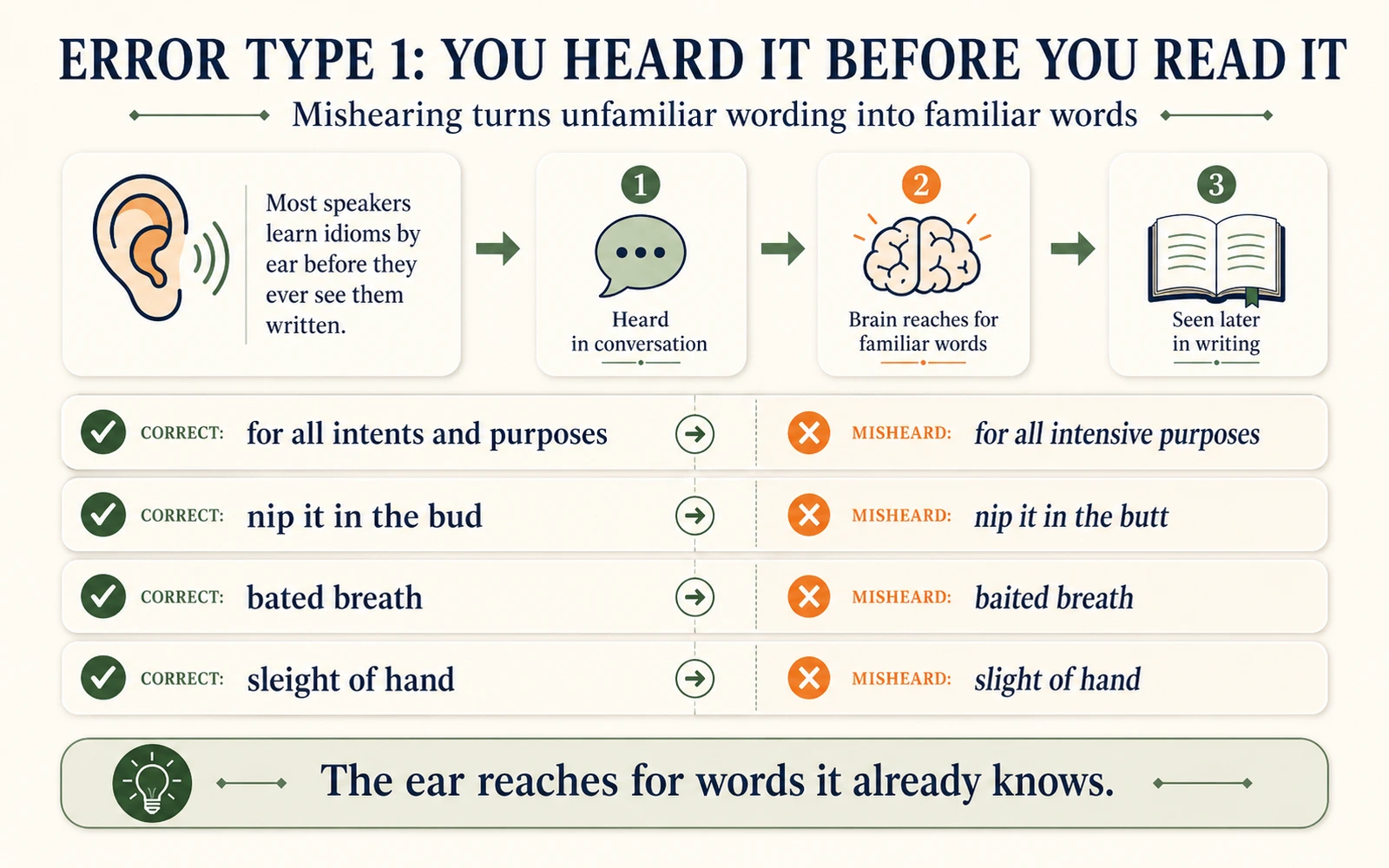
This is the biggest category by a distance, and the one people are least embarrassed by once they understand it. English is full of phrases that most speakers acquire by ear, years before they ever see them written. When the ear reaches for a spelling, it picks a word it already knows over a word it does not.
"For all intents and purposes" becomes "for all intensive purposes". Nobody who says that is being careless. They are doing what a listener has to do, which is to fit unfamiliar sound onto familiar vocabulary.
The phrase itself came out of legal English. Merriam-Webster traces the pairing of intents and purposes to a 1546 Act of Parliament that gave Henry VIII authority to interpret laws, and which carried the wording "to all intents, constructions, and purposes". English kept the intents and the purposes and quietly dropped the constructions. The version with to survives mainly in British English, and the version with for became the ordinary American form.
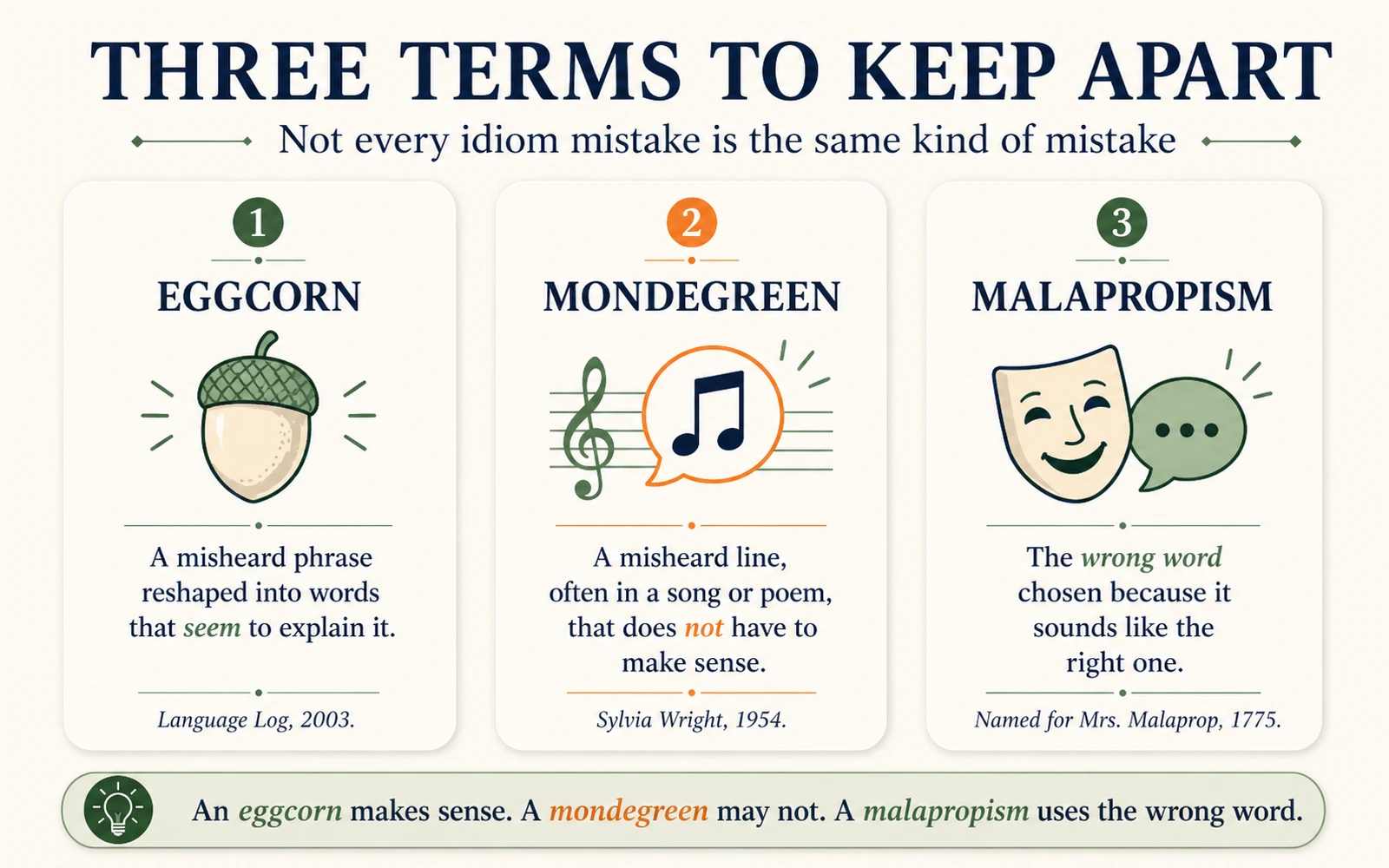
There is a name for this specific kind of error. In September 2003, on the linguistics blog Language Log, Mark Liberman wrote about a woman who had spent her life writing egg corn for acorn, and Geoffrey Pullum suggested that "eggcorn" was as good a name as any for the phenomenon, since no existing term quite fitted. The word stuck and is now in dictionaries. An eggcorn is not simply a mistake: it is a mistake that makes its own kind of sense, which is exactly why it spreads.
It is worth keeping three related terms apart, because they get used interchangeably and they are not the same thing.
| Term | What it is | Where the name comes from |
|---|---|---|
| Eggcorn | A misheard phrase reshaped into words that seem to explain it | Language Log, 2003. Mark Liberman's post about egg corn for acorn; the name proposed by Geoffrey Pullum |
| Mondegreen | A misheard line, usually in a song or poem, that does not have to make sense | Sylvia Wright, "The Death of Lady Mondegreen", Harper's Magazine, November 1954. As a child she heard "laid him on the green" in the ballad "The Bonnie Earl o' Moray" as "Lady Mondegreen" |
| Malapropism | The wrong word entirely, reached for because it sounds like the right one | Named for Mrs. Malaprop in Richard Brinsley Sheridan's 1775 comedy The Rivals |
Phrases that fail this way, with the standard written form on the left:
| Standard form | The common mishearing | Register | Region |
|---|---|---|---|
| for all intents and purposes | for all intensive purposes | neutral | both, with to all intents chiefly UK |
| nip it in the bud | nip it in the butt | casual | both |
| beck and call | beckon call | neutral | both |
| bated breath | baited breath | neutral, slightly literary | both |
| sleight of hand | slight of hand | neutral | both |
| tenterhooks | tenderhooks | neutral, dated in some uses | chiefly UK |
Each of those has a first-citation history of its own, and this site treats a history as something to be sourced rather than asserted, so none is summarized here.
Error type 2: the logic runs backwards
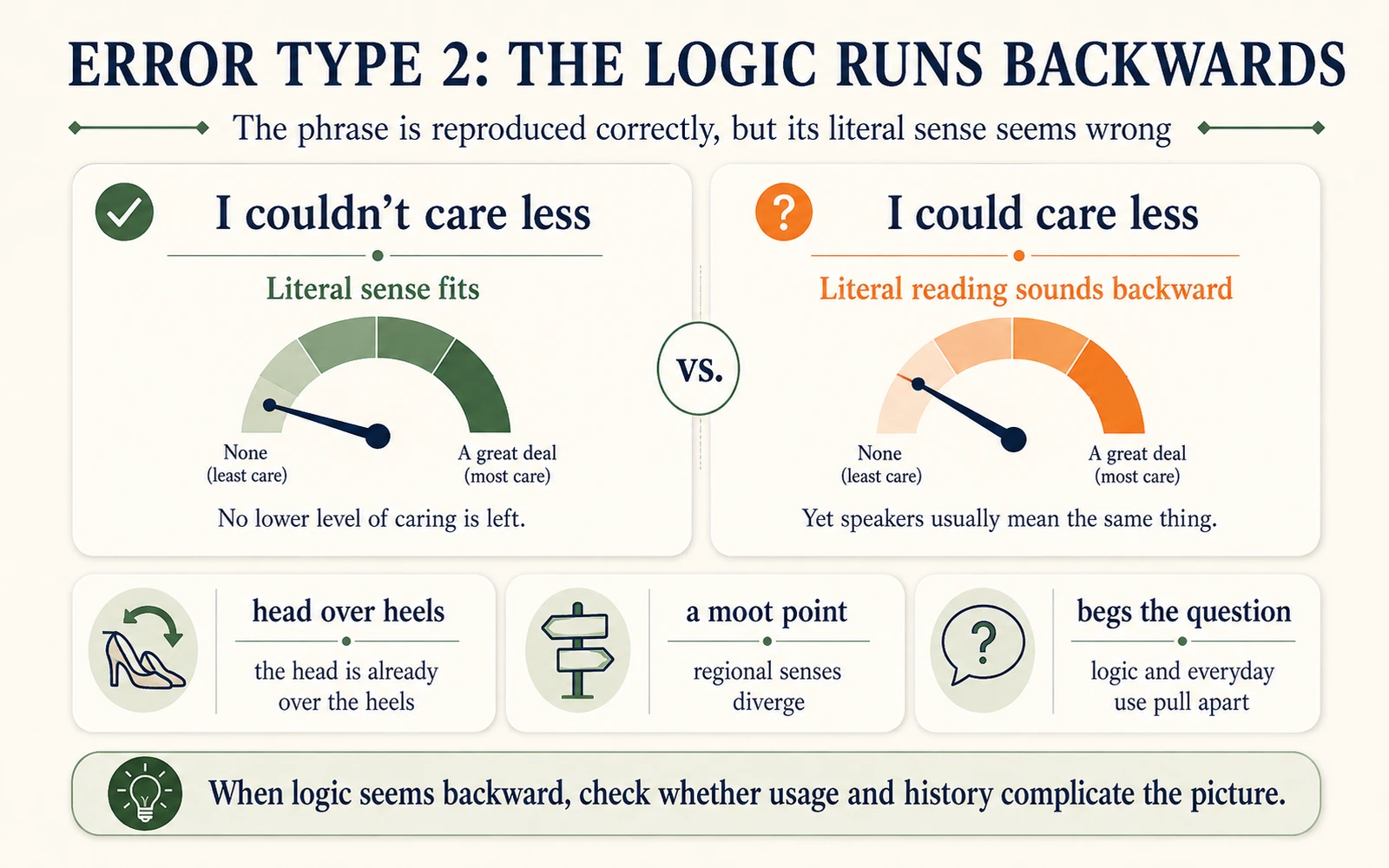
A smaller group, but the one that generates the most argument. Here the phrase is heard correctly and reproduced correctly, and it still appears to say the opposite of what the speaker means.
"I could care less" is the famous one. Read literally it says you have some caring available to spend, which is the reverse of the intended sense.
What makes it interesting is that the references do not agree on the history, and this site's position is to print the disagreement rather than to resolve it.
- Merriam-Webster reports evidence of "couldn't care less" well before the 1940s, including an example in Hearst's International-Cosmopolitan in May 1929, and finds "could care less" in North American print from as early as the 1950s. It enters "could care less" as a variant of the older phrase, with the same meaning, on the grounds that it is encountered constantly.
- Grammarphobia, the blog of Patricia O'Conner and Stewart Kellerman, gives a different set of earliest finds: a Kansas City Star story of 25 January 1942 for "couldn't care less", and the Ottawa Evening Citizen of 20 July 1948 for "could care less". It notes that the Oxford English Dictionary credits Anthony Phelps's 1946 book I Couldn't Care Less and describes "could care less" as a US colloquialism of the 1960s, while Canadian and Australian newspaper examples from the 1940s have since been documented.
Three references, three different starting dates, and no way to reconcile them into one clean sentence. That is the honest state of the question, and the dedicated page on this phrase lays out all of it.
Others that belong in this group:
| Standard form | Why it looks backwards | Register | Region |
|---|---|---|---|
| I couldn't care less | the widespread variant drops the negative | casual | both; the could variant is chiefly US |
| head over heels | the head is normally over the heels already | casual | both |
| a moot point | the British and American senses are close to opposite | neutral, business | differs by region |
| begs the question | the logical term and the everyday use pull apart | neutral, academic | both |
Error type 3: one word swapped for a near neighbor
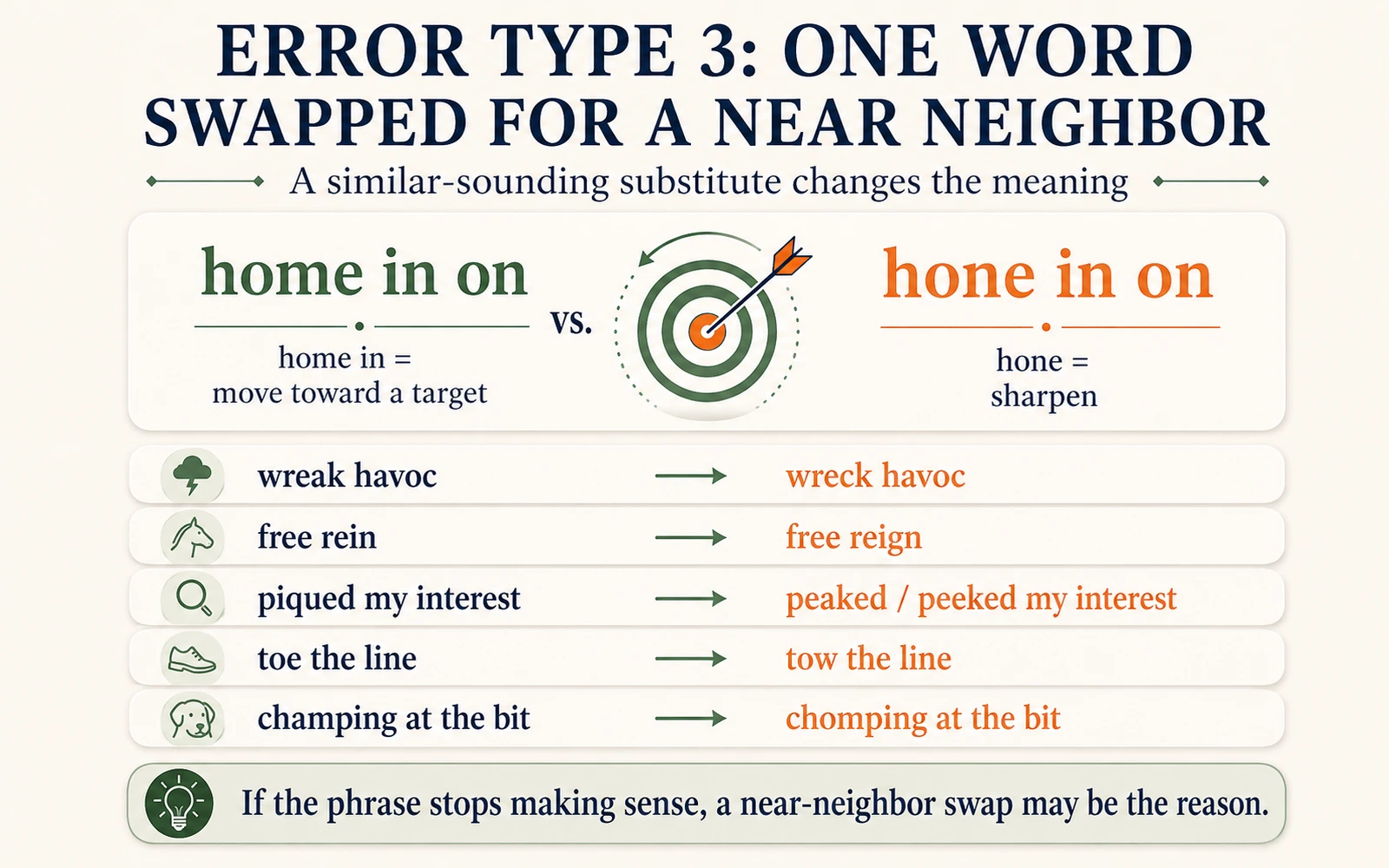
Here nothing is misheard. A word is simply replaced by another that sounds close and means something else, and the phrase stops meaning what it meant.
"Hone in" for "home in" is the clearest case in modern English, and it is also a live example of how usage advice and dictionaries can sit apart.
Merriam-Webster explains that home in this sense comes from the homing pigeon: to move toward an objective by following a signal or a landmark. By the 1920s pilots were homing toward destinations, and by the 1950s the figurative use had spread to anyone directing their attention at a target. "Hone in" appears around 1965, roughly a decade after the figurative home in, and the dictionary now enters both forms on the grounds that both are commonly found, while noting that most usage commentators treat hone in as an error.
The usage commentators are indeed unmoved. In a LawProse lesson published on 7 October 2014, Bryan Garner calls "hone in" both a faulty metaphor and a grammatical mistake, pointing out that home is intransitive and hone is transitive, so "sharpen in" is not a thing anyone can do. His Modern American Usage placed it at Stage 3 of his Language-Change Index in the third edition of 2009, and he wrote that Merriam-Webster's recognition of the form had probably pushed it to Stage 4.
Both of those positions are accurately reported and they point in different directions, because a dictionary records what people write and a usage guide advises what to write. Knowing which kind of book you are holding is most of the skill.
Others in this group:
| Standard form | The swap | Register | Region |
|---|---|---|---|
| home in on | hone in on | neutral, business | both |
| wreak havoc | wreck havoc | neutral | both |
| free rein | free reign | neutral | both |
| piqued my interest | peaked, or peeked | neutral | both |
| toe the line | tow the line | neutral | both |
| champing at the bit | chomping at the bit | casual | both; both forms now widely accepted |
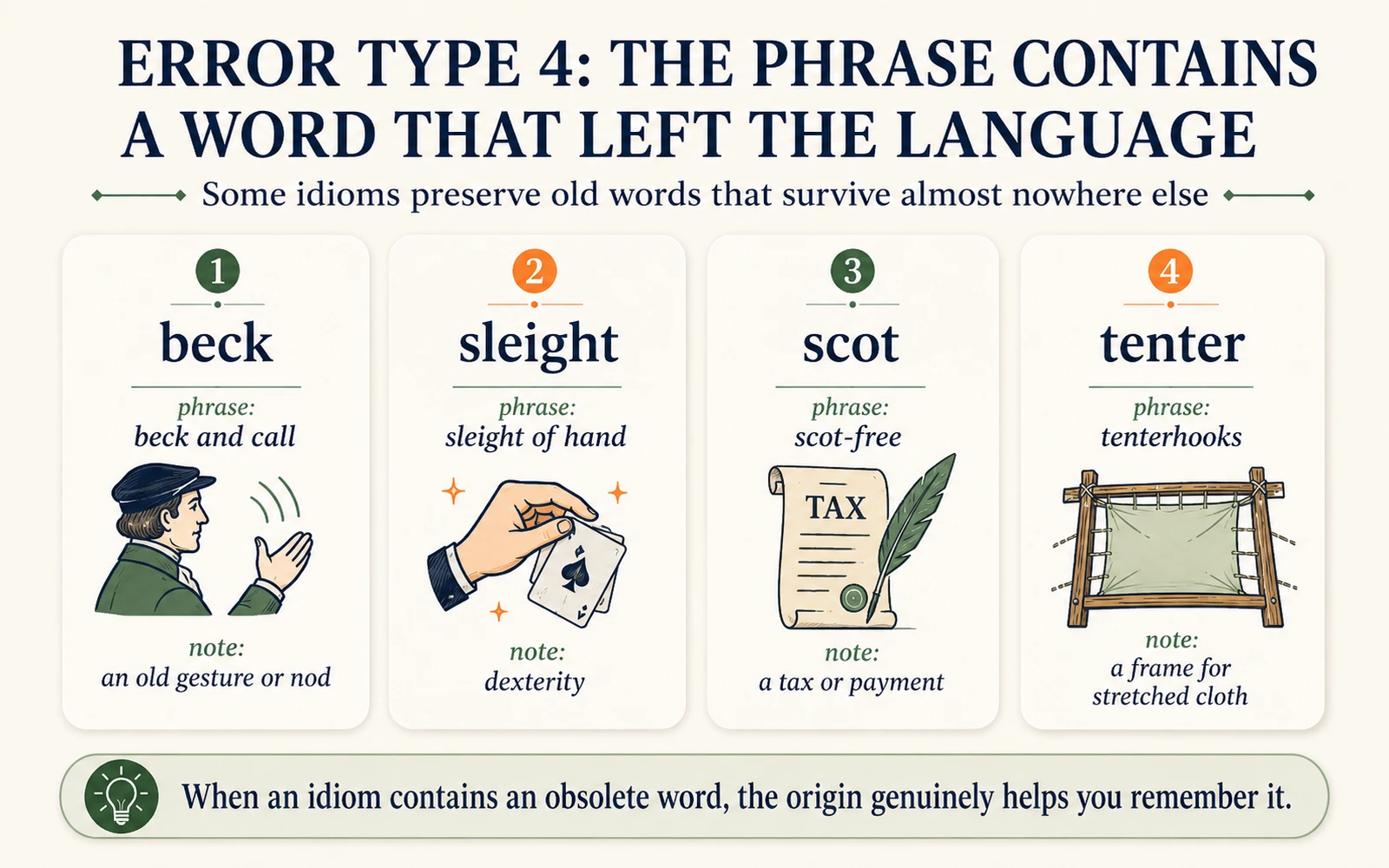
Error type 4: the phrase contains a word that has left the language
The last group is the smallest and the least anyone's fault. Some idioms preserve a word that dropped out of general English centuries ago and now survives nowhere else. Speakers cannot check it against anything, because there is nothing to check it against.
Beck, in "beck and call", is one. Sleight, meaning dexterity, is another. Scot, in "scot-free", is a third, and it is a tax rather than a Scotsman. Tenter, the frame that cloth was stretched on, is a fourth.
These are the idioms where knowing the origin genuinely helps, because a word you can picture is a word you will not misspell. That is not true of the other three groups: knowing when "for all intents and purposes" entered legal English will not stop your ear from hearing "intensive". Here it will.
What to do with this
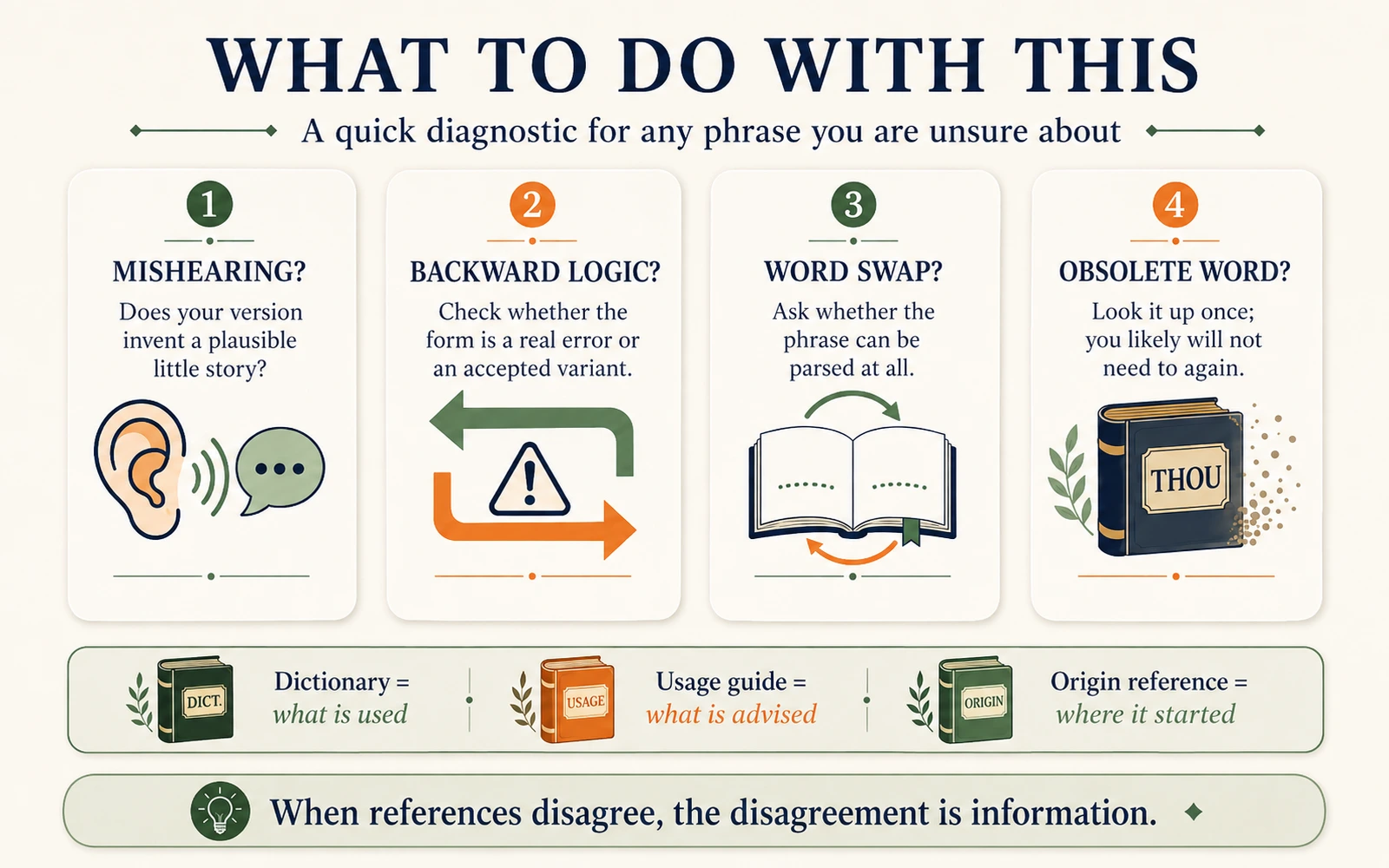
If you are unsure of a phrase, ask which of the four you are dealing with.
If it is a mishearing, the test is whether your version invents a plausible little story. Rabbits nipped in the butt, breath that has been baited: the story is the warning sign.
If the logic runs backwards, check whether you are looking at a genuine error or at a form that references have accepted. Those are different situations and could care less is in the second one.
If a word has been swapped, ask whether your version can be parsed at all. You can hone a knife. You cannot hone in on anything.
If a word has left the language, look it up once. You will not need to again.
And a note on where to check. A dictionary tells you what is used; a usage guide tells you what is advised; a phrase-origin reference tells you where something started. When they disagree, that disagreement is information rather than a problem, and no page that hides it is doing you a favor.