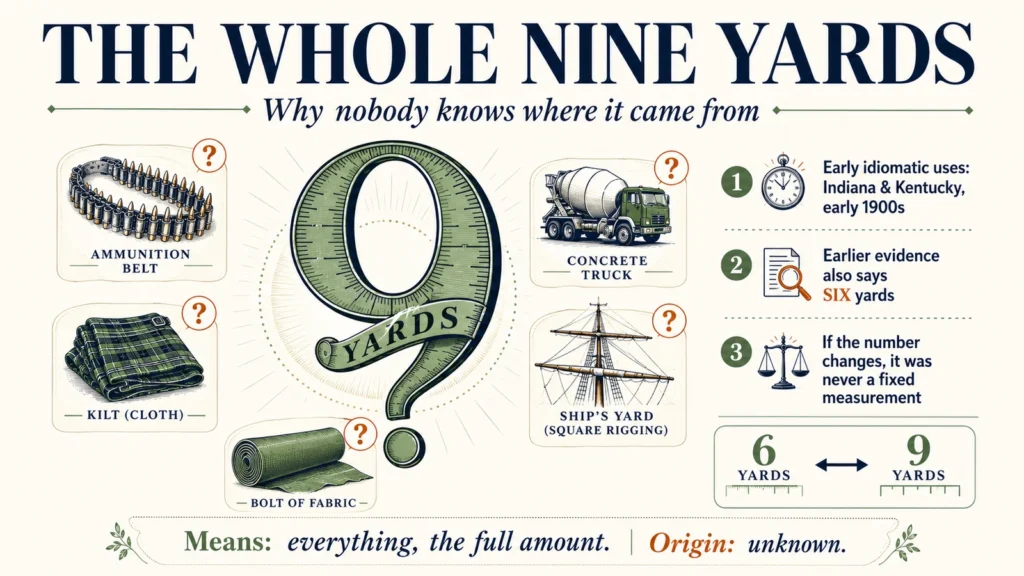
The whole nine yards means everything, the full amount, the works. Its origin is unknown. No researcher has ever produced a document connecting the phrase to a machine gun belt, a kilt, a concrete truck, a burial shroud or a sailing ship, and the earliest known uses are ordinary small-town newspaper writing from Indiana and Kentucky in the early 1900s. Earlier versions used six yards, which is the detail that sinks every theory at once: a number that changes was never a measurement of anything.
That is the answer. What follows is why it is the answer, and why every confident origin page you have read is telling you a story that was invented backward from the phrase.
What it means, and where it belongs
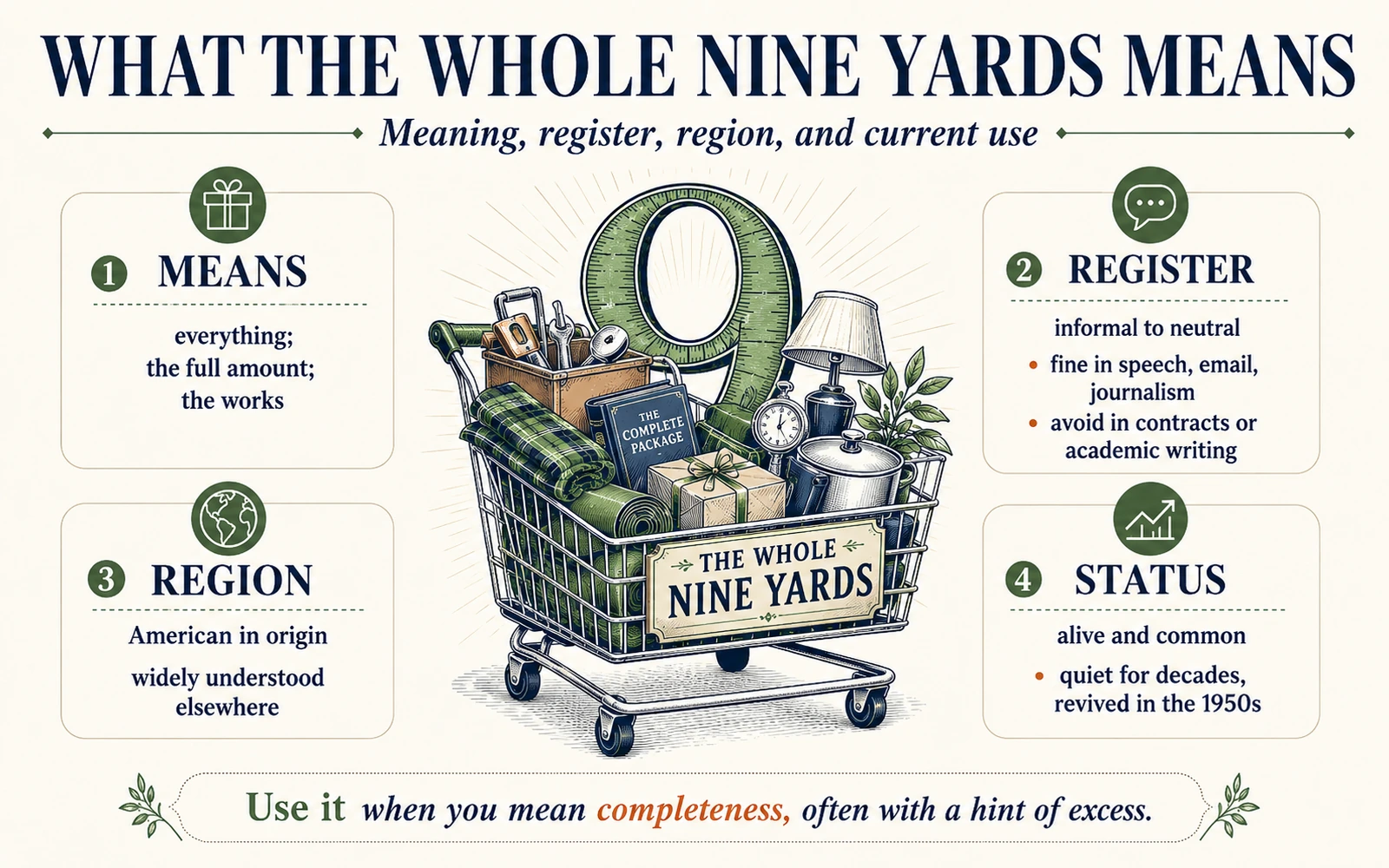
Gary Martin's Phrase Finder puts the meaning in five words: "all of it, the full measure."
It works as a noun phrase ("she gave us the whole nine yards") and adverbially ("he went the whole nine yards"). It usually carries a hint that the full amount was more than strictly necessary, which is why it suits a wedding, a car's option list or a sales pitch.
| Register | Informal to neutral. Fine in speech, email and journalism. Out of place in a contract or an academic paper. |
| Region | American in origin and mainly American in use. British and other English speakers understand it. |
| Status | Alive and common. Martin notes the phrase went quiet for roughly forty years after its early uses before resurfacing in the 1950s. |
The earliest recorded uses, and where the references disagree
Most pages give you one first date. There is no one first date, because the references do not agree on which citation counts.
| Reference | Earliest use it puts forward | What it is |
|---|---|---|
| Wikipedia's article, citing the Oxford English Dictionary | New Albany Daily Ledger, Indiana, January 30, 1855, in a comic story called "The Judge's Big Shirt": "she has put the whole nine yards into one shirt" | A literal quantity of cloth used as a punchline, not the modern idiom |
| David Wilton, Wordorigins.org (entry updated September 19, 2025) | Democratic Banner, Louisiana, Missouri, December 4, 1850, a letter by W. K. Kennedy using "nine yards" of statements | Earlier still, and figurative, but not the fixed phrase |
| Wordorigins.org and Wikipedia together | Mitchell Commercial, Mitchell, Indiana, May 2, 1907: "we can not promise the full nine yards" | The earliest idiomatic use both agree on |
| David Wilton, Wordorigins.org | Mitchell Commercial, June 4, 1908 | Wilton calls this the first known use of the phrase in its modern form |
| Michael Quinion, World Wide Words (page created March 20, 1999, updated January 12, 2013) | Mount Vernon Signal, Kentucky, 1912: "give you the whole six yards in our next" | The six-yard version |
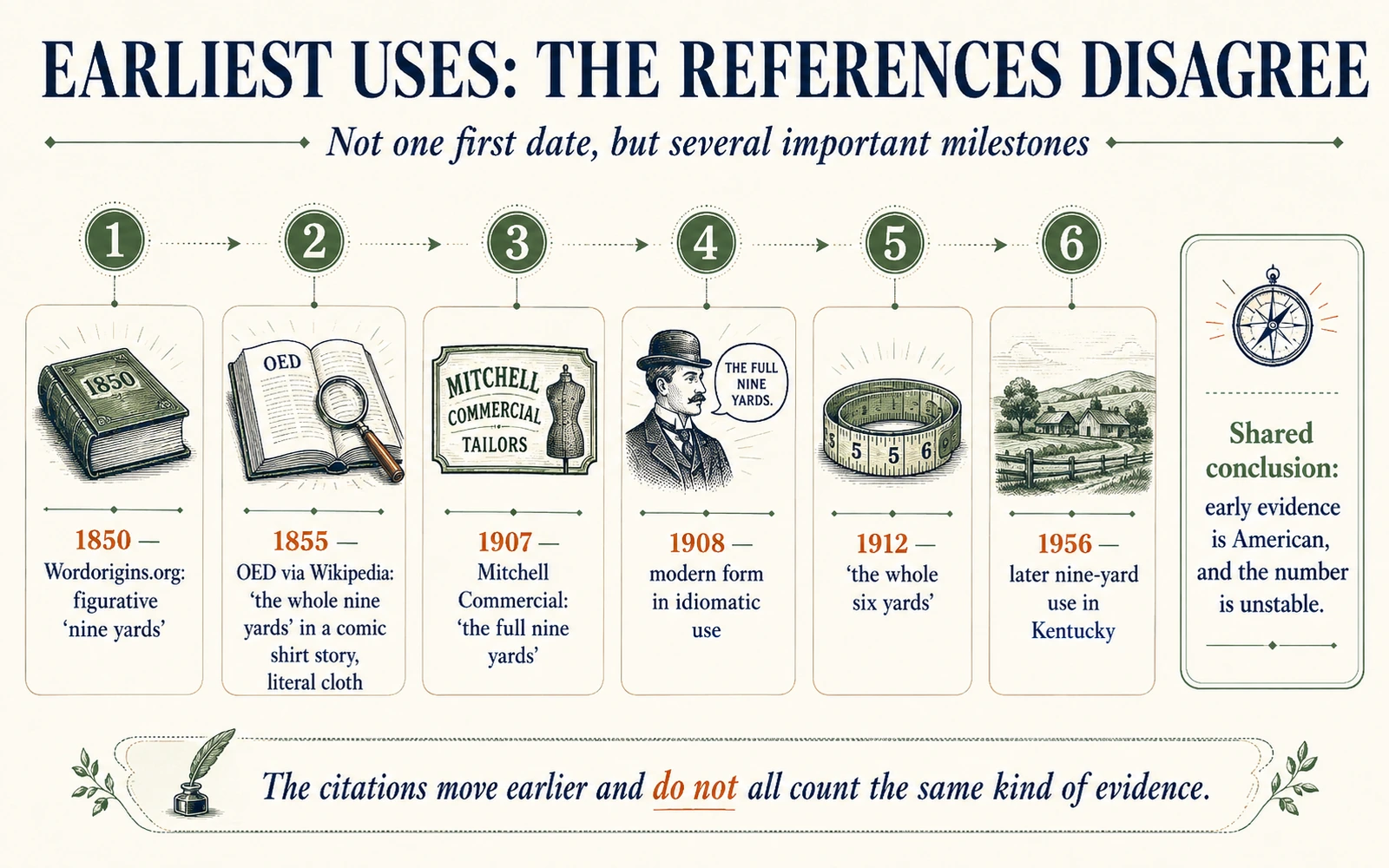
Wikipedia records the same Indiana paper running "give him the whole nine yards" in 1908, "take the whole nine yards" in 1912 and "settled the whole nine yards" in 1914, and lists six-yard examples from southern newspapers across 1912, 1917, 1921, 1922 and 1927. Quinion adds a 1921 headline in the Spartanburg Herald-Journal, "The Whole Six Yards of It", and a 1956 nine-yard use in the Kentucky magazine Happy Hunting Ground. The dates run about a century earlier than the events most origin stories rely on, and the phrase's own number is unstable from the beginning.
The pattern nobody puts on the page: each new citation killed the leading theory
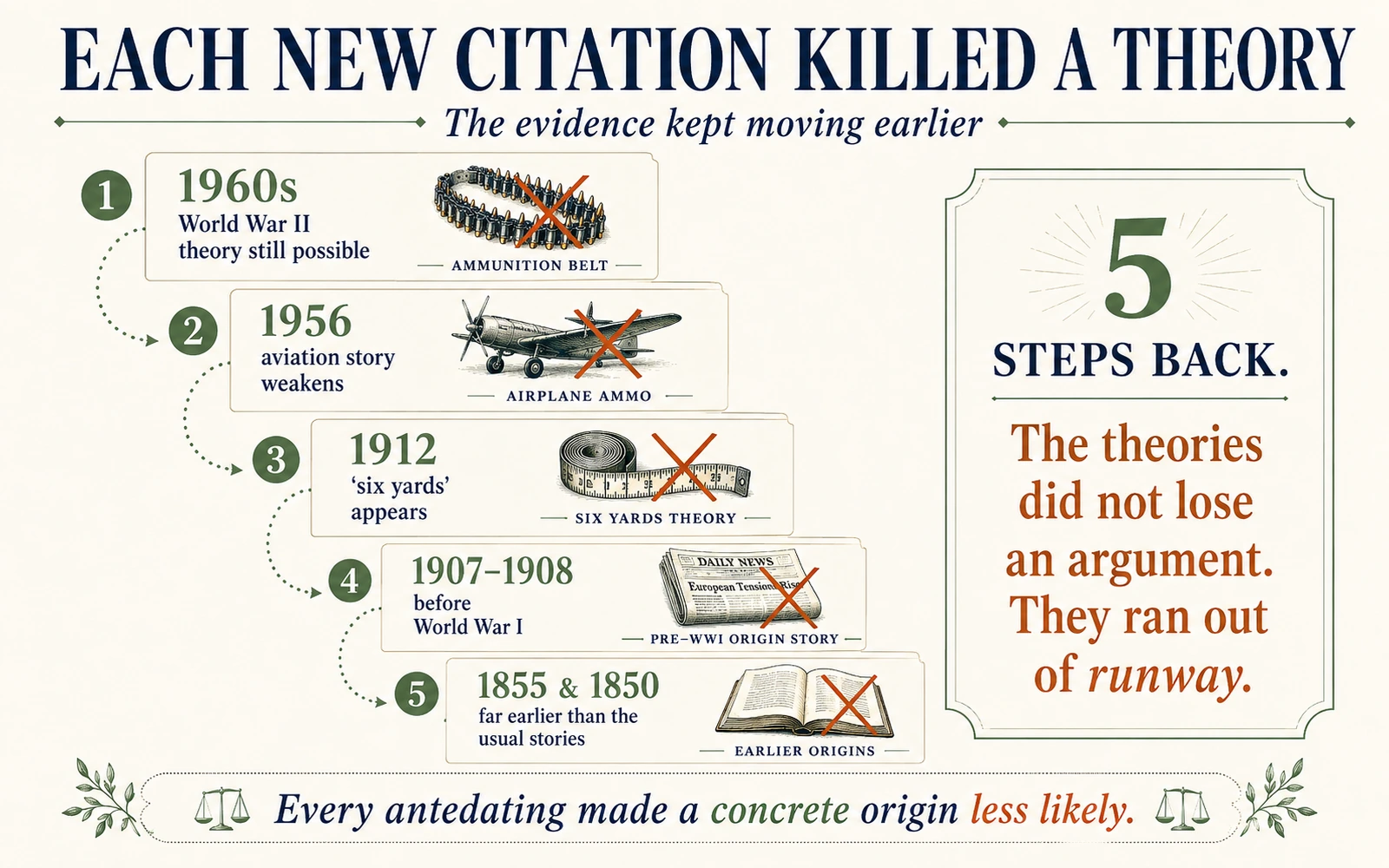
This is what makes the topic worth a page. The research history is a sequence in which somebody finds an earlier printed example and the most popular explanation stops being possible overnight. The theories did not lose an argument. They ran out of runway.
- The 1960s floor. Ben Zimmer's Word Routes column at Vocabulary.com sets out the evidence as it stood before the recent finds: a fall 1962 short story by Robert E. Wegner in Michigan's Voices, located by Stephen Goranson; a December 1962 letter to Car Life, found by Bonnie Taylor-Blake; and an April 1964 syndicated article on NASA jargon, found by Sam Clements. With the record starting there, a World War II ammunition belt was chronologically comfortable. Zimmer still refused to endorse it: "it's still a bit of a jump to say that the expression originated in World War II military usage, as many claim, since no contemporary wartime evidence has yet been found."
- The 1950s. Quinion's 1956 citation from Kentucky Happy Hunting Ground, a state fish and wildlife magazine writing about fishing and hunting, moved the phrase out of an aviation setting and into rural Kentucky.
- 1912, and the wrong number. Fred R. Shapiro of Yale found "the whole six yards" in the Mount Vernon Signal in 1912. Patricia T. O'Conner and Stewart Kellerman covered the find at Grammarphobia on January 8, 2013, reporting that "the six-yard version of the expression meant exactly what the nine-yard version does, the whole extent of something." At that point the ammunition belt was finished, and so was anything else invented in the twentieth century.
- 1907 and 1908. The Mitchell Commercial finds pushed idiomatic use back before World War I. Wikipedia states flatly that the Vickers machine gun belt theory is "no longer considered viable, since the phrase predates World War I."
- 1855 and 1850. The Indiana shirt story and the Missouri letter put "nine yards" on paper before the American Civil War, in contexts that have nothing to do with any object in the popular stories.
Wikipedia notes that William Safire wrote nine separate New York Times columns on the phrase after 1982, and quotes Shapiro calling it "the most prominent etymological riddle of our time." A riddle that outlived nine columns and four antedatings is not going to be settled by an anecdote about a bomber.
The popular theories, graded
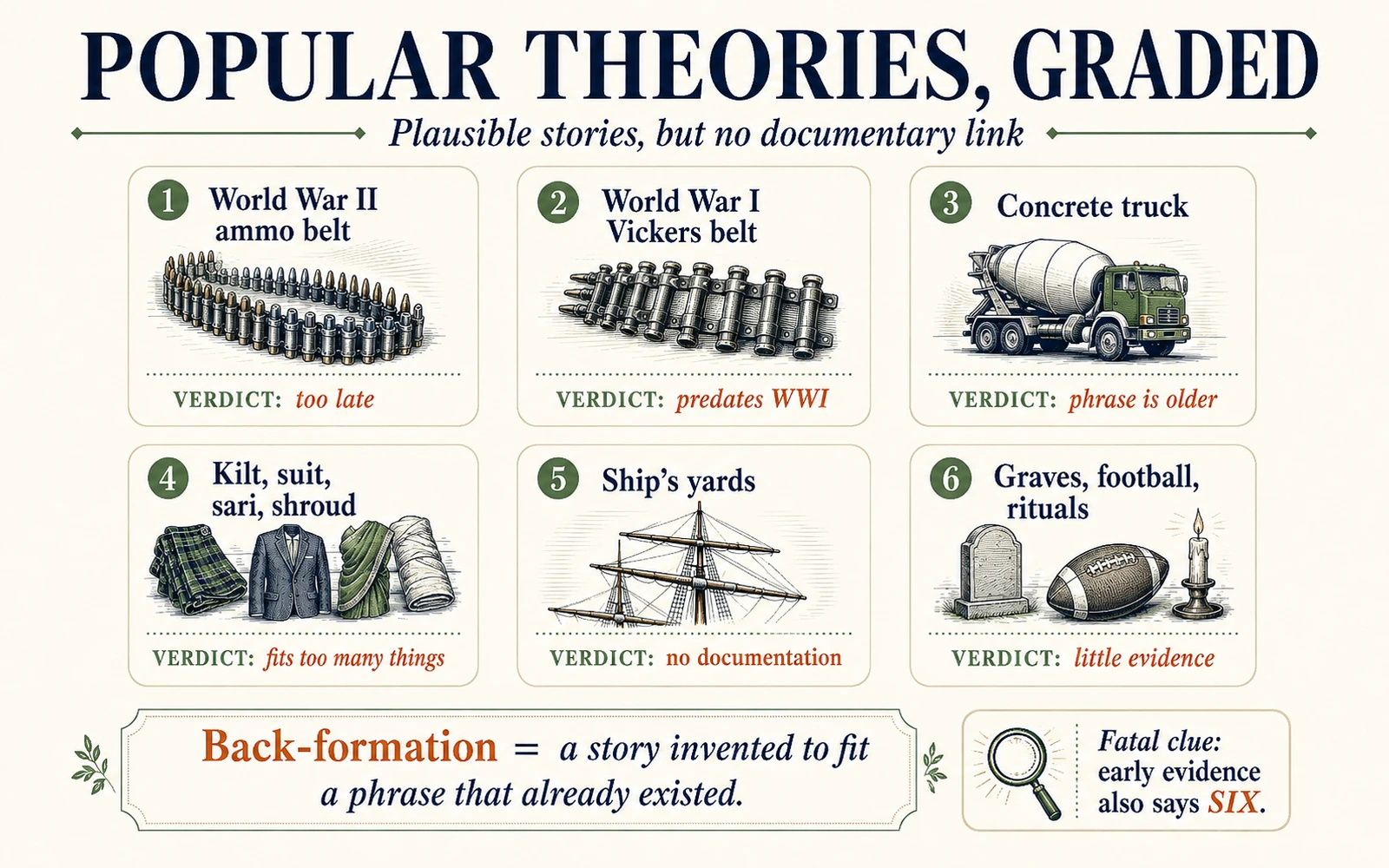
Every one of these is a back-formation. Martin's definition at Phrase Finder is exact: "apparently plausible explanations which are made up when a definitive explanation isn't available." The story was not discovered as the source of the phrase. It was proposed to fit a phrase that already existed.
| Theory | What would have to be true | Why it fails | Reference |
|---|---|---|---|
| A World War II fighter's ammunition belt was nine yards long | The phrase begins in the 1940s among American airmen | Idiomatic use is documented from 1907, and no wartime document using the phrase has been found | Wikipedia; Zimmer at Vocabulary.com |
| A World War I British Vickers gun belt | The phrase begins around 1914 to 1918 | Wikipedia: "no longer considered viable, since the phrase predates World War I" | Wikipedia |
| The capacity of a ready-mix concrete truck in cubic yards | The phrase postdates such trucks, and "yards" means cubic yards | Wikipedia calls the cubic measure reading inconsistent with the phrase's history; the phrase predates the trucks by decades | Wikipedia; Wilton at Wordorigins.org |
| The cloth for a kilt, a sari, a burial shroud or a three-piece suit | Nine yards is the standard quantity, and the phrase grows out of tailoring | Wikipedia cites an article in Comments on Etymology showing fabric was sold in standard nine-yard lengths through the 1800s and 1900s, which is why so many different garments get claimed. A detail that fits every candidate identifies none | Wikipedia |
| The yards on the masts of a square-rigged ship, three masts by three yards | The phrase is nautical, and ships reliably carried nine | Wikipedia: "no actual documentation has been uncovered", and rigging varied from ship to ship | Wikipedia |
| Graves, ritual disembowelment, American football | Any documentary link at all | Wikipedia records "little documentary evidence" for these | Wikipedia |
| Any of the above | The number nine measures something | The early phrase says six just as readily | Quinion; Grammarphobia; Wilton |
The tell: when the number moves, it was never a measurement
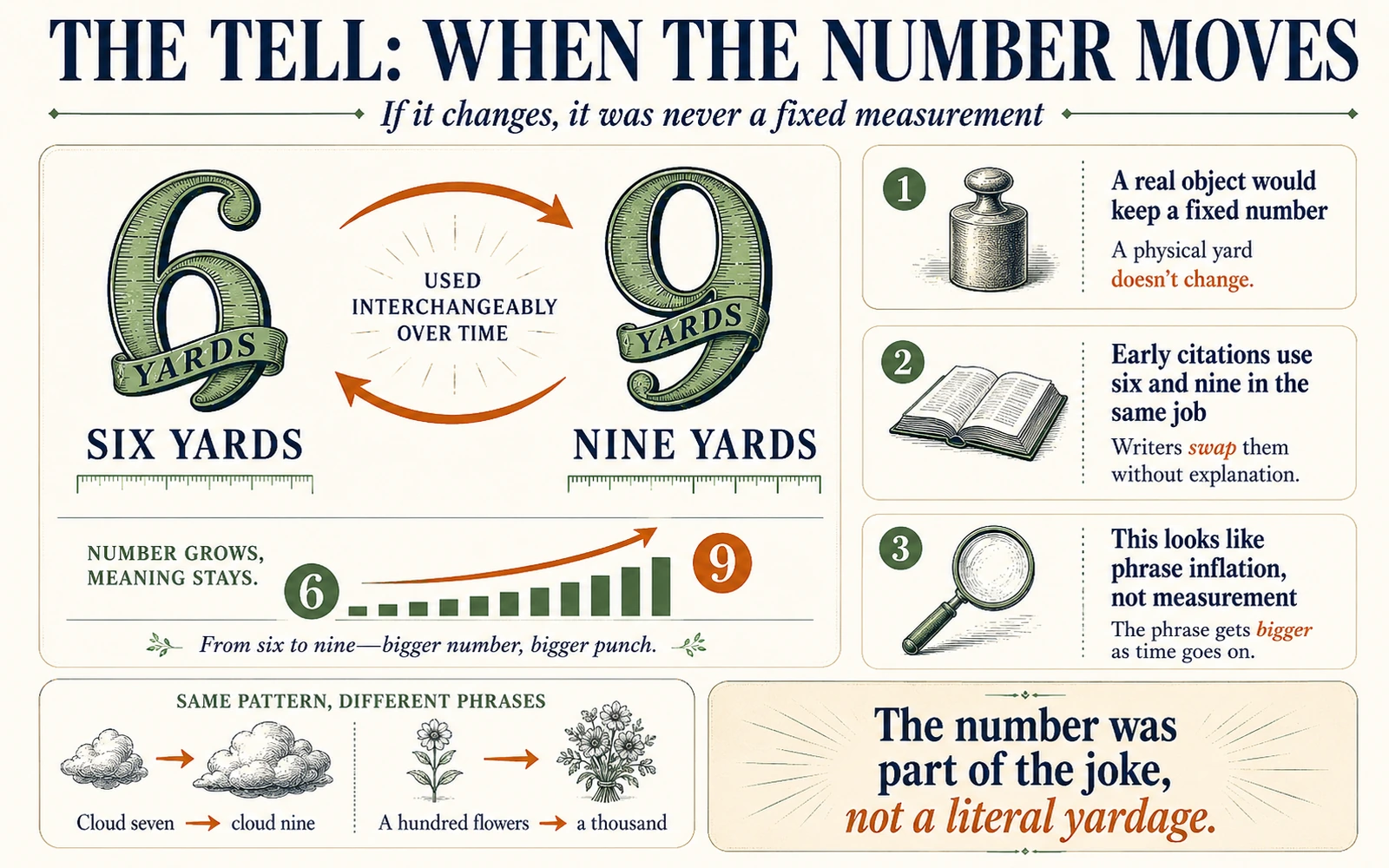
The bottom row of that table is the whole case, and it deserves stating on its own.
If "nine yards" measured a real object, the number would be fixed, because the object is fixed. Instead the earliest evidence gives six and nine doing the same job in the same decade. Shapiro's explanation, as Grammarphobia reports it, is phrase inflation: "in expressions that use a number meant to be impressive, that number is likely to grow over time." His comparisons are ones most people have lived through without noticing. Cloud nine started as cloud seven and cloud eight. "Let a hundred flowers bloom" is now often a thousand.
Wilton reaches the same place from the citations. The phrase, he writes, "doesn't have one particular origin, nor does it represent one particular metaphor"; it grew out of a sense of yard meaning a vague quantity, with numbers attached later, until nine settled in. Martin is blunter: the six or nine yards "isn't a reference to any specific object but is merely a jokey synonym for 'whole thing'", made up, he suggests, by someone within a day's drive of Indiana. Shapiro told the New York Times Arts Beat blog, as the ABA Journal reported, that it is likely just a hyperbolic use of the word "yard", a use the Oxford English Dictionary traces back as far as Chaucer.
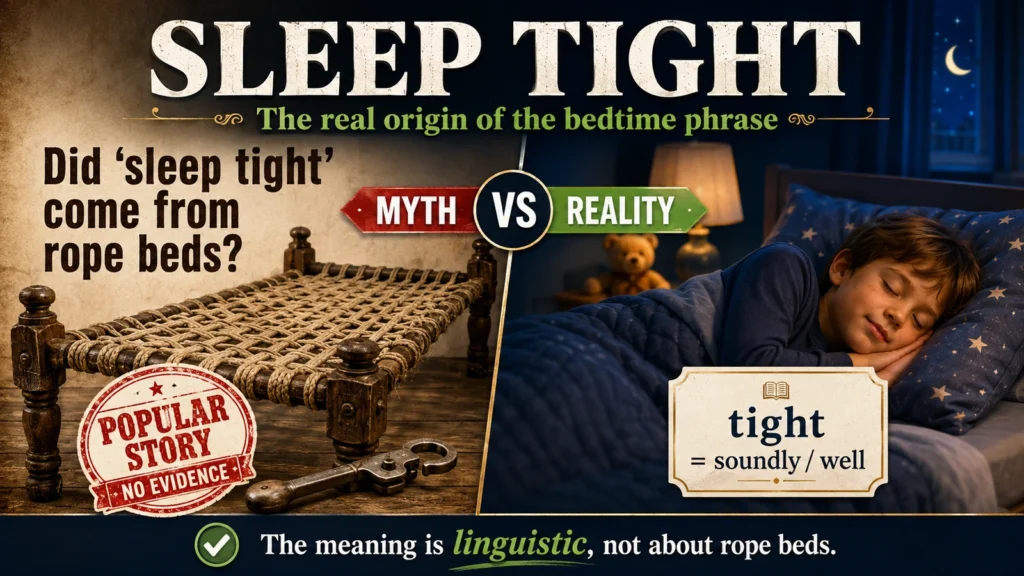
This is the same shape as the rope bed story behind why "sleep tight" has nothing to do with tightening bed cords: a real object, a real practice, a real tool you can photograph in a museum, and no citation linking any of it to the words. When a page can show you the object but not the sentence, you are reading a back-formation.
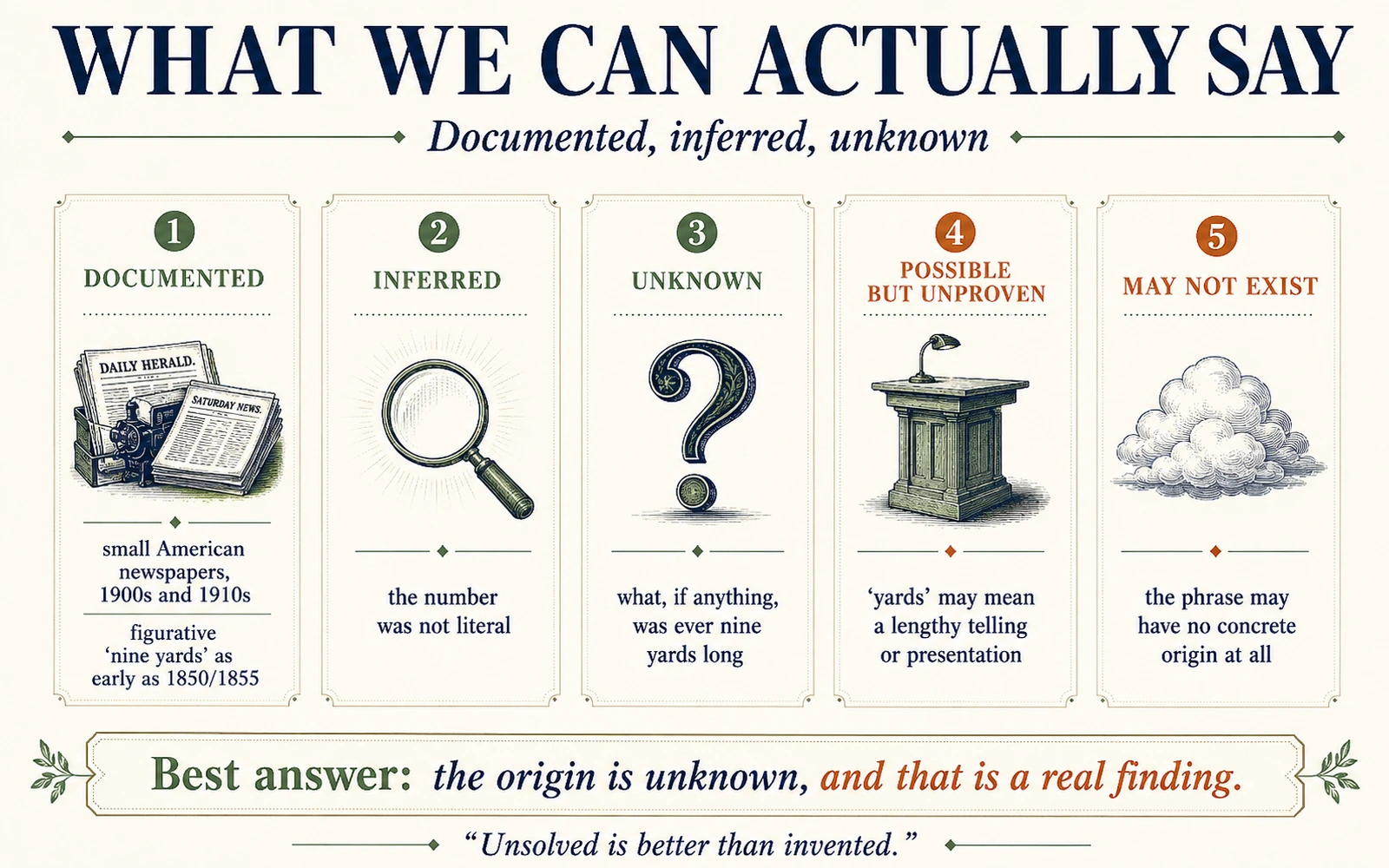
What we can actually say about the whole nine yards origin
Honest limits, stated plainly:
- Documented. The phrase and its six-yard sibling are in print in small American newspapers from the 1900s and 1910s, with "nine yards" in other senses as early as 1850 and 1855.
- Inferred, but well supported. The number was never literal, on the strength of the six-and-nine interchange and the general pattern of number inflation.
- Unknown. What, if anything, was ever nine yards long. Quinion says it as plainly as it can be said: "we have no idea of the circumstances that led somebody to create the expression."
- Possible but unproven. Taylor-Blake has suggested, per Wikipedia, that "yards" here means a lengthy or thorough presentation of news or anecdote, which fits the early examples that "give" or "tell" the nine yards. That is a reading of the evidence, not a documented source.
- May not exist. Wikipedia reports that Jesse Sheidlower of the Oxford English Dictionary and Shapiro have argued the phrase may have no concrete origin at all, in the way "the whole shebang" has none.
That last possibility is the one origin pages will not print, because it ends the article. Quinion has called the phrase "one of the great unsolved mysteries of modern etymology", and unsolved is a finding: the evidence has been searched, the candidates have been tested, and they failed. That is a stronger thing to be able to say than a story, because it can be checked and it can be overturned. Anyone who finds an early use of the phrase sitting next to a nine-yard object changes the answer tomorrow. In more than forty years of people trying, nobody has.
How to use it today
Say it when the point is completeness, usually with a touch of amusement at how much completeness that turned out to be. "They redid the kitchen, new cabinets, new floor, the whole nine yards." Keep it out of formal writing, where "everything" does the job without the wink. And if someone at the table tells you it comes from a bomber, you now have something better than a correction: you have the reason nobody knows.
Frequently asked questions
What is the origin of "the whole nine yards"? Unknown. No reference traces it to a source. The earliest idiomatic use Wikipedia and Wordorigins.org agree on is May 2, 1907, in the Mitchell Commercial of Mitchell, Indiana, and the phrase also appears in print with "six" instead of "nine" from 1912 onward. Michael Quinion of World Wide Words calls it "one of the great unsolved mysteries of modern etymology."
Does it come from a World War II ammunition belt? No. Wikipedia states the machine gun belt explanation is not viable because the phrase predates World War I, and Ben Zimmer notes at Vocabulary.com that no wartime document using the phrase has ever been found. The belt story was proposed to explain a phrase that already existed, which is what a back-formation is.
Why did people once say "the whole six yards"? Because the number was never measuring anything. Fred R. Shapiro found "the whole six yards" in Kentucky's Mount Vernon Signal in 1912, and Grammarphobia reports his explanation as phrase inflation: an impressive-sounding number tends to grow over time, the way cloud seven became cloud nine.
Was the phrase really first printed in 1855? That depends on what counts. Wikipedia, citing the Oxford English Dictionary, gives an 1855 comic story in the New Albany Daily Ledger whose punchline is "she has put the whole nine yards into one shirt", but that is a literal amount of cloth rather than the idiom. Wordorigins.org points to an even earlier 1850 letter using "nine yards" figuratively, and treats 1907 and 1908 as the first appearances of the phrase as we use it now.
Is "the whole nine yards" American or British? American. It is understood across the English-speaking world and used freely in British writing, but its documented history is entirely in American newspapers and magazines, mostly from Indiana and Kentucky.
Sources consulted for this page, all read on August 26, 2026: Wikipedia, "The whole nine yards"; David Wilton, Wordorigins.org (entry updated September 19, 2025); Michael Quinion, World Wide Words (created March 20, 1999, updated January 12, 2013); Gary Martin, Phrase Finder; Patricia T. O'Conner and Stewart Kellerman, Grammarphobia, January 8, 2013; Ben Zimmer, Word Routes at Vocabulary.com; the ABA Journal's report of Fred R. Shapiro's findings. Snopes and NPR's 2013 segment on the phrase could not be retrieved, so nothing here rests on either.