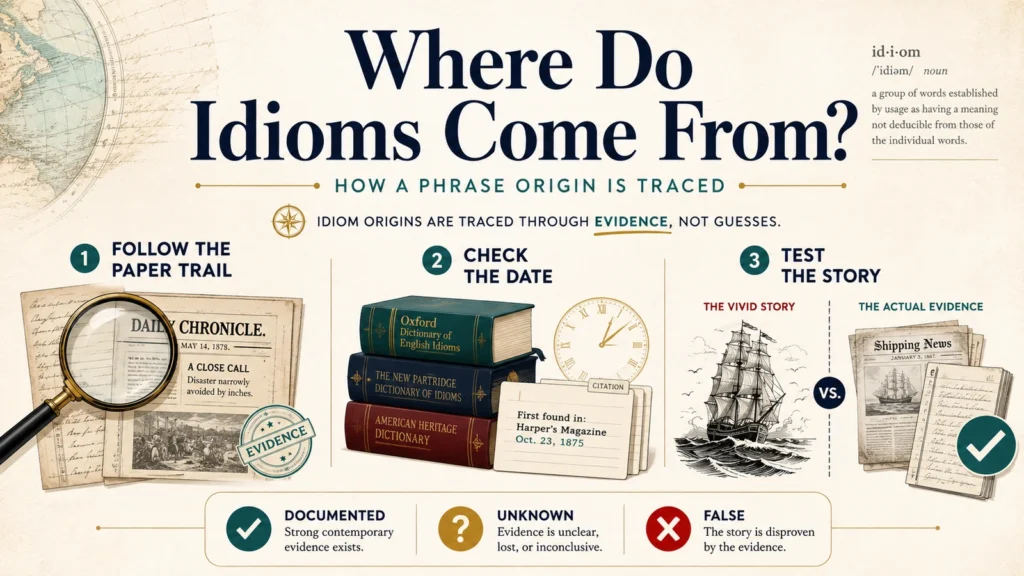
To trace an idiom’s origin, check what its cited texts actually establish: the words used, their meaning in context, and the date of the evidence. A passage can document a related metaphor without containing today’s exact phrase. It can also show an expression in use without proving who invented it or made it popular.
We followed three citation trails through four literary passages: Matthew Arnold’s organ metaphor, two different texts by Jonathan Swift, and a proverb in Walter Scott’s Guy Mannering. The result is a worked guide to choosing a claim your source can support. It is not a search for the earliest occurrence of every expression.
Where do idioms come from? Separate the questions first
In this small audit, four passages do four different jobs. Arnold supplies a figurative comparison with wording different from the modern idiom. Swift’s poem supplies a scene; his dialogue supplies the core words of a weather expression. Scott supplies a proverb spoken by a fictional character. None of these passages, on its own, establishes the expression’s coinage or measures its spread.
Those limits do not make the passages useless. They tell you what to write. A citation is an identified passage you can check. An attestation is evidence that a word or expression occurs in a particular source. A first known citation depends on the records searched; finding a passage does not establish that nobody used the expression earlier. The cases below keep those questions separate instead of turning every old quotation into an origin story.
The four passages and what they establish
We checked the linked digital texts on November 4, 2026. The table distinguishes the edition accessed from dates attributed to earlier writing or publication. A later edition can preserve an earlier passage, but reading that edition is not the same as inspecting the first printing.
| Passage | Witness accessed | What it supplies | What this passage alone does not establish |
|---|---|---|---|
| Arnold, Essays in Criticism, preface | A. L. Burt, 1900; preface labeled 1865 | A related organ metaphor, with variant wording | Exact modern wording or coinage |
| Swift, A Description of a City Shower | William Ernst Browning’s edition, G. Bell and Sons, 1910; poem heading attributes it to October 1710 | Represented scenery involving floodwater and animal remains | The exact idiom or its cause |
| Swift, Polite Conversation, Dialogue II | George Saintsbury’s edition, Chiswick Press, 1892 | The exact core words of the weather expression | First-ever use or transmission from the poem |
| Scott, Guy Mannering, Dinmont’s response to the will | Project Gutenberg text; underlying print edition not established in this audit | A Scots variant used as a kinship proverb | Coinage, readership or measured popularity |
Case 1: Arnold’s organ metaphor is not the exact modern phrase
Phrase Finder’s account of “pull out all the stops” gives Arnold’s preface as an apparent early figurative use. Follow the quotation into the Project Gutenberg text of Essays in Criticism, preface page vii, and the important words are “pull out a few more stops.” The comparison’s target is the modern Englishman, described as an organ with a restricted range of tone.
This is clearly a figurative use of the organ image. It is not an occurrence of the exact wording “pull out all the stops.” The difference between a few more and all matters when the claim you are checking is about a particular sequence of words.
It also matters that the accessed book is a later edition. Its front matter identifies the publisher and year as A. L. Burt, 1900, while the preface is labeled 1865. The digital edition lets us check the wording. It does not turn this audit into an inspection of an 1865 first edition.
What you can safely say about Arnold
Supported: the accessed edition contains a figurative organ comparison in a preface labeled 1865, using a variant of the modern expression. Withhold: this passage proves Arnold coined the exact modern idiom. That stronger statement would require evidence beyond this quotation.
This distinction is not newly discovered here. Uncoverwords also distinguishes Arnold’s wording, and Word Histories separates literal and figurative uses and variants. Our decision is to retain the variant explicitly when describing what this particular textual witness proves.
Case 2: Swift’s flood scene and weather idiom are separate evidence
Two texts by the same writer can invite a tempting story: he described something, then turned it into a saying. That connection needs evidence of its own. It cannot be supplied simply by placing two quotations next to each other.
In Swift’s A Description of a City Shower, the closing lines picture animal remains and other debris moving through floodwater. The 1910 edition’s heading attributes the poem to October 1710. The passage is represented literary scenery. It is neither a verified observation of a particular flood nor an occurrence of the exact idiom “rain cats and dogs.”
Now compare Polite Conversation, Dialogue II, page 166. Lord Sparkish discusses Sir John’s determination to leave and uses “rain Cats and Dogs.” Here the core words occur together in a remark about weather. The surrounding exchange concerns whether Sir John will stay, and he eventually leaves.
What the two Swift passages do not connect
The poem supports a statement about imagery. The dialogue supports a statement about wording and use. Neither passage explains that the phrase developed from the scene in the poem. Reading them together does not fill that gap.
Phrase Finder’s rain entry already calls the proposed connection speculative. Our comparison agrees with that limitation; it does not expose the entry as a false account. “Origin unknown” remains a valid conclusion even when the wording and literary examples are visible.
Supported: the accessed dialogue contains the exact core wording, and the poem depicts relevant imagery. Withhold: the poem caused the expression, or the dialogue proves its first-ever use. “Exact core wording” here ignores capitalization and surrounding sentence structure. It does not mean every modern form of the idiom has identical grammar.
Case 3: Scott’s character uses a proverb, but the passage cannot measure popularity
Phrase Finder’s “blood is thicker than water” entry credits Scott with bringing the proverb to a wider public. To examine the literary evidence, we separately checked the Project Gutenberg text of Guy Mannering. Search within it for Dinmont’s declaration after the shock of the will.
He says “blude’s thicker than water” and expresses continued willingness to provide food despite his disappointment. He then urges the assembled people to help. The passage supports a reading of a fictional character invoking kinship while expressing continued support. Its Scots spelling makes it a wording variant under the same rule used for Arnold.
What it cannot tell us is how many readers adopted the proverb, how widely they already knew it, or how much the novel changed its use. Those are questions about reception and circulation, not simply the presence of words in a book.
What you can safely say about Scott
Supported: the accessed novel contains a Scots form of the proverb in a scene of family obligation. Withhold: this scene alone proves Scott invented or popularized it. The second conclusion would need other records that connect publication with readership or subsequent adoption.
That limitation does not refute Phrase Finder’s wider-public claim. It identifies what this audit’s source can establish. We have not established the print edition underlying the accessed digital text, so we also do not use its appearance here to make a new first-use or dating claim.
Choose a conclusion that matches the passage
The practical result of the audit is a set of editing decisions. Use it when deciding whether an old quotation warrants the sentence you are about to write.
| If you are writing this claim | Use this narrower conclusion | Reason from the audit |
|---|---|---|
| Arnold used today’s exact expression | Arnold used a related organ metaphor | The quotation says a few more, not all |
| Swift’s poem explains the idiom’s birth | The poem depicts imagery associated with the proposed explanation | The scene does not state or explain the idiom |
| Swift’s dialogue proves who coined the phrase | The dialogue contains its core wording | An occurrence establishes use, not first use |
| Scott’s scene proves the proverb became popular | Scott’s character uses a Scots variant | The scene supplies no readership or adoption evidence |
These are limits on four passages, not verdicts that stronger evidence cannot exist. Nor does an unsupported inference automatically become a disproved origin. Keeping those outcomes separate prevents a skeptical explanation from becoming another overconfident story.
What this audit covers, and what it leaves open
The sample was deliberately selected from three expressions in this guide. It is not representative of English idioms or origin websites. We checked wording, surrounding context and accessible edition information, then repeated those classifications using the same rules. That repeat check used the same annotator; it was not a study of agreement between independent researchers.
We did not inspect the original first printings, establish new earliest dates, or measure how frequently people use these expressions today. The source pages already explain several of the cautions discussed here. The contribution is the completed comparison: exactly which claim changes when each textual witness is read.
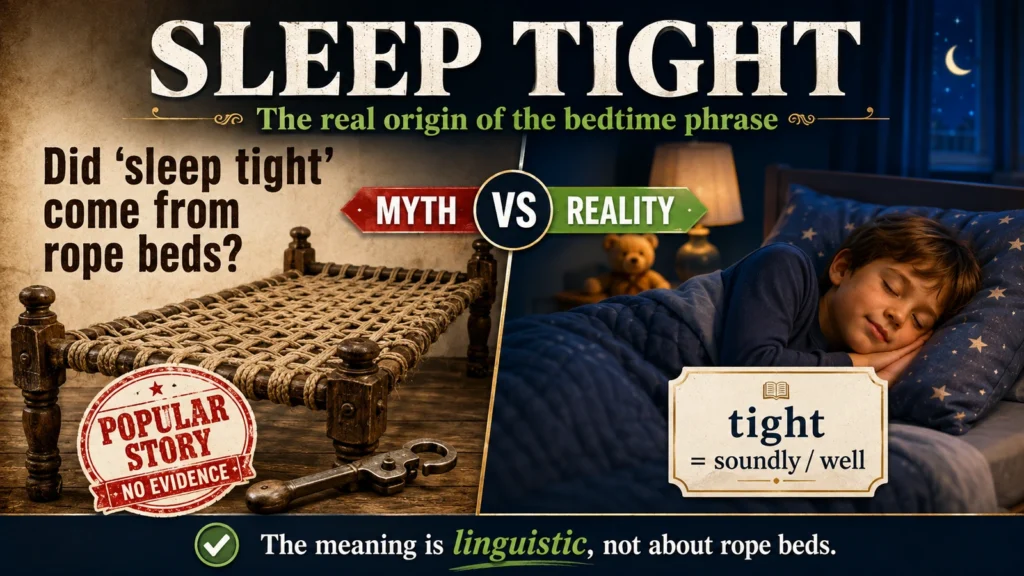
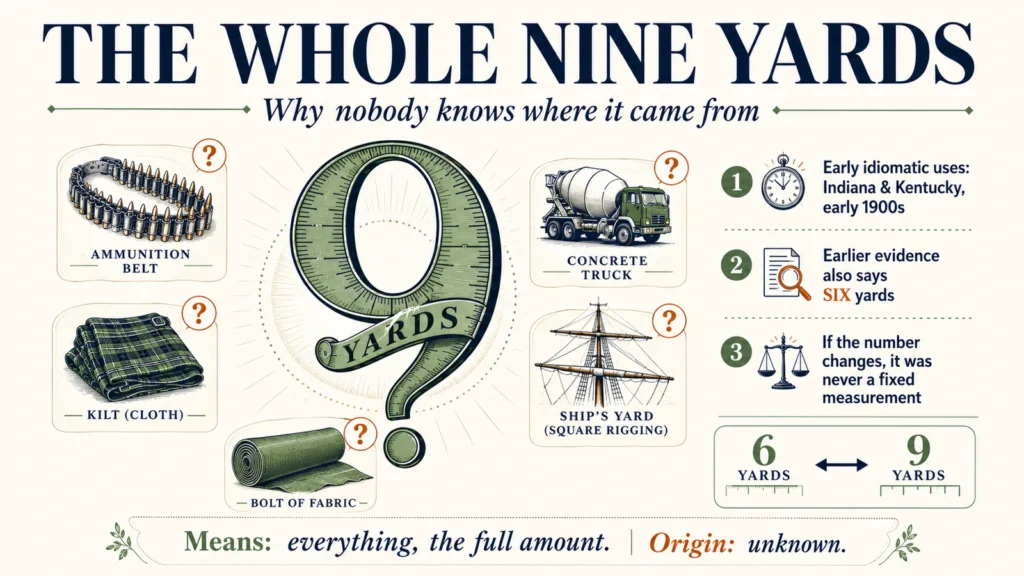
For related deep dives, compare the evidence questions in the origin of “the whole nine yards” and the competing explanations for “sleep tight”. Use the same distinction between an attested passage and a proposed explanation when reading either account.
Questions about checking an idiom’s origin
Does the oldest quotation prove who invented an idiom?
Not by itself. A quotation documents an occurrence. This audit did not establish that any of its four passages was the first occurrence, and none explains the act of coining its expression. Keep the claim about recorded use separate from the claim about invention.
Can a variant count as evidence?
Yes, if you identify it as a variant. Arnold’s wording supports a related organ metaphor; Scott’s Scots wording supports a form of the kinship proverb. Neither should be silently presented as an exact match to the modern wording being checked.
Why record the edition as well as the original date?
Because they identify different things. The Arnold witness accessed here is dated 1900, while its preface is labeled 1865. Recording both tells a reader which text was checked and prevents a digital transcription of a later edition from being mistaken for direct inspection of the first printing.