Short answer: touch wood or knock on wood depends mainly on where you are. Both mean the same thing: you have just said something hopeful ("the car hasn't broken down yet") and you add the phrase, often with a tap on something wooden, so as not to "tempt fate." "Touch wood" is the usual British and Irish form. "Knock on wood" is the standard American form. Grammarist and The Phrase Finder agree that the British form is the older of the two. Where the custom itself comes from is not settled: the references offer several theories and none is proven.
Touch wood vs knock on wood at a glance
| Touch wood | Knock on wood | |
|---|---|---|
| Main region | UK and Ireland | United States |
| Meaning | "I hope this good luck continues" | Same |
| Gesture | Touching or tapping wood, sometimes jokingly your own head | Knocking on wood |
| Register | Casual to neutral | Casual to neutral |
| Earliest print record found by The Phrase Finder | 1850, Notes and Queries | 1905, The Syracuse Herald |
| Grammatical forms | touches wood, touched wood, touching wood | knocks on wood, knocked on wood, knocking on wood |
Wikipedia's article on knocking on wood puts the regional split this way: in England, Scotland and Ireland "touch wood" is more common than "knock on wood," while in the United States "knock on wood" is standard. That is a lean, not a wall. British speakers will understand "knock on wood," which they hear in American films and television. American speakers who hear "touch wood" will usually work it out from the gesture.
How the phrase is used
Both phrases are a small verbal charm. You say them right after you have said something good about your own luck, health or plans, as if saying it aloud might jinx it:
- "I've never had a parking ticket, touch wood."
- "The new system has been running for a month without a crash, knock on wood."
The words usually come with a gesture: a tap on a desk, a door frame or a table. If no wood is handy, people often tap their own head as a joke. The Phrase Finder's entry on "knock on wood", which we read on September 27, 2026, notes that in the UK the "touch wood" version is often said jokingly while tapping one's head, and Grammarist mentions the same head-tapping habit.
Most people who say it are not seriously superstitious. It works more like "fingers crossed": a light way of admitting that your luck could change.
Which is older? The references disagree
This is where the two main usage references part company, and it is worth knowing before you repeat a date.
Grammarist's page on "knock on wood" and "touch wood", read on September 27, 2026, says that "knock on wood" "appears around the beginning of the twentieth century," and that "touch wood" "dates at least from the early seventeenth century, and perhaps earlier." It does not quote a 17th-century example.
The Phrase Finder is more cautious. It says "touch wood" was in use by 1850 and quotes a line from Notes and Queries that year listing "I touch wood" alongside "Bar omen" and "Bar ill-luck." It gives an early American example from The Syracuse Herald in February 1905: "Neglecting to knock on wood may have been responsible for the weather's unseemly behaviour today." It also notes that an older Latin expression, absit omen ("far be that omen from us"), was used for the same purpose before either English form.
What the two agree on: the British "touch wood" came first and the American "knock on wood" is later. What they do not agree on is how much earlier. On this page we treat 1850 as the earliest date we can point to with a quoted source, and the early 17th century as a claim we could not confirm.
Where the custom comes from: several theories, no winner
The popular pages usually pick one story and tell it as fact. The references do not.
Tree spirits. The most repeated story says that pre-Christian peoples believed spirits or gods lived in trees, and that touching or knocking on wood called on their protection or let them know you were there. The Phrase Finder lists this as a possible source, along with a tradition of tapping trees to alert wood spirits that it says still persists in Ireland. Wikipedia mentions Germanic and Celtic beliefs of this kind. None of these sources shows a documented line from those beliefs to the modern phrase.
The Christian cross. Another theory ties touching wood to the wood of the cross. The Phrase Finder and Wikipedia both mention it. Again, no one has shown the link in the historical record.
A children's game. The most specific theory comes from the folklorist Steve Roud. Wikipedia summarizes his view that the widespread modern use "derives from a form of tag called 'Tiggy Touchwood' in which players are safe from being tagged if they are touching wood." This theory has the advantage of pointing to a concrete, recorded game rather than a vague belief. It is still a proposal, not a proof.
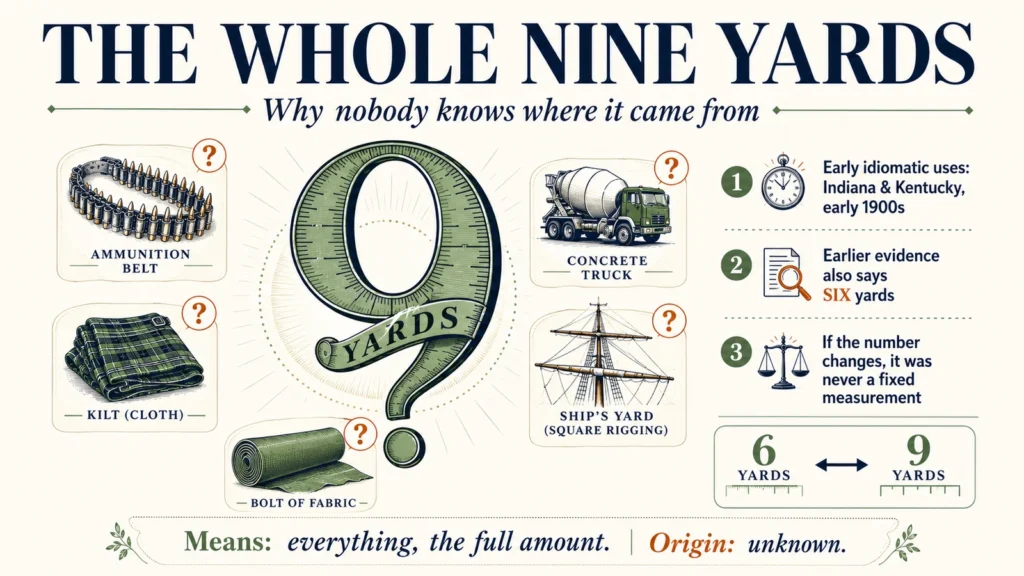
The Phrase Finder's own wording is that the derivation "may be" from these associations. That is the honest state of the evidence: the phrase is documented in print from the mid-19th century, the custom may be older, and nobody has settled where it began. We take the same line on other phrases with a crowded field of theories, such as raining cats and dogs, where nobody has settled it. For how researchers separate a documented origin from a good story, see our explainer on how a phrase origin is traced.
The same idea in other languages
The wood charm is not only English. Wikipedia's article lists close equivalents across Europe and beyond, including French toucher du bois (touch wood), Spanish tocar madera (touch wood) and Portuguese bater na madeira (knock on wood). Some cultures use a different material: Italian speakers say toccare ferro, "touch iron."
This spread is one reason the origin is hard to pin down. A custom found in many languages may have several roots, or one very old one, or it may have traveled in the modern period. The English phrase is only the most recent layer that we can date.
Which should you use?
Pick the form your readers expect.
- Writing for British or Irish readers: "touch wood." It is the everyday form, and "knock on wood" can sound American.
- Writing for American readers: "knock on wood." "Touch wood" will likely be understood but may sound British.
- International or mixed audiences: either works, because the meaning is clear from context. "Knock on wood" may be more widely recognized through American media, but that is our judgment, not a measured figure.
- Formal writing: leave it out. Both phrases are casual. In a report, write "if current conditions hold" or "so far" instead.
- Business email: fine in a friendly message to a colleague ("the launch is on track, touch wood"), out of place in a contract or a formal update.
Both phrases are alive and common. Neither is dated, and neither is rude.
A note on superstition phrases and folk origins
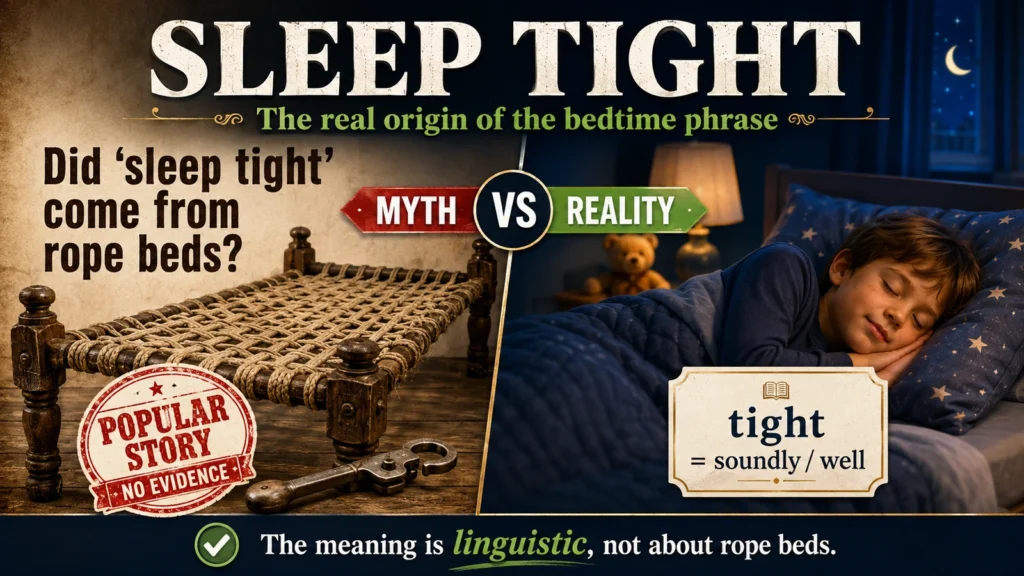
Superstition phrases attract confident origin stories, and many of them do not survive a check against dated sources. "Sleep tight" is a good example: the popular rope-bed story does not hold up, as our page on sleep tight and the rope bed myth explains. "Touch wood" is not a myth case, because no single story has been proven false. It is an "unknown" case: several plausible theories, none confirmed.
Frequently asked questions
Is it "touch wood" or "knock on wood"?
Both are correct. "Touch wood" is the usual form in the UK and Ireland, and "knock on wood" is the standard form in the United States. They mean the same thing.
What does "touch wood" mean?
It is said after a hopeful statement to avoid tempting fate, as in "I haven't been ill all winter, touch wood." People often tap something wooden, or their own head, as they say it.
Which phrase is older?
"Touch wood." The Phrase Finder dates it to at least 1850 and "knock on wood" to 1905. Grammarist claims "touch wood" goes back to the early 17th century, but it gives no example, and we could not confirm that date.
Where does knocking on wood come from?
The origin is not settled. Theories include tree spirits in pre-Christian belief, the wood of the Christian cross and a tag game called "Tiggy Touchwood," suggested by folklorist Steve Roud. None has been proven.
Is "knock on wood" formal?
No. Both phrases are casual. They are fine in conversation and friendly email, but should be left out of formal reports and contracts.