Short answer: most British and American idioms differ in one of three ways. Some keep the idea and swap a single word, so "toot your own horn" becomes "blow your own trumpet." Some use a completely different image for the same idea, so "a whole new ball game" becomes "a different kettle of fish." A small and dangerous group uses the same words for different meanings, and "table a motion" is the one that costs people money. The tables below cover about forty pairs with a register label on each, and a last table for the forms that have already crossed over.
How to read the labels
Two labels sit on every pair below, because a phrase list without them is only half an answer.
Region marks where the form is at home, not where it is legal. English does not divide cleanly. Most of the British forms here are also current in Ireland, Australia, New Zealand and South Africa, and a growing number of American forms are ordinary in the United Kingdom. When a form genuinely belongs to one side only, the table says so.
Register says where you can use it: casual for speech and friendly messages, neutral for most writing, business-safe for an email to someone you do not know, and dated for a phrase a younger speaker may not use. Register matters more than region for a reader writing to a mixed audience. A casual regional idiom in a formal email reads as both informal and foreign, which is two problems rather than one.
Same idea, one word swapped
These are the easiest pairs, because the structure survives the crossing and the meaning does not move. Only one noun changes, usually a noun from local life: a barge, a spanner, a cupboard, tuppence.
| Meaning | American form | British form | Register |
|---|---|---|---|
| Praise yourself | toot your own horn | blow your own trumpet | casual |
| Refuse to get involved | wouldn't touch it with a ten-foot pole | wouldn't touch it with a barge pole | casual |
| Wreck a plan | throw a monkey wrench in the works | throw a spanner in the works | neutral |
| Offer an opinion | put in my two cents | put in my tuppence worth | casual |
| Keep pushing a settled matter | beat a dead horse | flog a dead horse | neutral |
| Hide a problem | sweep it under the rug | sweep it under the carpet | neutral |
| Ward off bad luck | knock on wood | touch wood | casual |
| A tiny amount of what is needed | a drop in the bucket | a drop in the ocean | neutral |
| A hidden shame | a skeleton in the closet | a skeleton in the cupboard | neutral |
| Treat with doubt | take it with a grain of salt | take it with a pinch of salt | neutral |
| Act too late | shut the barn door after the horse has bolted | shut the stable door after the horse has bolted | neutral |
| Renewed energy | a new lease on life | a new lease of life | business-safe |
| Miss the big picture | can't see the forest for the trees | can't see the wood for the trees | neutral |
| A fuss over nothing | a tempest in a teapot | a storm in a teacup | neutral |
| Total indifference | couldn't care less | couldn't care less | casual |
Three of these are worth a note. Wiktionary labels throw a spanner in the works as British English and gives "throw a wrench in the works" as the American equivalent, which is the clearest case of the swap: the tool has a different name, so the idiom does. The same source labels blow one's own trumpet as British and Commonwealth English, with "blow one's own horn" alongside it. And the last row is the pair that is not regional at all: "could care less" is an American variant of "couldn't care less" rather than a British and American split, and our page on could care less vs couldn't care less sets out what the usage references actually say about it.
The same idea, a completely different image
Here the two Englishes did not swap a word. They built the phrase out of different material, usually a local sport or a local habit. American forms lean on baseball and American football; British forms lean on cricket, tea and weather.
| Meaning | American form | British form | Register |
|---|---|---|---|
| An entirely different matter | a whole new ball game | a different kettle of fish | neutral |
| Something surprising and tricky | throw someone a curveball | bowl someone a googly | casual |
| Very easy | a piece of cake | a doddle | casual |
| Stop work for the day | call it a day | pack it in | casual |
| Calm down | cool your jets | keep your hair on | casual |
| Lose your temper | pitch a fit | throw a wobbly | casual |
| Chat about nothing much | shoot the breeze | have a natter | casual |
| Face something unpleasant | bite the bullet | grasp the nettle | neutral |
| Pay for almost no work | easy money | money for old rope | casual |
| Improve your effort | shape up | pull your socks up | casual |
| Go wrong | it went south | it has gone pear-shaped | casual |
| Delighted | tickled pink | chuffed to bits | casual |
| Criticize after the result is known | a Monday-morning quarterback | an armchair critic | neutral |
| From nowhere | out of left field | out of the blue | neutral |
The sport-derived rows are the ones that fail hardest across the Atlantic, because the listener needs the game, not just the phrase. A googly is a delivery in cricket that spins the opposite way to the one the batter expects, so "bowling someone a googly" means setting a trap that looks like the usual thing. A curveball is the near-equivalent in baseball. Neither phrase survives translation to a reader who does not know the sport, which is why both are poor choices in writing for an international audience even though they are perfectly natural at home.
A note on "touch wood" and "knock on wood": Wiktionary records touch wood as the British, Irish and Commonwealth form and "knock on wood" as the United States equivalent, and is careful to say the underlying folk practice is "of unclear origin." That is the honest position. Where a phrase has no settled source, the useful thing a page can tell you is which side of the Atlantic says it, not an invented backstory. Our explainer on where idioms come from describes how a reference establishes an origin and why so many phrases never get one.
The traps: same words, different meaning
This is the short table that matters most. Everything above is a style question. The rows below are the pairs where both speakers believe they understood each other.
| Phrase | British sense | American sense | Why it matters |
|---|---|---|---|
| table a motion | bring it forward for discussion now | set it aside for later | In a meeting with both nationalities, half the room thinks the item is starting and half thinks it is shelved |
| quite good | fairly good, often faint praise | very good | A British "quite good" on your work is not the compliment an American hears |
| knock someone up | call at their door, or wake them (dated) | make them pregnant (vulgar) | The British sense is fading; the American sense is the one most listeners now hear |
| homely | cozy, comfortable, of a house | plain-looking, of a person | Said of a person, the American sense is an insult |
| pissed | drunk | annoyed | Both are informal; neither belongs in work writing |
| momentarily | for a moment | in a moment | "We will land momentarily" reads very differently in each country |
| fanny pack / bum bag | the American word is vulgar in British English | the ordinary word for the item | Use "belt bag" or "bum bag" for a British audience |
"Table a motion" is the classic and deserves its own page, because the two senses come out of two different procedures rather than two different vocabularies. The rest divide into two groups: a shift in strength, as with "quite" and "momentarily," and a shift into rudeness, as with "knock up" and "fanny." The strength shifts are the ones that cause quiet damage, because nobody notices them happening. For a wider list of phrases that go wrong without anyone noticing, see our page on commonly misused idioms.
The forms that already crossed over
Any table like this one is a snapshot. Films, television and the internet move idioms faster than dictionaries record them, and the usual direction is both ways at once.
| Form | Home | Status now |
|---|---|---|
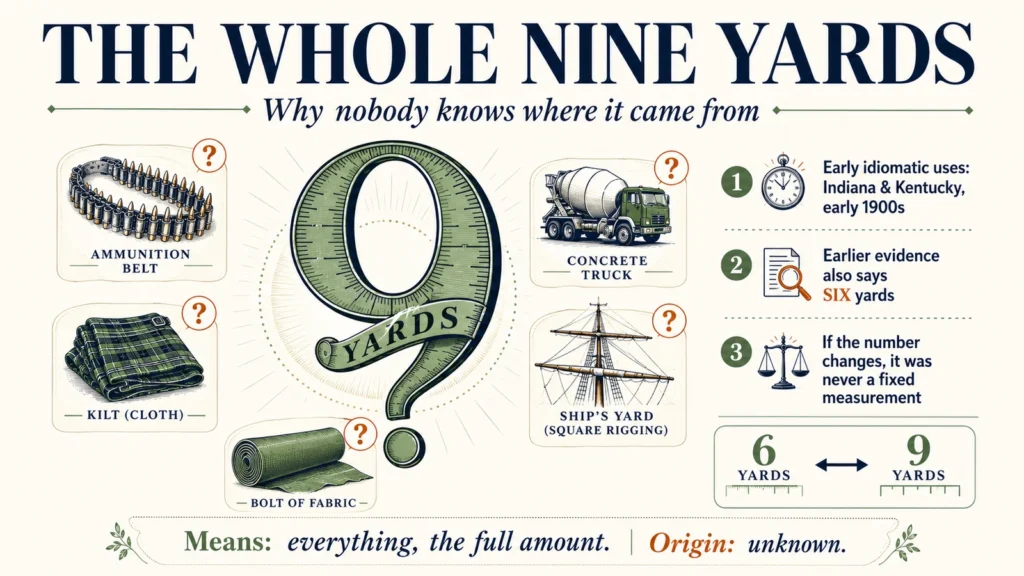
| the whole nine yards | American | ordinary in the UK; its source is still unsettled |
| ballpark figure | American | common in British business speech |
| touch base | American | common in British business email, and widely disliked in both |
| my bad | American | current among younger British speakers |
| spot on | British | understood and used in the US |
| gobsmacked | British | used in the US for emphasis, still marked as British |
The lesson for a writer is that regional labels describe tendency rather than law. If you want to know whether a phrase will travel, the test is not where it was born but whether your reader can see the picture inside it. "A drop in the ocean" works everywhere because everyone has seen an ocean. "Bowl someone a googly" does not. Our page on the whole nine yards is a good example of how little the birthplace tells you: the phrase is fully transatlantic now and nobody has established what the nine yards were.
Choosing a form for a mixed audience
Three rules cover most cases.
- Prefer the pair member built on something universal. Weather, water, animals and food travel. Sports, currency and tools do not.
- Drop the idiom entirely in business writing to people you do not know. "A different kettle of fish" and "a whole new ball game" both lose to "a separate problem," which nobody has to decode.
- Watch the traps table, not the style tables. Getting "trumpet" and "horn" the wrong way round makes you sound foreign. Getting "table a motion" the wrong way round loses an agenda item.
Frequently asked questions
Are British and American idioms mostly different?
No. The great majority are shared. The differences cluster in a few hundred pairs, and most of those are one-word swaps that both sides can decode on hearing. The genuinely risky group, where the same words carry different meanings, is small enough to learn in an afternoon.
Which British idiom confuses Americans most?
Candidates are the cricket phrases, because they need the game explained before the idiom makes sense, and understatement phrases such as "not bad" and "quite good," where the literal words understate the intended meaning by a wide margin.
Is it wrong to use an American idiom in British writing?
No, but it is a register choice. Many American forms are now ordinary in British English. The question to ask is whether the phrase draws attention to itself: if a reader notices the idiom rather than the point, change it.
Do Australian and Indian English follow the British forms?
Usually, for the pairs in the first table, because those varieties inherited the British form. Both also carry a large set of idioms of their own that neither Britain nor the United States uses, which is a separate subject.
What is the safest way to check a regional idiom?
Look it up in a dictionary that carries regional labels, such as Wiktionary or a major learner's dictionary, and check whether the entry marks the form British, American or both. Where the label is missing, treat the phrase as local until you find it used in writing from the other side.