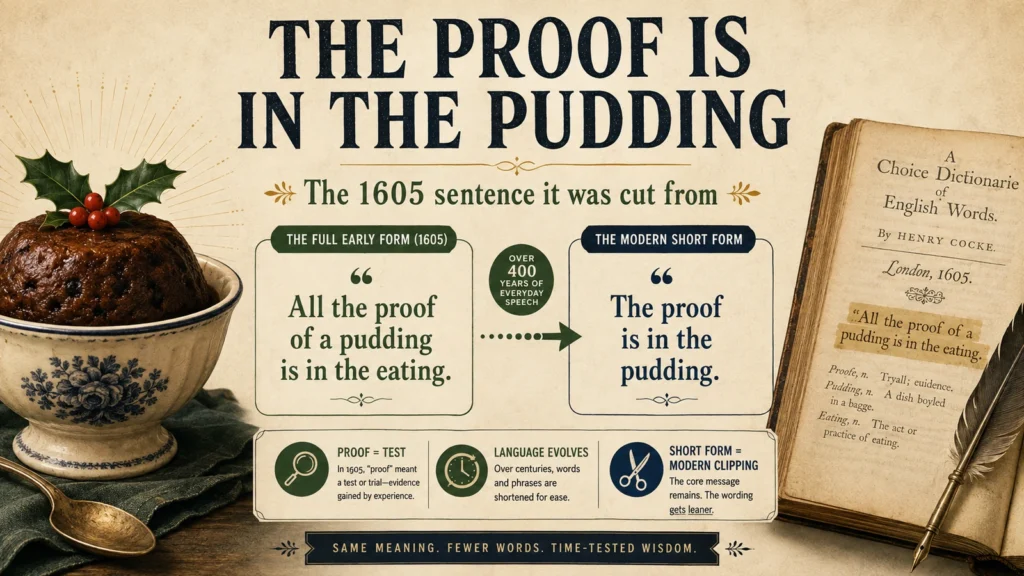
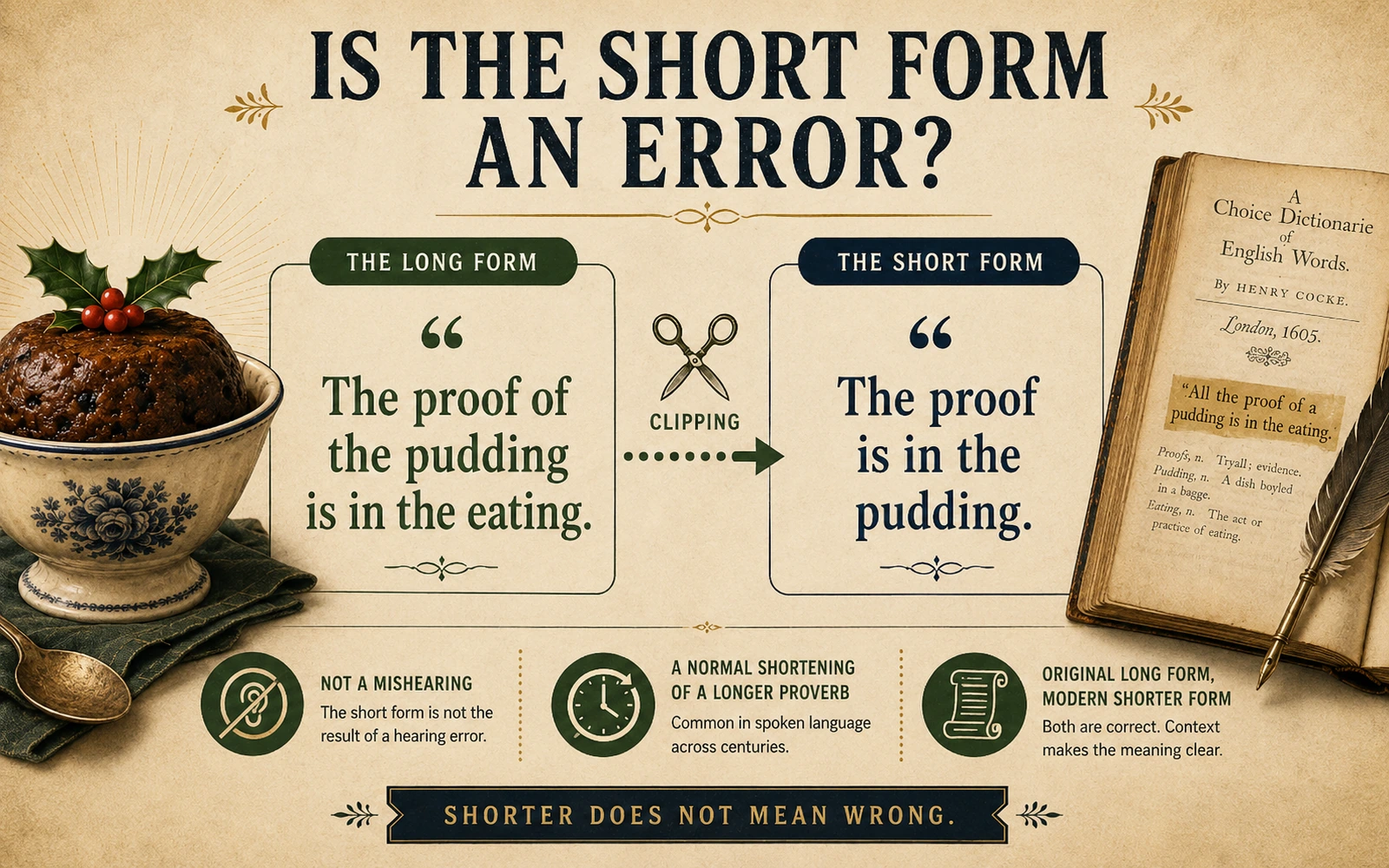
The phrase people say today is a compression. The full form is "the proof of the pudding is in the eating", and in it the word "proof" does not mean evidence. It means test. Read that way, the proverb says something completely ordinary: the way to find out whether a pudding is any good is to eat it.
That single shift of sense is the whole page, and it is why the short form confuses people. "The proof is in the pudding" looks like it is claiming that some sort of evidence has been hidden inside a dessert, which is nonsense, and readers who notice the nonsense often conclude the phrase has been corrupted. The longer answer is more interesting, and reaching it means doing what the method behind every origin page on this site asks for: find the earliest printed use, then work out what its words meant at the time.
The citation trail
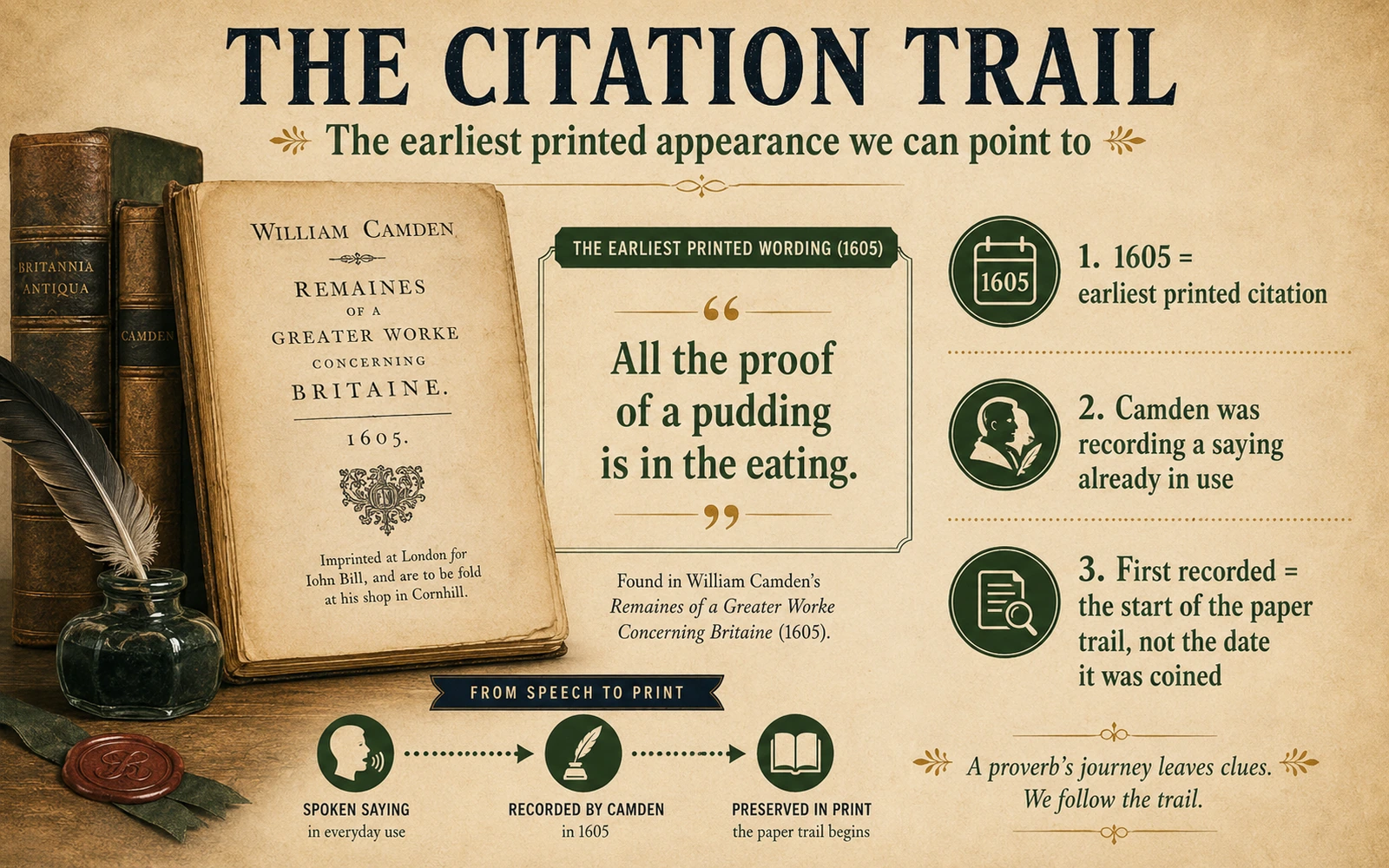
Phrase Finder gives the earliest printed appearance as William Camden, Remaines of a Greater Worke Concerning Britaine, 1605, in the wording "All the proof of a pudding is in the eating."
Two things about that sentence are worth pausing on, because they are what the modern form has lost.
It says "a pudding", not "the pudding". The proverb is general. It is about puddings as a class, not about one particular pudding in front of you, which is exactly the sense the "of a" construction carries and the sense the modern "in the pudding" quietly drops.
It was already a proverb in 1605. Camden was collecting sayings, not coining them, so the phrase was in circulation before he wrote it down. This is a routine feature of proverb dating and it is worth stating plainly: an earliest printed citation is the earliest date we can prove, not the date the phrase was invented. Every date on this site should be read that way.
What "proof" meant
The older sense of "proof" as a test rather than as evidence has not vanished from English. It survives in a handful of fixed expressions most readers use without noticing.
- A proving ground is a place where something is tested, not a place where something is shown to be true.
- Proofing bread, or proofing a printer's page, means testing it before committing.
- Alcohol proof is a number that came out of literally testing spirits.
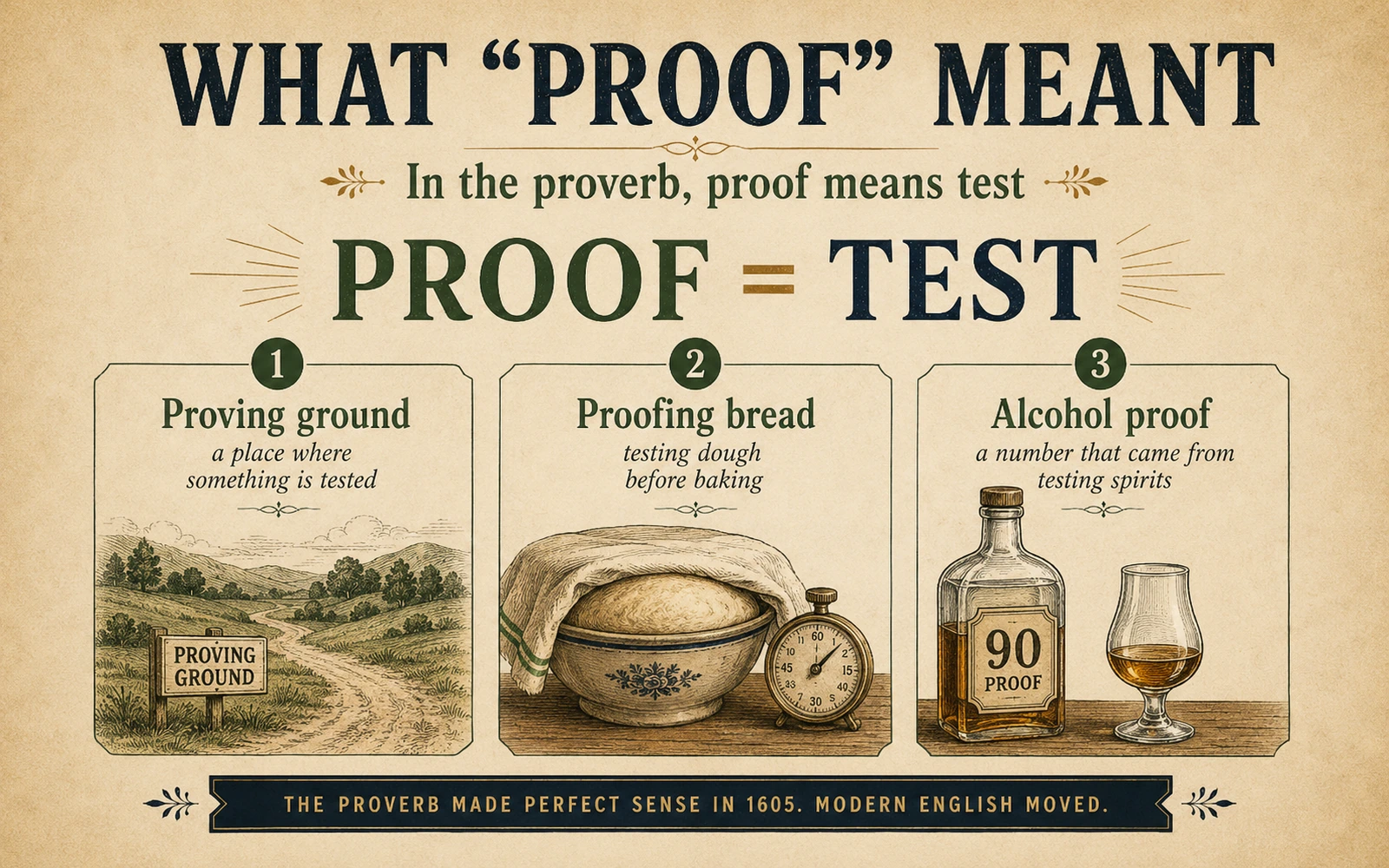
So the 1605 sentence is not using a strange word. It is using an ordinary word in the ordinary sense of its time, and it is modern English that moved. Once "proof" narrowed toward "evidence", the proverb stopped parsing, and a phrase that stops parsing is a phrase that starts getting shortened, because speakers keep the part that carries the tune and drop the part that has stopped meaning anything.
Is the short form an error?
This is where most readers arrive, and it deserves a straight answer rather than a scolding.
The short form is not a mishearing. It is a clipping, and clipping is one of the most ordinary things that happens to long proverbs in speech. Nobody says "a rolling stone gathers no moss, and neither does an idle brain gather wisdom." They say the first half. The same mechanism produced "the proof is in the pudding."
It is also true that the short form is younger, and that the long form is what the proverb originally said. Both statements hold at once and there is no contradiction between them. A writer who wants to be precise in formal prose can use the full form. A speaker using the short form is doing what English speakers have always done with proverbs.
What this page will not do is tell you the short form is wrong on the authority of a reference we could not open. Merriam-Webster has written about this phrase and its page returned an HTTP 403 to our request on 28 August 2026. That is our retrieval failing, not the publisher withholding anything, and until someone opens it directly, nothing here rests on what it says.
The pattern this phrase shares with the others
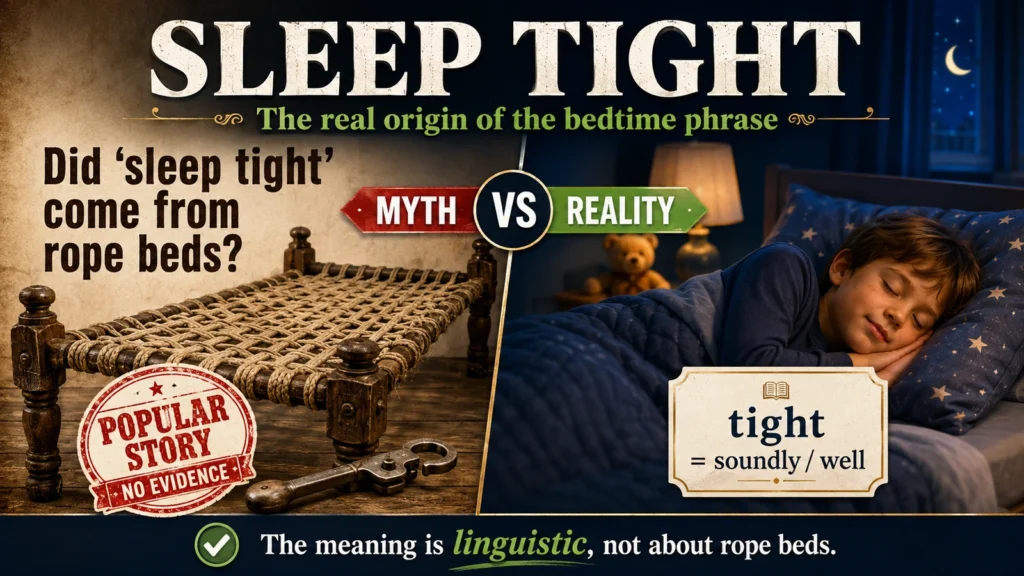
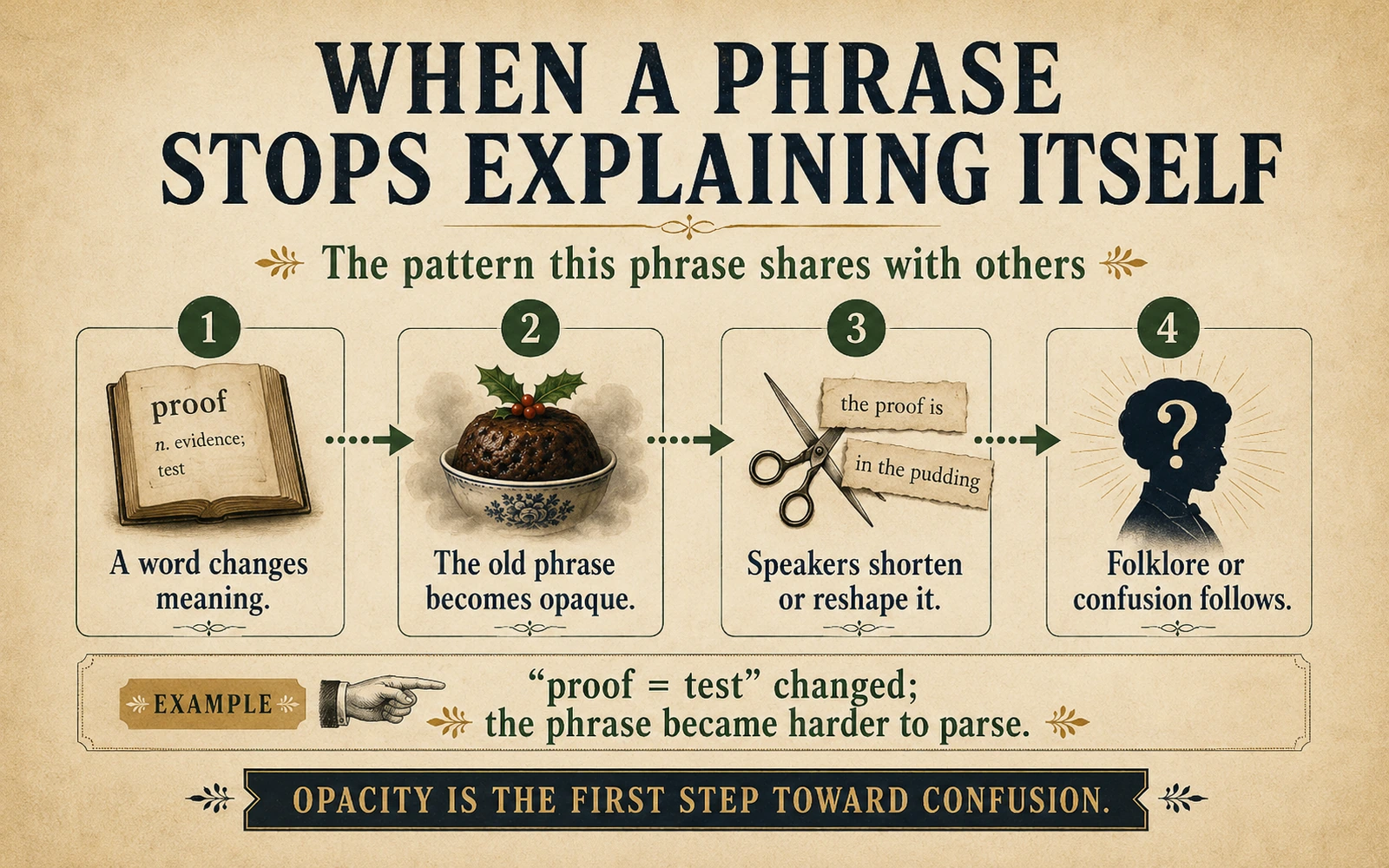
The compression story here is the mirror image of a pattern this site keeps meeting from the other direction. With "rule of thumb" and with "sleep tight", a phrase whose plain sense had gone opaque attracted a colorful story that explained it, and the story traveled much further than the evidence ever did. With "the proof is in the pudding", the opaque phrase did not attract a story. It attracted a shrug and a shortening.
Both outcomes come from the same cause: a word inside the phrase changed meaning and the phrase stopped explaining itself. That is the single most reliable predictor of an idiom about to acquire folklore, and it is worth knowing as a reader, because it tells you where to be suspicious.
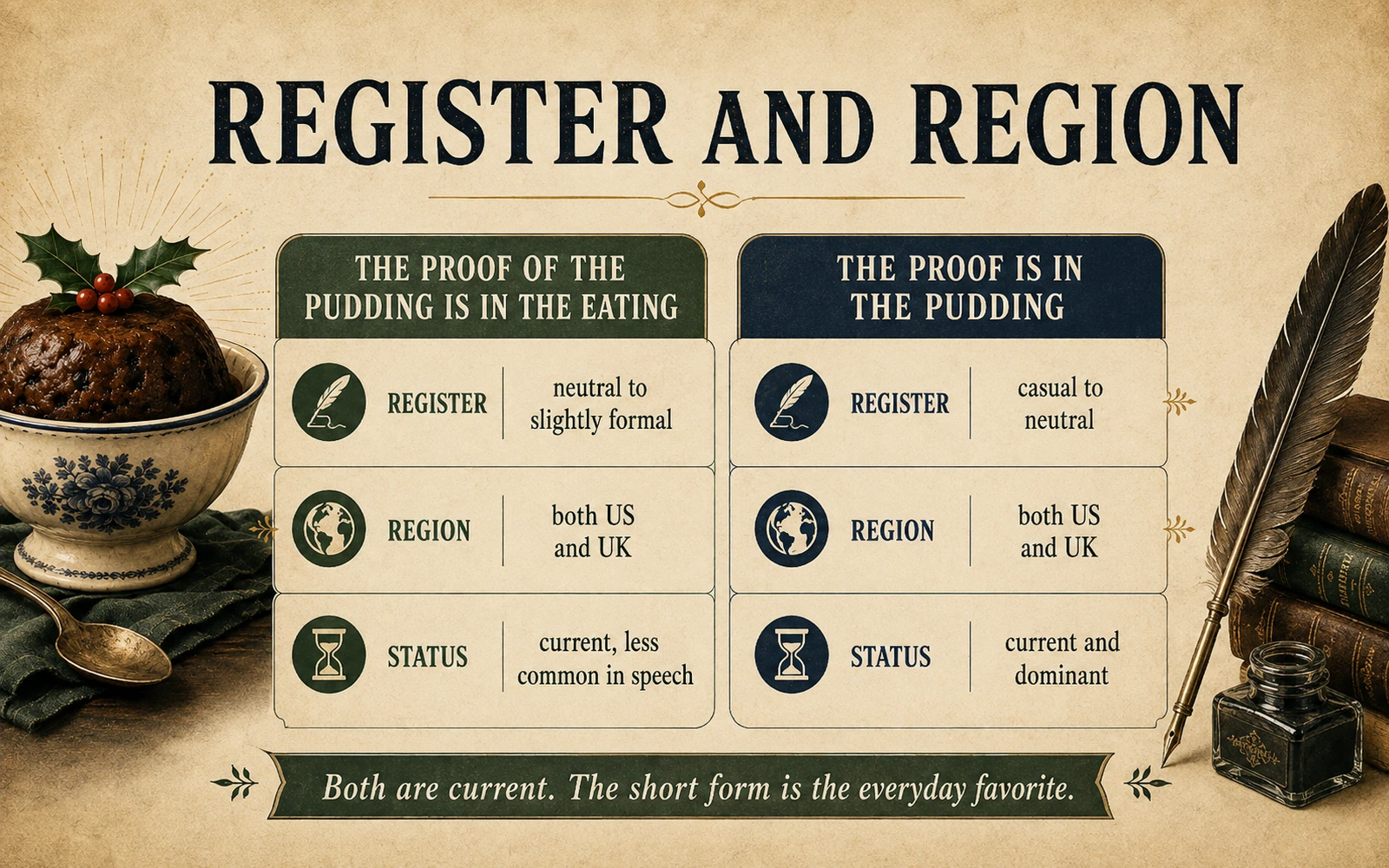
Register and region
| Register | Region | Status | |
|---|---|---|---|
| the proof of the pudding is in the eating | neutral to slightly formal. Fine in written argument, and reads as deliberate | both US and UK | current, though much less common in speech than the short form |
| the proof is in the pudding | casual to neutral. Very common in speech and in business writing | both US and UK, and more common in US usage | current and dominant |
What is genuinely unresolved
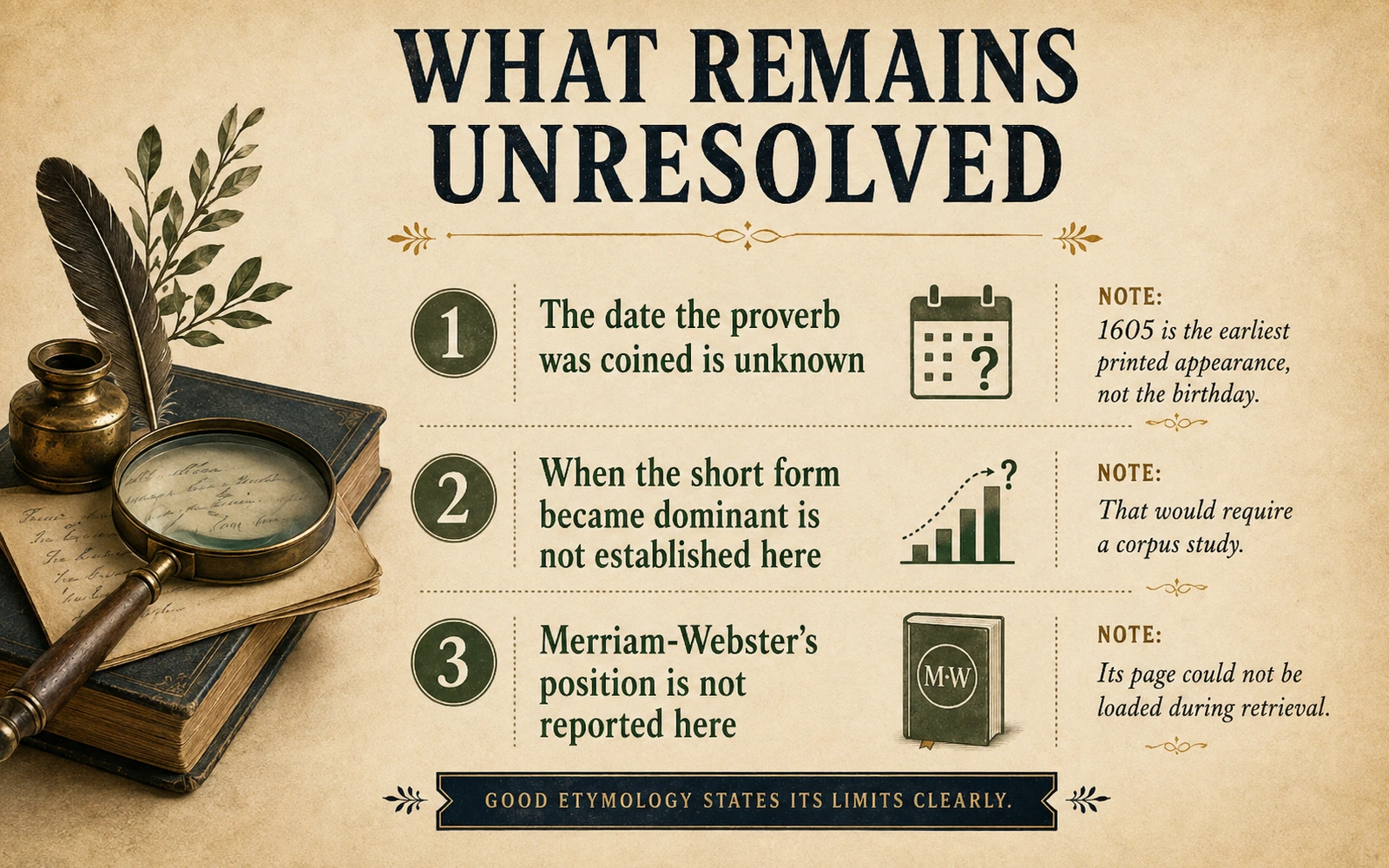
The date the phrase was coined is unknown. 1605 is the earliest printed appearance we can point to, and Camden was recording a saying already in use.
When the short form became dominant is not established here. Dating that would take a corpus study, and we have not run one. Anyone who gives you a year for it should be asked which corpus they used.
Merriam-Webster's position on the short form is not reported on this page, because we could not load it. It is worth reading before anyone treats the question as closed.