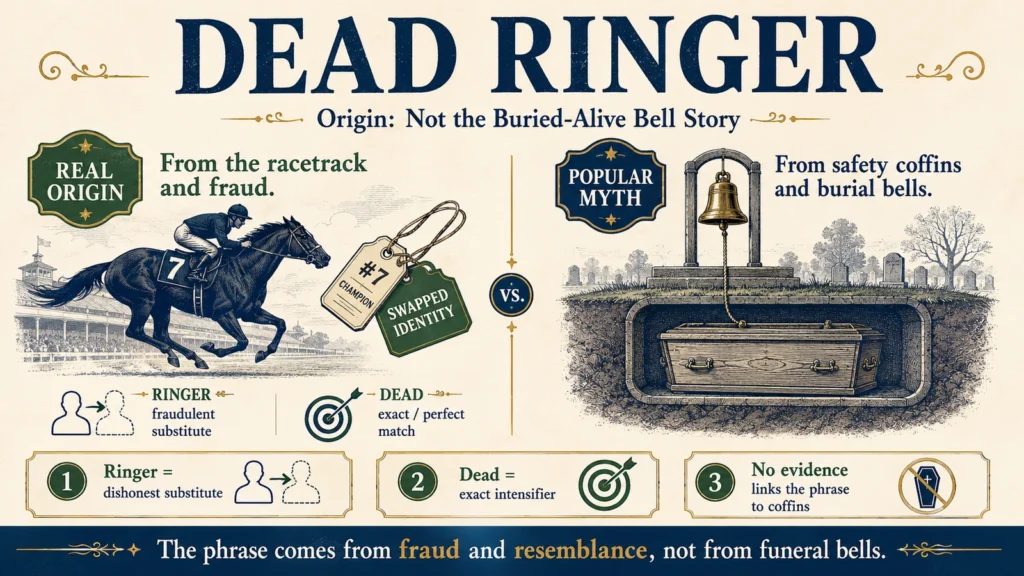
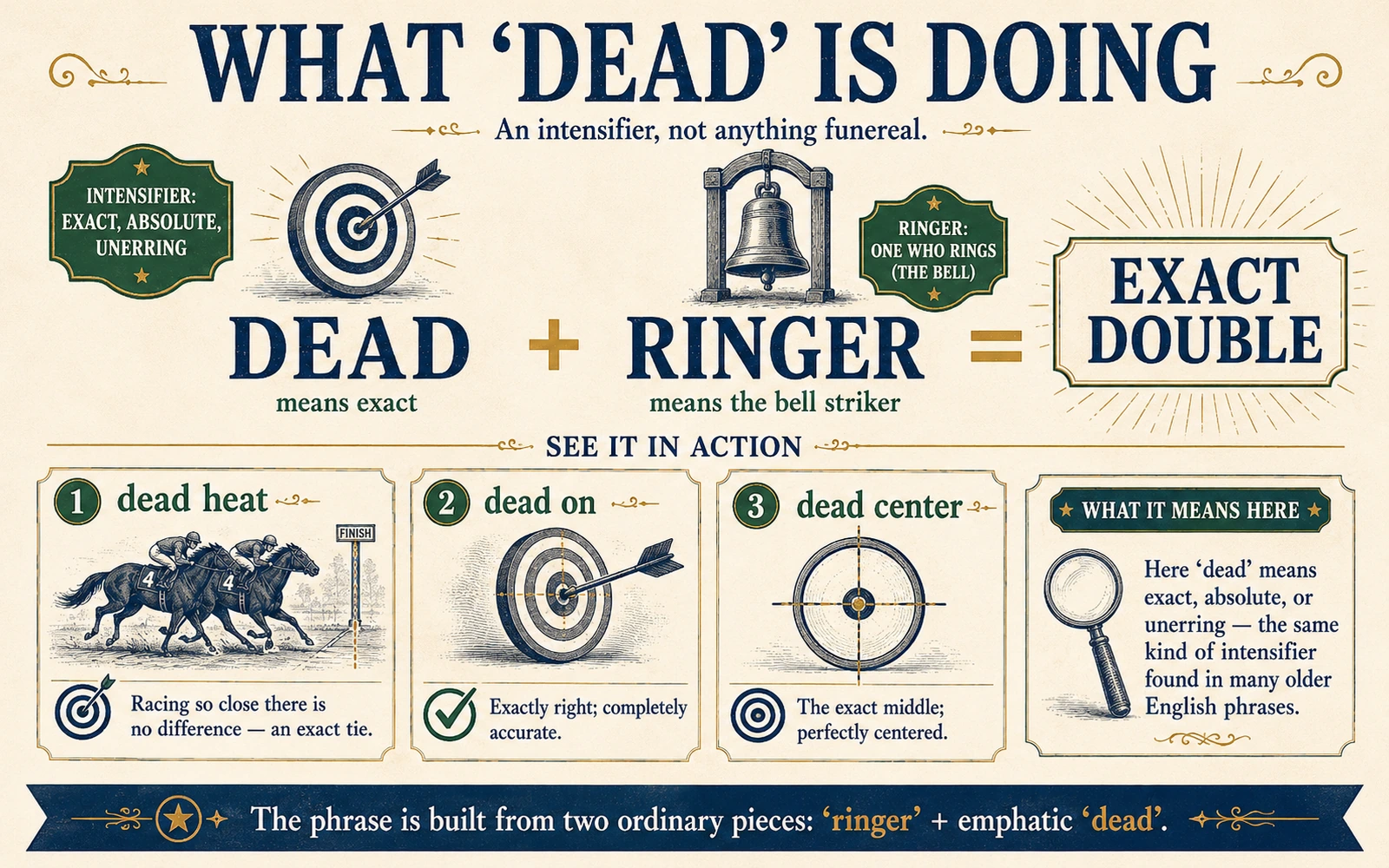
A dead ringer is an exact double, and the phrase comes from fraud rather than from funerals. In the record the major dictionaries keep, a ringer is a substitute entered dishonestly, most famously a horse swapped into a race under another animal's name, and dead is the ordinary intensifier meaning exact, the same one at work in dead heat and dead on. No dictionary traces the phrase to a bell rope in a coffin. The earliest example the Oxford English Dictionary carries, as quoted by Grammarphobia, is from an 1878 Colorado newspaper.
That is the short answer, and most pages on this phrase stop there. The more useful question is the one they skip: why does the coffin story keep winning against it? The answer is that half of the story is true, and the true half is the half a curious reader checks first.
What "dead ringer" means, and where it belongs
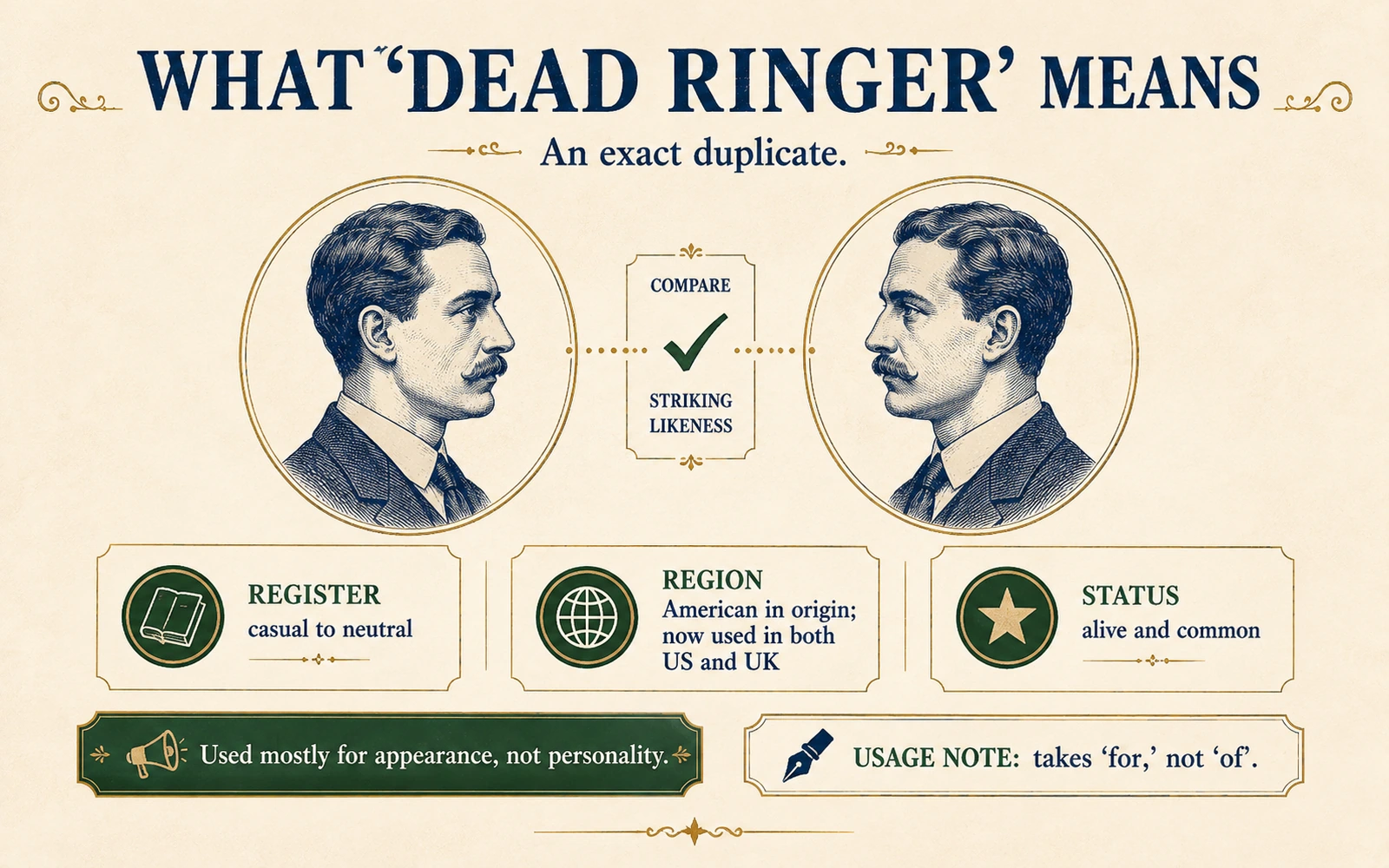
Gary Martin's Phrase Finder gives the meaning in three words: "An exact duplicate."
It is used of people far more often than of things, and almost always of appearance rather than character. You are a dead ringer for your grandmother in a photograph; you are not a dead ringer for her in temperament. The phrase takes for, never of.
| Register | Casual to neutral. At home in speech, journalism and email. Slightly too colorful for a legal or academic document. |
| Region | American in origin, now used in both American and British English and widely understood elsewhere. |
| Status | Alive and common. No sign of fading. |
The story that circulates, and what it claims
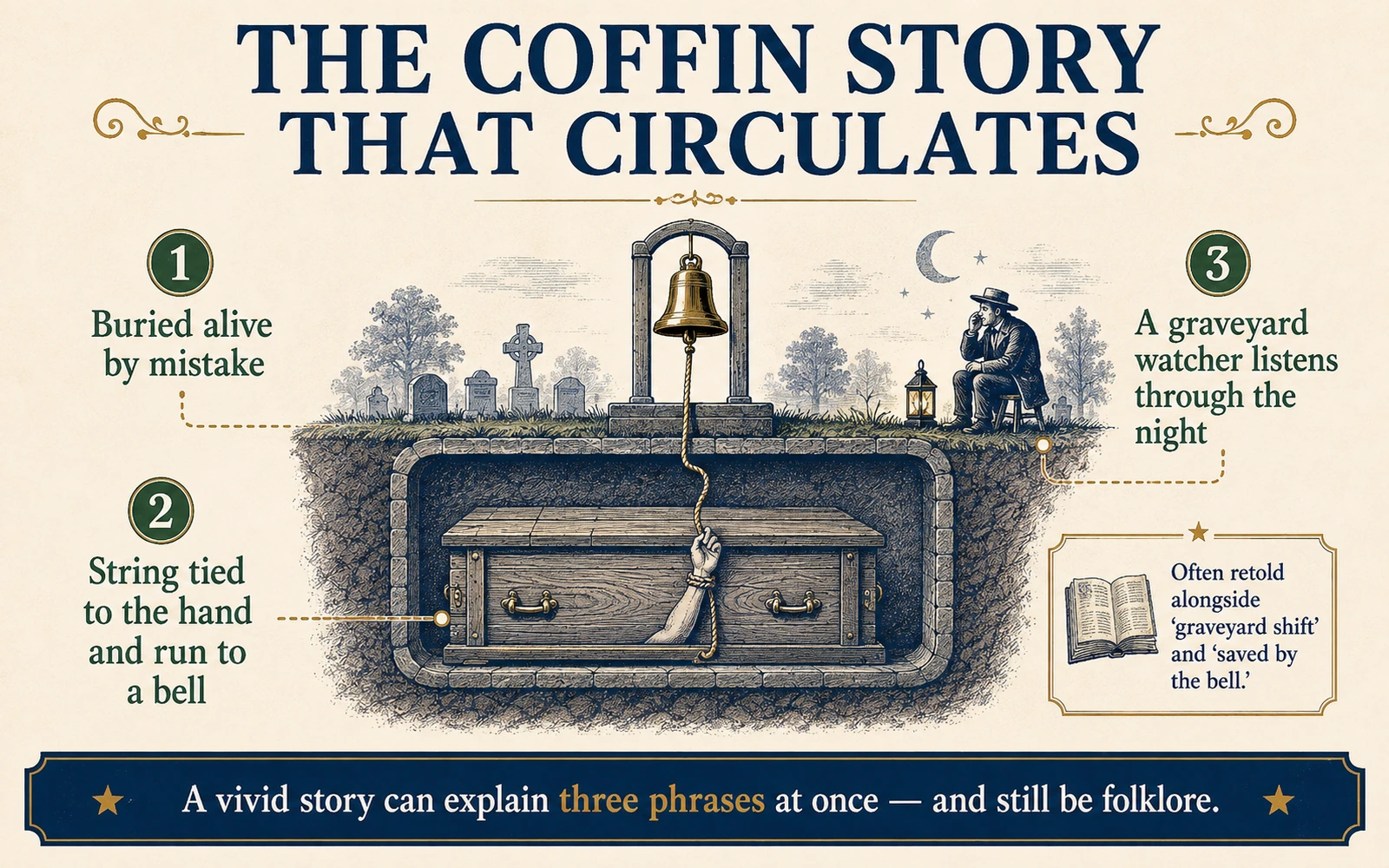
The popular account runs like this. In earlier centuries, people were sometimes buried alive by mistake. To guard against it, a string was tied to the corpse's wrist, run up through the coffin and the soil to a bell above the grave, and somebody sat in the graveyard through the night listening for it. Anyone who rang was a "dead ringer." The same story is usually told with two companions attached, "graveyard shift" for the night watch and "saved by the bell" for the rescue.
It is a good story. It is also the sort of story that arrives already assembled, explaining three phrases at once with a single image, and that is the first thing worth noticing about it. Real etymologies rarely come in matched sets.
What "ringer" actually meant, according to the dictionaries
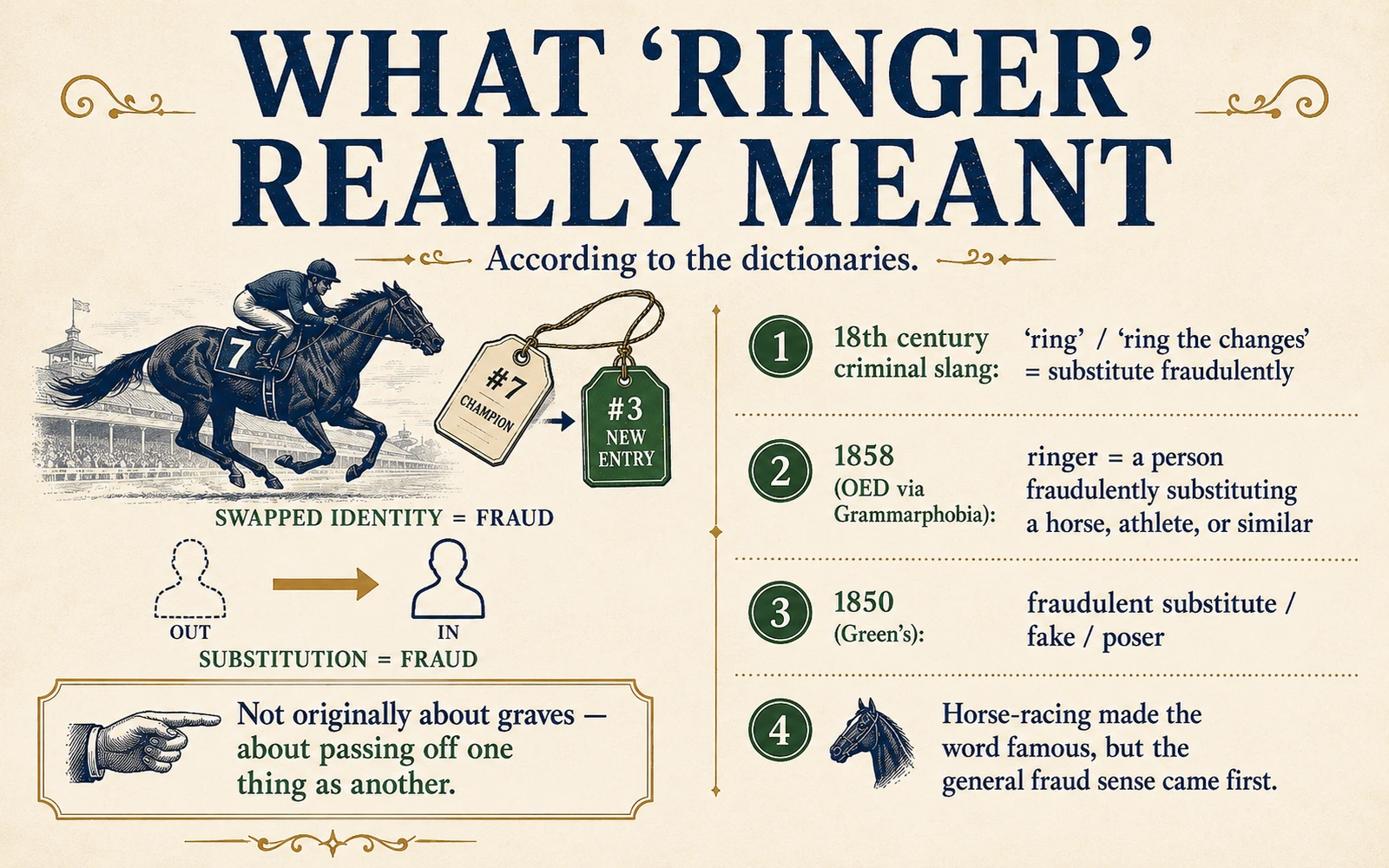
The word does not start with graves. It starts with swapping one thing for another and hoping nobody looks closely.
Grammarphobia's post of February 19, 2014, by Patricia O'Conner and Stewart Kellerman, reports the Oxford English Dictionary's account: the illicit senses go back to eighteenth-century criminal slang in which to ring, or to ring the changes, meant to substitute one thing for another fraudulently. From there the OED records ringer meaning a person who fraudulently substitutes a horse, athlete or similar for another in a competition, with its earliest citation in 1858, and by the mid-1880s the word had moved to the substituted horse itself.
Green's Dictionary of Slang, the fullest published record of English slang citations, prints a similar shape with different dates:
| Sense of "ringer" | Earliest citation Green's prints |
|---|---|
| A fraudulent substitute, of a person: a fake, a poser | 1850, The G'hals of New York, by "Ned Buntline" |
| An exact likeness, a double | 1896, Stephen Crane |
| A fraudulently substituted horse or animal | 1900, The Bulletin, Sydney |
| A person who illegally substitutes animals in races | 1901, The Bulletin, Sydney |
Michael Quinion's World Wide Words page on the word, created January 9, 1999 and last updated July 30, 2005, agrees on the route: the verb to ring is an abbreviation of the older to ring the changes, a bell-ringing term used for passing off something inferior in place of the real thing. Douglas Harper's Etymonline dates that fraudulent-horse sense of the verb to 1812.
Read those three together and the usual one-line summary needs a small correction. Horse racing is where the word became famous, and it is where nearly every retelling places its birth, but in the citations these dictionaries actually print the general fraud sense is the older one and the horse comes later. "It comes from horse racing" is a compression of "it comes from cheating, and the most public cheating in nineteenth-century America happened at the track."
What "dead" is doing in front of it
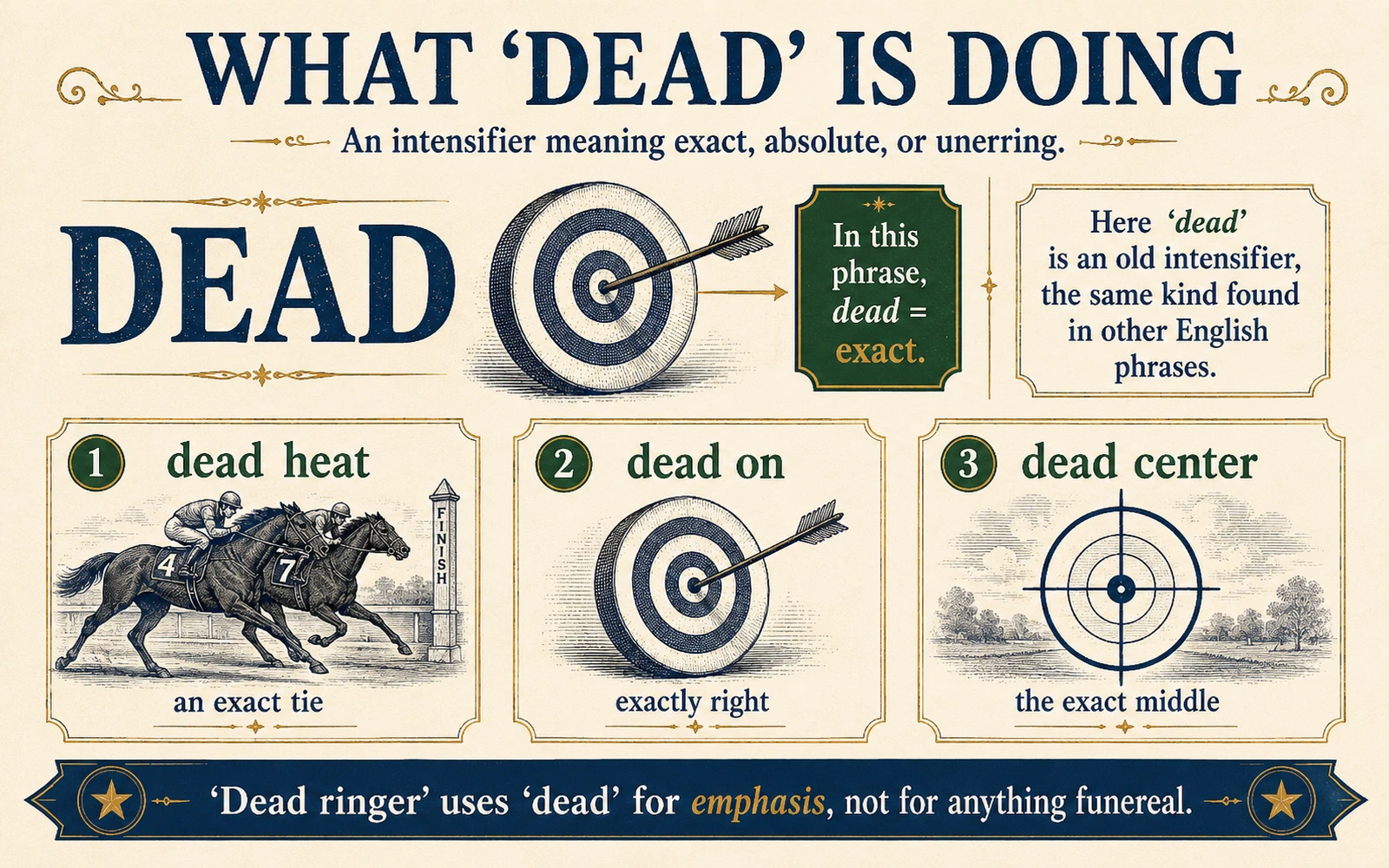
Nothing funereal. Etymonline records dead as an intensifier meaning utter, absolute or quite from the sixteenth century, with dead drunk from the 1590s, and a related sense of quite certain or unerring from the same period. The same intensifier gives dead heat, which Etymonline dates to 1796, and dead-on, which it dates to 1889 and traces to marksmanship. Phrase Finder lists dead shot, dead center and dead heat as the company this dead keeps.
Quinion puts the construction plainly: a dead ringer is simply "ringer with dead added to give the phrase greater emphasis."
So the phrase decomposes into two well-documented pieces, neither of which needs a graveyard to explain it. That matters more than any single date, because an origin story is only worth reaching for when the plain reading fails, and here it does not.
The first attestations, and why the references disagree
This is where a careful page has to stop asserting. Four references were read for this article on September 2, 2026, and they give four different earliest uses.
| Reference | Earliest "dead ringer" it gives | Source it names |
|---|---|---|
| Grammarphobia, quoting the OED (post of February 19, 2014) | 1878 | Weekly Register-Call, Central City, Colorado |
| Gary Martin, Phrase Finder | June 1888 | Oshkosh Weekly Times |
| Etymonline (Douglas Harper) | 1891 | none named in the entry |
| Michael Quinion, World Wide Words (created 1999, updated 2005) | 1893 | an Ohio newspaper |
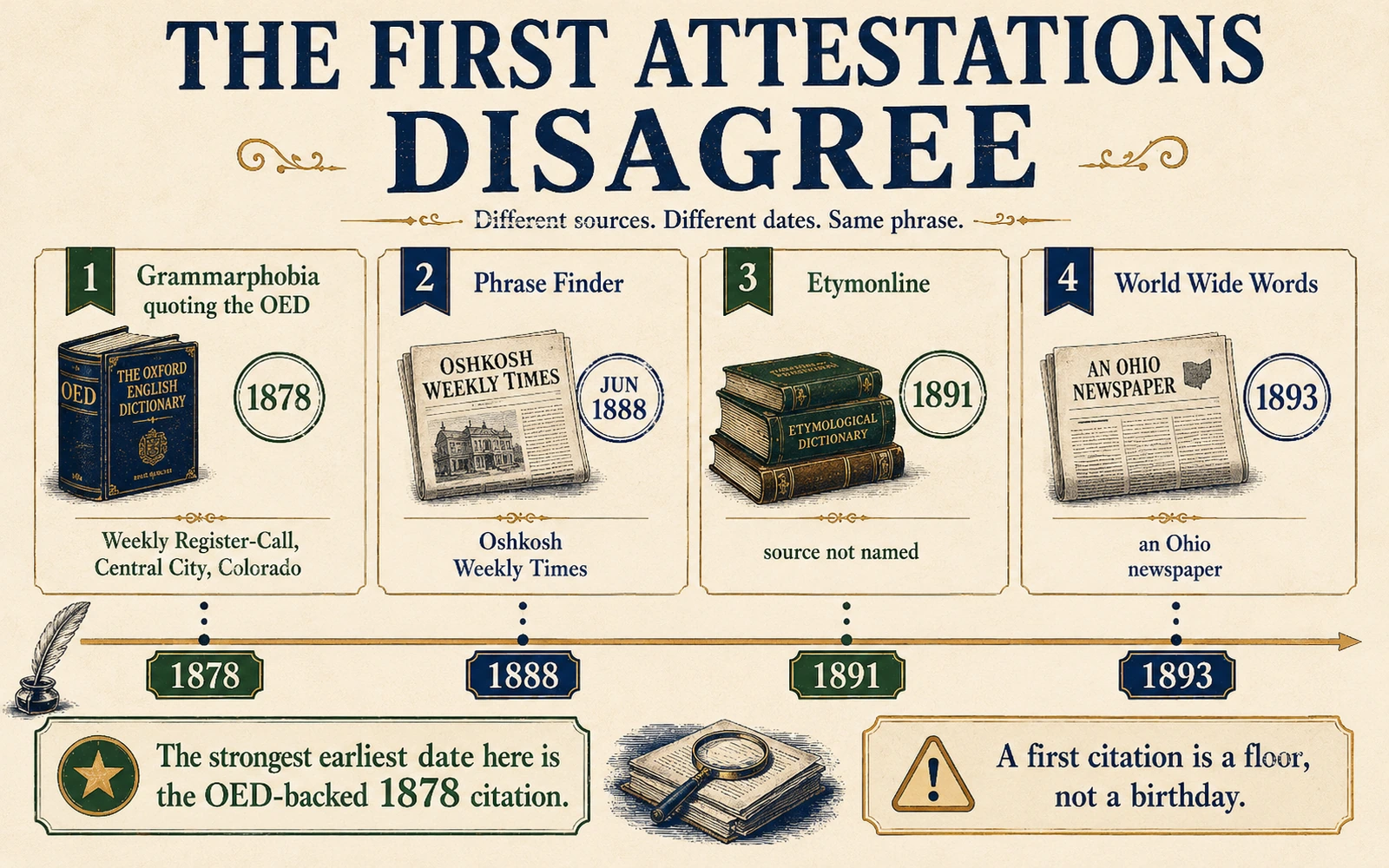
The 1878 line, as Grammarphobia quotes it from the OED, reads: "The knight of La Mancha storming a wind mill, is a 'dead ringer,' so to speak, for Windy Bill riding down a phalanx of Mexicans on a long-eared mule." Quinion's 1893 example runs: "Israel Williams wearing a wig would be no longer Israel Williams, but would be a dead ringer for Wellington just before the battle of Waterloo." Phrase Finder's 1888 citation is transcribed dialect from a newspaper report, "Dat's a dead ringer fo me. I nebber done see such a semblence," and we did not find it carried in either dictionary entry read here, so it is repeated as Martin's claim rather than as a corroborated one.
Fifteen years separate the outer dates. The spread is not a scandal, it is what happens when a dictionary revises an entry and the secondary pages that quoted the old version stay online. Quinion's page was last touched in 2005 and says the phrase is "known from the 1890s"; the OED citation Grammarphobia prints is more than a decade earlier. The later reading of an older reference wins here.
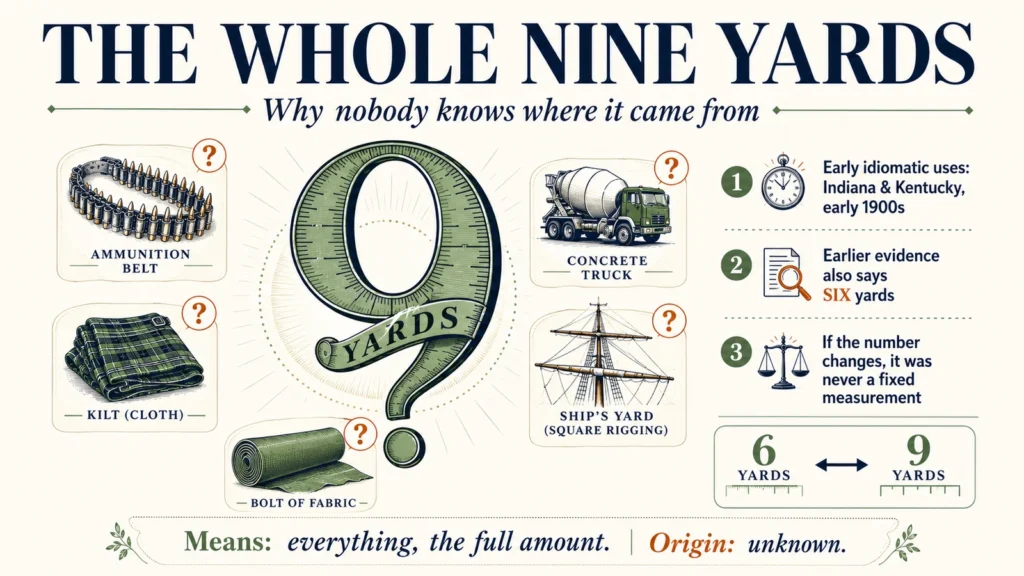
One further caution. A first citation is a floor, not a birthday. It records the earliest surviving printed example somebody has found, and phrases circulate in speech long before anyone writes them down, which is exactly why a date gap on its own settles less than people expect. The same problem runs through the whole nine yards, where the earliest citations are contested and no origin has ever been established.
Why the coffin story is convincing, which is the part nobody explains
Debunking the story is easy. Understanding why it survives is the useful work, and it comes down to one thing: the checkable half of it is true, so the reader who checks stops checking.
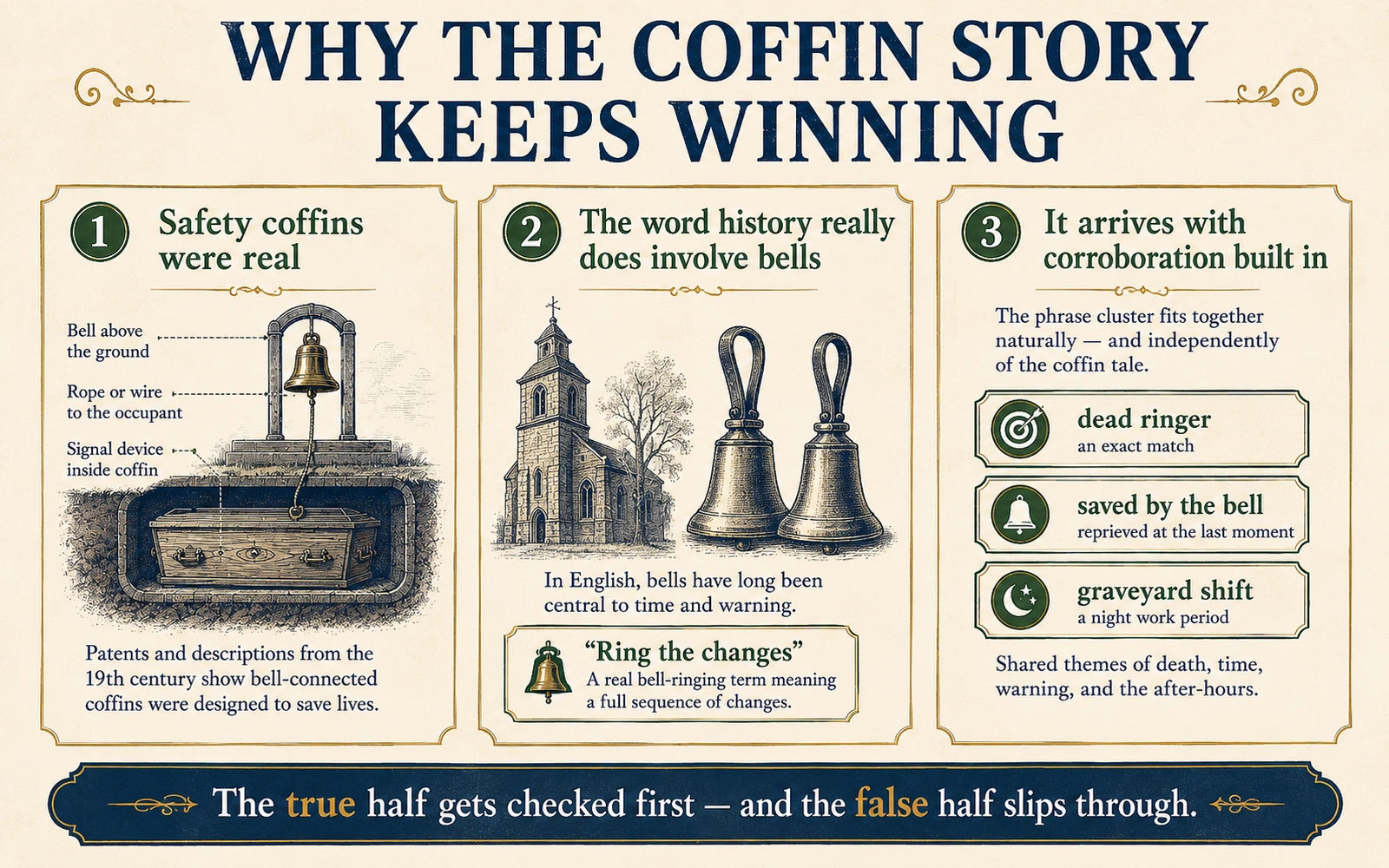
The coffins were real, and they had bells. Franz Vester of Newark, New Jersey was granted United States patent 81,437 for an "Improved Burial-Case" on August 25, 1868. The specification, read at Google Patents on September 2, 2026, describes a tube running from the coffin to the surface and states that "the said tube has near its top a bell, I, from which a cord, K, is suspended, the lower end of said cord being placed in the hand of the person laid in the coffin," so that a person who revived could "ring the bell I, giving the desired alarm for help." Wikipedia's article on safety coffins records others: Christian Eisenbrandt's 1843 spring-loaded lid, a ventilated design by Charles Sieber and Frederick Borntraeger in 1885, and Count Michel de Karnice-Karnicki's Le Karnice of 1897, which raised a flag and rang a bell. Anyone who goes looking for the bell in the coffin finds it on the first search.
The bell is even in the etymology, just the wrong bell. Ring the changes is a bell-ringing term, as Quinion notes, borrowed by thieves for substitution. A reader who half-remembers that the phrase has something to do with bells is not wrong about bells. They are wrong about which ones, and about which century, and that is a much harder error to feel.
It arrives with corroboration built in. The claim usually travels as part of a list of invented sixteenth-century word origins that Grammarphobia, in a post of July 12, 2012, says has been circulating since 1999. Three phrases explained by one custom feels like three pieces of evidence. It is one assertion, repeated three times in the same paragraph.
Here is the gap that all of this papers over. Not one of the references above produces a single dated use of "dead ringer" anywhere near a coffin, a graveyard or a bell watch. And Wikipedia's safety coffin article notes that despite the genuine Victorian fear of premature burial, there are no documented cases of anybody being saved by one of these devices. The patents are real. The rescues are not established, and the phrase does not follow from either.
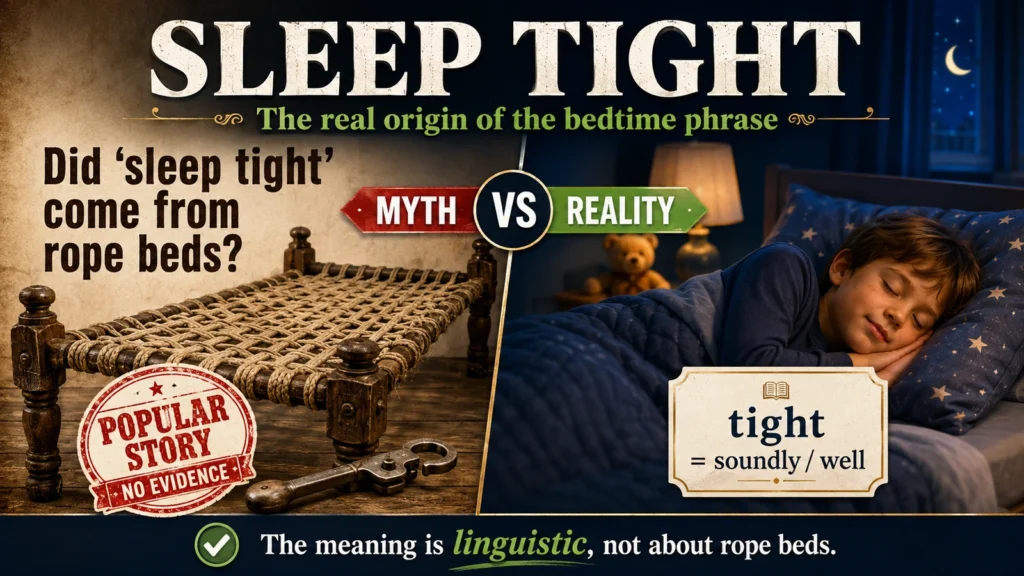
Separating those two things is the whole skill. "This related thing existed" is a fact. "Therefore the phrase came from it" is a separate claim that needs its own evidence, and it almost never has any. The rope-bed explanation for sleep tight fails in exactly the same way: rope beds were real and did need tightening, and none of that connects them to the words.
AAP FactCheck examined the burial claim for all three phrases on May 6, 2022, quoting linguists Pam Peters of Macquarie University, Jane Simpson of the Australian National University and Rebecca Shapiro, and rated it false. Its report notes that the OED's early citation for "saved by the bell" is a boxing use in the Galveston Daily News of February 16, 1909.
What the evidence does not settle
Being right about the myth is not the same as being certain about the answer, and a debunk that overclaims in the other direction has made the same mistake facing the other way.
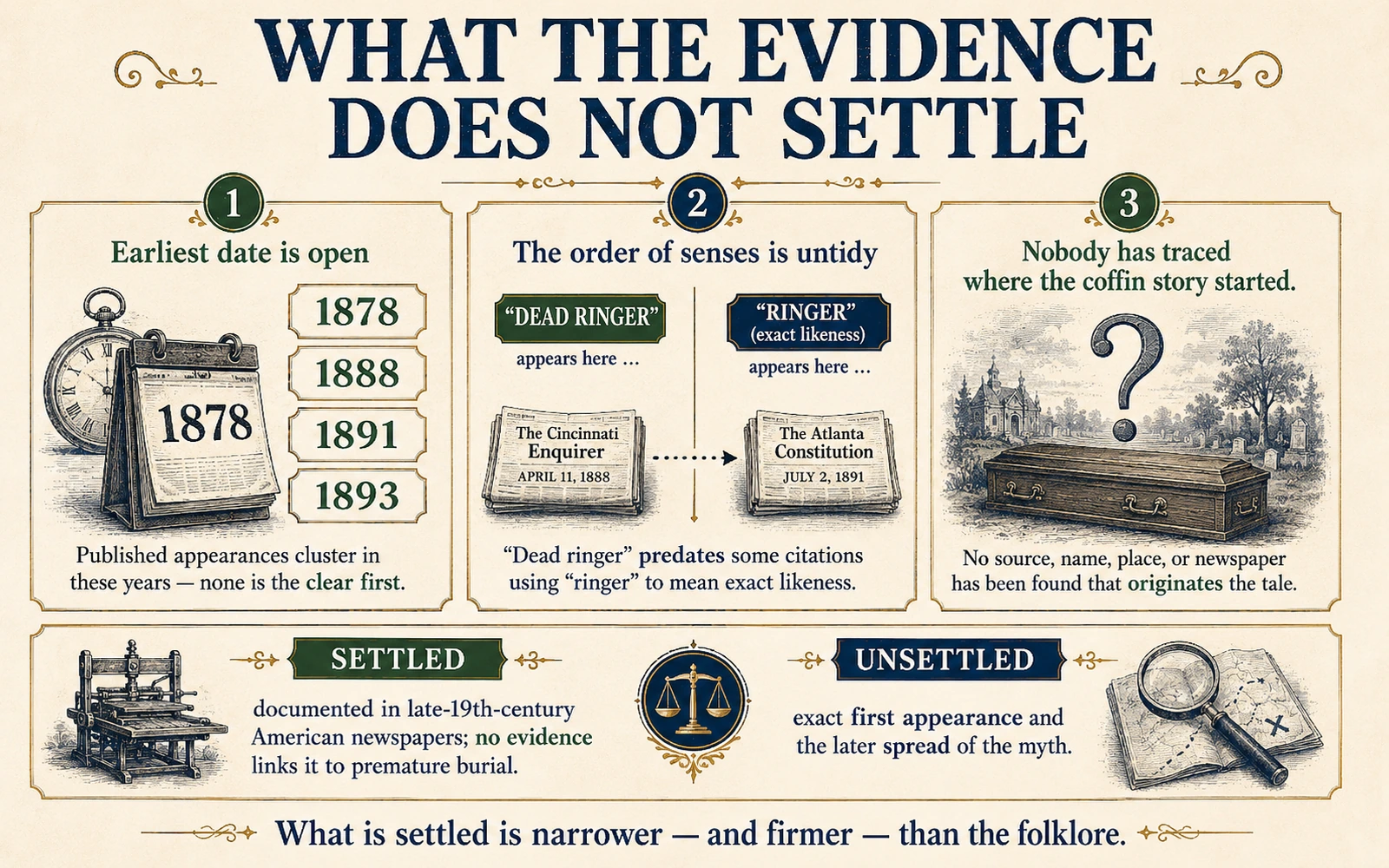
The earliest date is open. 1878, 1888, 1891 or 1893, depending on which reference you open. The 1878 OED citation is the strongest of the four because a major historical dictionary stands behind it; the 1888 Oshkosh line could not be corroborated here.
The order of senses is untidy. Green's earliest citation for plain ringer meaning an exact likeness is 1896, which is later than the OED's earliest citation for the full phrase dead ringer in 1878. On the citations these two references print, the compound turns up before the simple word in that sense. That is the wrong way round for the neat story in which ringer drifts from fraud to resemblance and then picks up dead, and it is a reason to treat any confident sequence, including the one on this page, as provisional.
Nobody has traced how the coffin story started. None of the references consulted names a first appearance in print for it, and neither did we. What can be shown is where it lives now, which is in forwarded lists of invented origins.
What is settled is narrower and firmer: the phrase is documented in American newspapers in the last quarter of the nineteenth century, its parts are separately documented long before that, and no reference connects it to premature burial. Confusing a folk origin with a misused phrase is a common slip, and they are different failures with different fixes, which is why the phrases people get wrong get their own treatment as misused idioms rather than being folded in here.
Frequently asked questions
Does "dead ringer" come from bells attached to coffins? No reference supports it. Michael Quinion at World Wide Words calls it false folklore and notes that although Victorian fears of premature burial were genuine and bell-fitted coffins really were invented, the expression has nothing to do with them. Wikipedia labels the burial account a folk etymology, citing David Wilton's Word Myths: Debunking Linguistic Urban Legends (2008), and AAP FactCheck rated the claim false on May 6, 2022.
What does "ringer" mean in the phrase? A substitute passed off as the real thing. Grammarphobia reports that the Oxford English Dictionary traces the sense to eighteenth-century criminal slang in which to "ring the changes" meant to substitute one thing for another fraudulently, and records "ringer" for a person who fraudulently substitutes a horse or athlete in a competition from 1858. Green's Dictionary of Slang dates the fraudulent-substitute sense to 1850 and the horse sense to 1900.
Why "dead"? It is an intensifier meaning exact or absolute, the same one in "dead heat," "dead center" and "dead on." Etymonline records this sense of "dead" from the sixteenth century, dates "dead heat" to 1796 and "dead-on" to 1889. Quinion describes the phrase as "ringer" with "dead" added for emphasis.
When was "dead ringer" first written down? It is unsettled. The Oxford English Dictionary's earliest example, as quoted by Grammarphobia, is from the Weekly Register-Call of Central City, Colorado, in 1878. Phrase Finder gives an Oshkosh Weekly Times line from June 1888, Etymonline dates the phrase to 1891, and World Wide Words gives an Ohio newspaper example from 1893.
Were coffins with bells actually real? Yes, and that is why the story travels. Franz Vester received United States patent 81,437 for an "Improved Burial-Case" on August 25, 1868, with a bell above the grave and a cord placed in the hand of the person in the coffin. Wikipedia's safety coffin article lists several more, from Christian Eisenbrandt in 1843 to Le Karnice in 1897, and also records that no case is documented of anybody actually being saved by one. The devices existed. The link to the phrase does not.