Most claims that an English phrase comes from sailing turn out to be stories told after the fact. "Under the weather" is the exception.
The phrase really does come from the sea. It appears in a literal seafaring sense in an American newspaper in 1786, in a figurative sense by 1803, and in the sense of feeling unwell by about 1810. What is not documented is the popular story that seasick sailors were sent below deck, "under the weather rail" or "under the weather bow." The origin is nautical; the sick-bay anecdote is a later explanation with no citations behind it. Being under the weather meant being in difficulty long before it meant having a cold.
What "under the weather" means today
It means mildly ill: a cold, a headache, a low day. It is a polite, slightly vague way to say you are not well without saying what is wrong.
- I'm feeling a bit under the weather, so I'll join the call with my camera off.
- He's been under the weather all week.
The vagueness is the point. It is one of the few illness phrases that works in a work email precisely because it tells the reader nothing clinical.
| Register | Region | Status | |
|---|---|---|---|
| under the weather (unwell) | neutral. Fine in speech and in a sick-day message to a manager | both US and UK | current |
| under the weather (in difficulty, broke, in decline) | dated | recorded in American English in the 1800s | obsolete |
| under the weather (drunk) | dated slang | recorded in American English in the 1820s | obsolete |
The citation trail
Here are the dates, each with the reference that reports it. We could not open the newspapers themselves.
1627, John Smith, A Sea Grammar. Both Wordorigins, written by David Wilton, and Phrase Finder begin with this seamanship manual by the Virginia colonist John Smith. It is cited for the sea vocabulary the phrase grew from, not for the phrase itself. In sailors' language, the "weather" side of a ship is the side the wind is coming from, and "weather" sets up words like weather shore, weather bow and weather quarter.
17 April 1786, New York Daily Advertiser. Wilton quotes: "they might have had safe anchorage under the weather." This is literal and nautical. Etymonline explains the sense: to be under the weather shore was to lie in the lee of the land, where the water was calmer. In its first recorded use, then, being under the weather was a good thing. It meant shelter.
17 June 1803, the Aurora, Philadelphia. Etymonline and Phrase Finder both point to this issue as the first figurative use, and Phrase Finder calls it the earliest known printed use of the exact phrase. Etymonline glosses the early sense as "in difficulties, perhaps originally held in jail." Wilton quotes the surrounding passage, in which the writer excuses a man "for being so kind hearted as to suppose that his sea lingo was the least return he ought to make for his release from quarantine." The writer is flagging the phrase as a sailor's expression, which is exactly the evidence a nautical origin needs.
By 1810, "indisposed." Etymonline dates the sense of being unwell to 1810. This is the meaning we use now, and it arrives last.
31 March 1815, Western Monitor, Kentucky. Wilton quotes: "a brother, who had been under the weather, rises into usefulness and independence, able to stand of himself." Here the phrase means down on one's luck, not ill.
The 1820s and 1840s. Mental Floss collects American newspaper uses in which the phrase applies to places and institutions rather than people: in 1824 piracy near Key West is "completely under the weather," meaning suppressed; in 1826 the College of William and Mary has "been long under the weather," meaning in decline; and in 1843 Boston is under the weather in its economic prospects. Mental Floss also records an 1826 use meaning drunk.
Wilton sums up the evidence in one sentence: "It's often the case that claimed nautical origins for English words and idioms turn out to be false, but this is one case where those who claim a nautical origin are correct."
The story everyone tells, and why it is not the same thing
Now for the version on most origin pages. Grammarist gives a representative telling: when a sailor became ill or seasick, he was sent below to the most stable part of the ship, "under the weather rail," and the phrase was shortened from there. Other versions put him "under the weather bow."
It is a good story, and it is not supported.
No citation shows it. Phrase Finder calls the sick-bay account "widely repeated but poorly supported," with no actual examples of the phrase used about a sick sailor being moved below. Mental Floss makes the same point: the sources that tell the story lack examples of the phrase in that context. Grammarist presents it as the most popular theory without offering a dated source.
The meanings arrive in the wrong order. If the phrase began with seasick sailors, the illness sense should come first. The record runs the other way: shelter in 1786, difficulty in 1803, illness by 1810, and a long list of nineteenth-century uses about money, decline and failure that have nothing to do with health. Illness is the last sense to appear, not the first.
The real nautical phrases are about position, not medicine. Phrase Finder and Mental Floss both note that nineteenth-century sources pair "under the weather" with "bow," "quarter" and "shore." Those are real terms for where a ship lies relative to the wind. Phrase Finder reads the pattern as a general sense of being caught in difficulty, not as a coded reference to a sick bay.
So the title of this page and the popular story are both about sailors, and only one of them is documented. The sea gave English the phrase. The sea did not give it the anecdote.
Why this one survives the test when so many fail
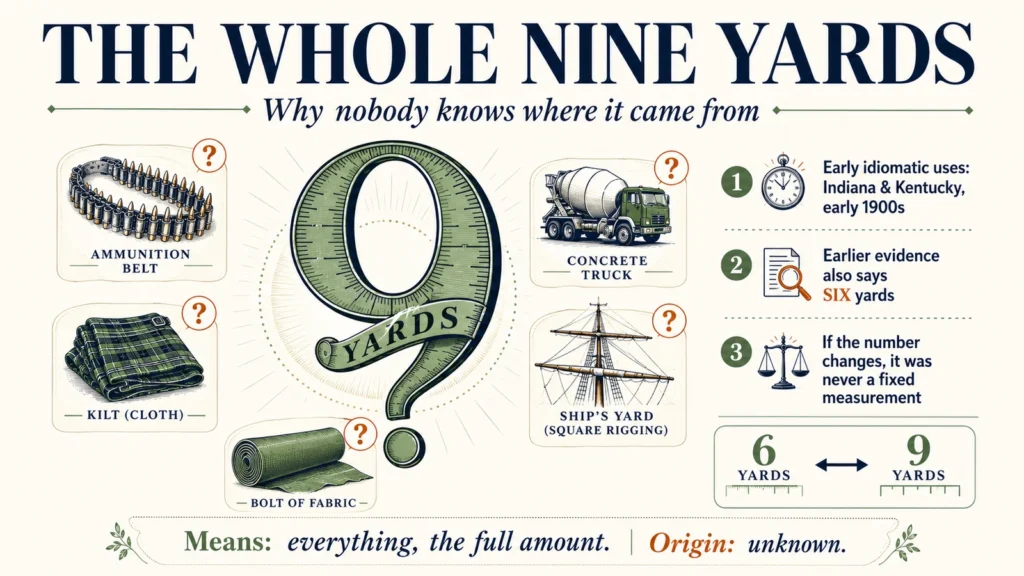
Plenty of phrases have been credited to sailors on no evidence, and the nautical explanations offered for "the whole nine yards" are a good example of the genre. What separates "under the weather" is the ordinary evidence that the method for tracing a phrase origin asks for:
- An early literal use in the source domain. The 1786 "safe anchorage under the weather" is sailing language used about ships.
- A figurative use that points back to that domain. The 1803 writer calls it "sea lingo."
- A plausible path of meaning. From a ship's position relative to the wind, to being caught in hard conditions, to hard times generally, to feeling unwell.
A folk etymology usually has a story and no first step. This phrase has the first step and no need for the story.
It is also a useful reminder that a debunked anecdote does not mean a debunked origin. The rope-bed tale told about "sleep tight" is false, and so is the phrase's supposed link to beds. Here the sick-sailor tale is unsupported, but the phrase's link to the sea is real. The two questions have to be checked separately, just as the phrase history and the folk legend of "rule of thumb" turned out to be two separate histories.
What is genuinely unresolved
The exact path from the sea to illness is not documented step by step. The dates show the order of the senses, not the moment one became another.
The earliest figurative use may be earlier than 1803. It is the earliest the references we read offer.
The newspapers were not opened for this page. Every citation comes through a named reference: Wordorigins, Etymonline, Phrase Finder or Mental Floss.
Frequently asked questions
What is the origin of "under the weather"?
It is a sailors' phrase. Wordorigins cites a literal nautical use in the New York Daily Advertiser of 17 April 1786, "safe anchorage under the weather," and Etymonline and Phrase Finder date the first figurative use to the Philadelphia Aurora of 17 June 1803, where it meant being in difficulty. The sense of being unwell followed by about 1810.
Did sick sailors go "under the weather rail" or "under the weather bow"?
That story is widely told but not documented. Phrase Finder calls it widely repeated but poorly supported, with no examples of the phrase used about sick sailors. The nautical origin is real; the sick-bay anecdote is not.
Did "under the weather" always mean ill?
No. In the 1800s it also meant broke, in decline or in trouble, and Mental Floss records it applied to piracy, a college and a city. An 1826 use meant drunk. Illness is the sense that survived.
Is "under the weather" OK to use at work?
Yes. It is neutral and polite, and it is one of the best phrases for a sick-day message because it says you are unwell without giving details.