Both forms are used, both are understood to mean the same thing, and one of them appears to say the opposite of what the speaker intends. That is the whole argument, and it has been running for the better part of seventy years.
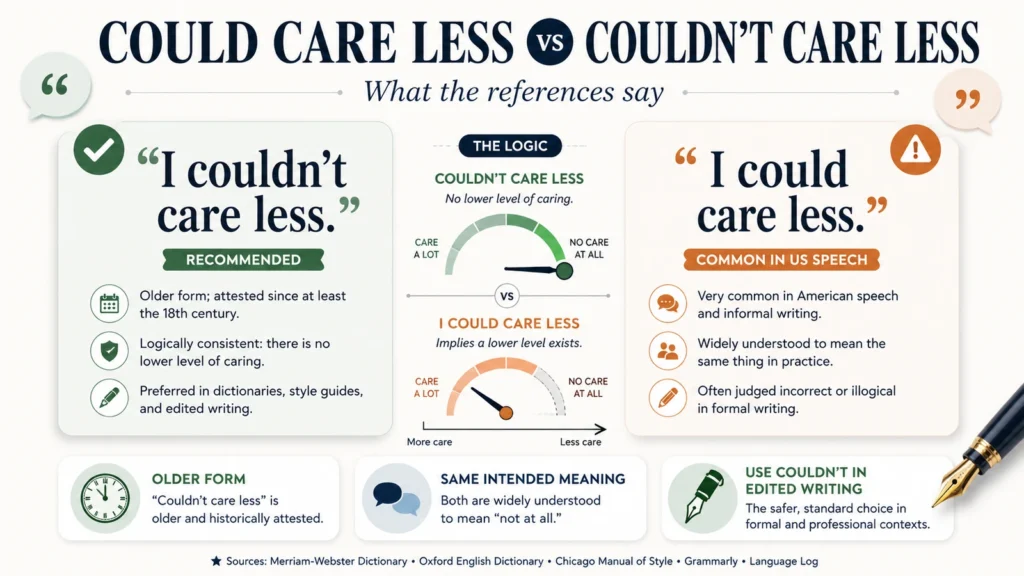
The short answer for anyone who needs one: "I couldn't care less" is the form that survives every kind of scrutiny, it is the older of the two, and it is the one to use in writing where correctness will be judged. "I could care less" is extremely common in American speech, dictionaries record it, and it is not a sign that anyone has misunderstood anything.
The longer answer is more interesting, because the references that would normally settle this do not agree with each other about a single date in the story.
What the phrase is supposed to mean
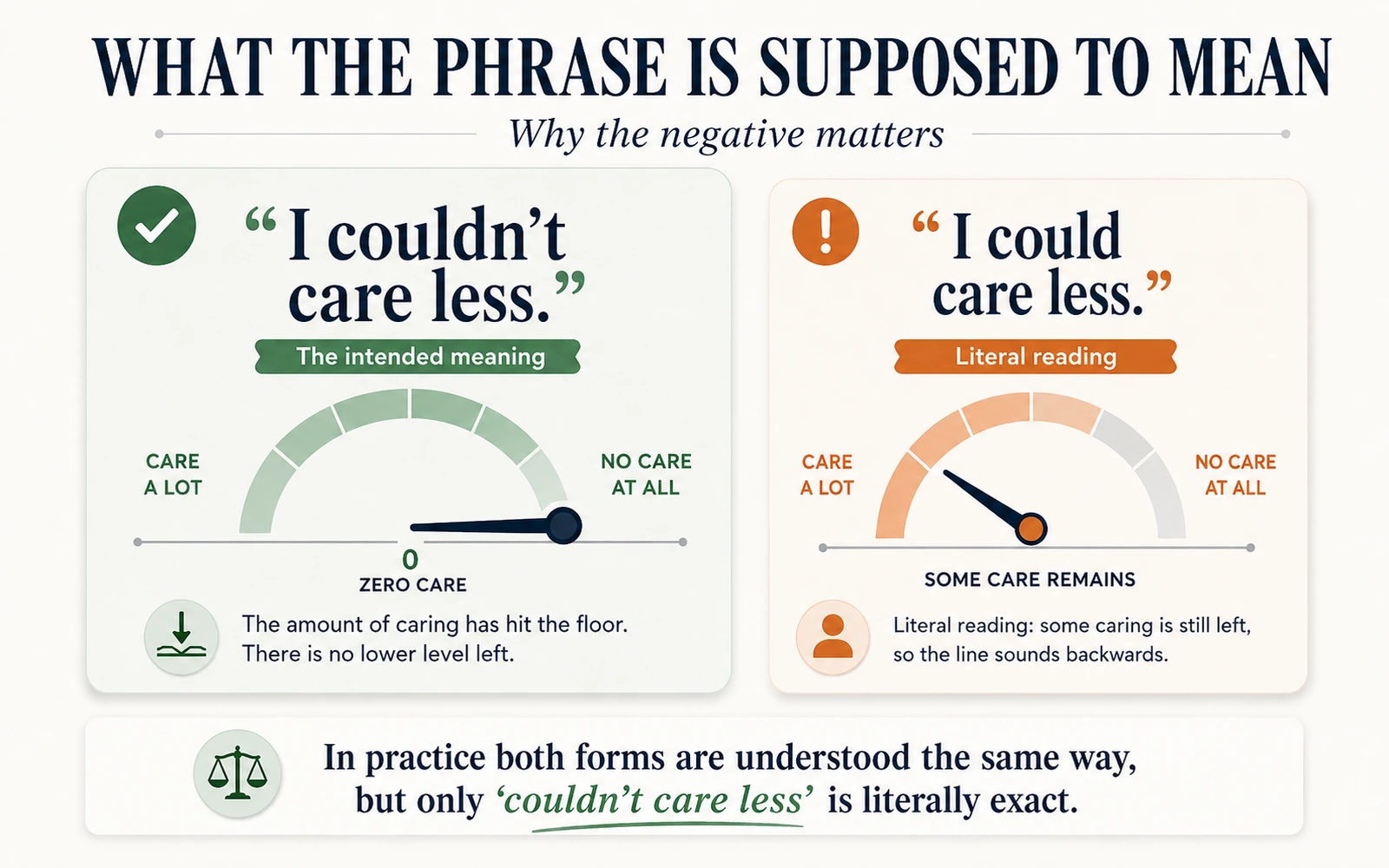
"I couldn't care less" is a statement about a floor. It says that the amount you care has bottomed out: there is no lower it could go, so no further reduction is available. That is why the negative is doing real work. Take it out and the sentence says you have caring in reserve, which is not the point being made.
The literal reading of "I could care less" is therefore backwards. Nobody who says it means it that way, and the meaning in practice is identical. But the literal reading is what makes people react to it, and it is why the phrase turns up on every list of misused expressions.
Where each form starts, according to whom
This is where the tidy version of the story falls apart, and this page prints the mess rather than choosing a favorite.
Merriam-Webster reports evidence for "couldn't care less" well before the 1940s, and points to an example in Hearst's International-Cosmopolitan from May 1929. It finds "could care less" in North American print from as early as the 1950s. The dictionary enters "could care less" as a variant of the older phrase, carrying the same meaning, on the grounds that it is encountered constantly. It also says plainly that no one is certain where "couldn't care less" came from in the first place.
Grammarphobia, the blog written by Patricia O'Conner and Stewart Kellerman, gives different earliest finds. Its search turned up "couldn't care less" in a Kansas City Star story of 25 January 1942, and "could care less" in the Ottawa Evening Citizen of 20 July 1948.
The Oxford English Dictionary, as Grammarphobia reports it, credits a 1946 book by Anthony Phelps titled I Couldn't Care Less, and describes "could care less" as a United States colloquialism of the 1960s. Grammarphobia notes that Canadian and Australian newspaper examples from the 1940s have since been documented, which sits awkwardly with the 1960s dating and with the "United States" label.
Set side by side:
| Form | Merriam-Webster | Grammarphobia | OED, as reported by Grammarphobia |
|---|---|---|---|
| couldn't care less | evidence before the 1940s; an example in Hearst's International-Cosmopolitan, May 1929 | Kansas City Star, 25 January 1942 | a 1946 book by Anthony Phelps, I Couldn't Care Less |
| could care less | in North American print from as early as the 1950s | Ottawa Evening Citizen, 20 July 1948 | a US colloquialism of the 1960s, though 1940s Canadian and Australian examples are documented |
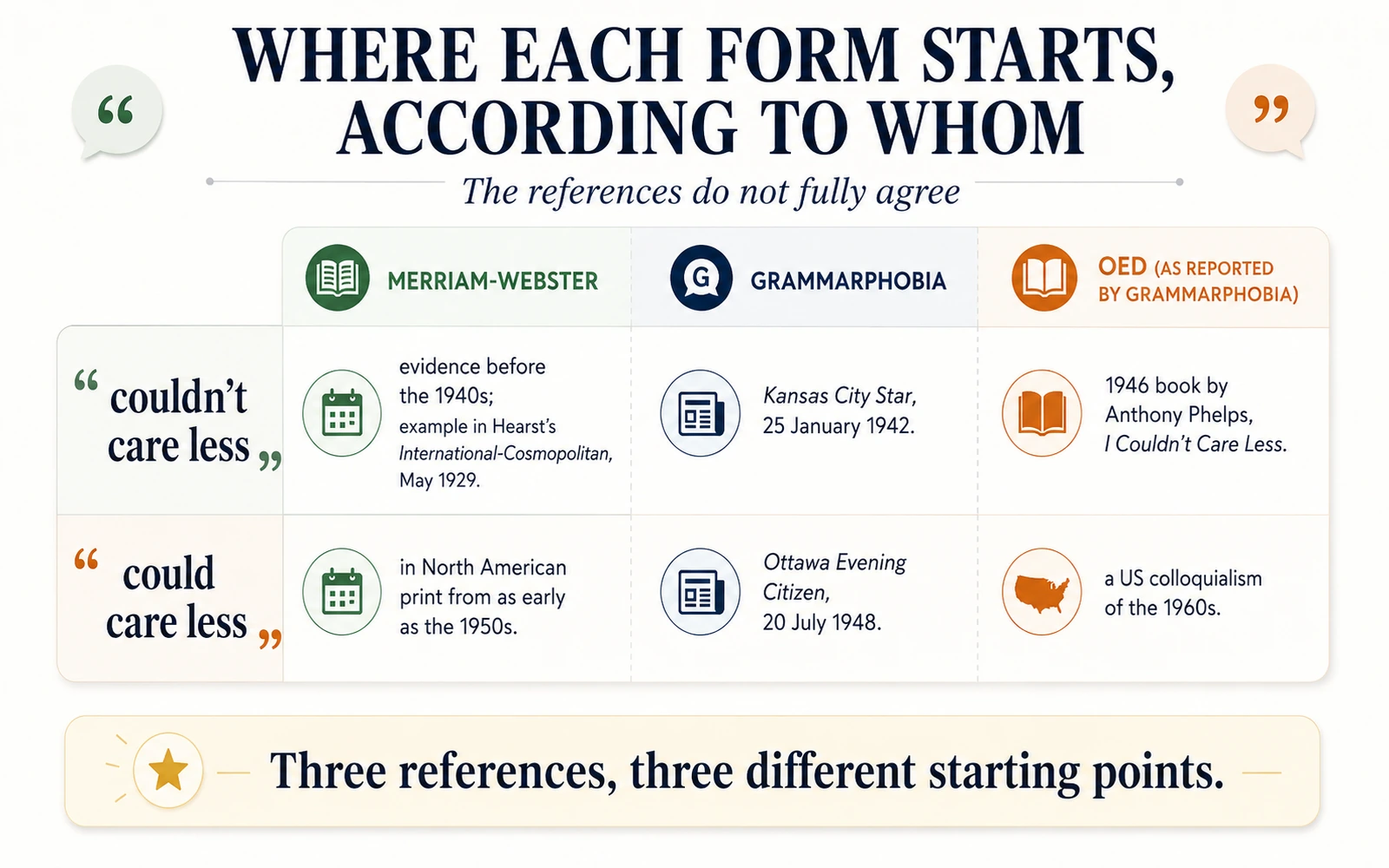
Three references. Three different starting points for each form. The spread is not small: for "could care less" it runs from the 1940s to the 1960s depending on whose entry you open.
None of that is a scandal. It is what happens when different projects search different archives at different times, and when a reference entry written decades ago has not caught up with a newspaper database that did not exist when it was drafted. But it does mean that anyone who tells you confidently that "could care less" began in a particular year is repeating one reference and not mentioning the others.
Why the shorter form appeared at all
There is no settled explanation, and several have been offered.
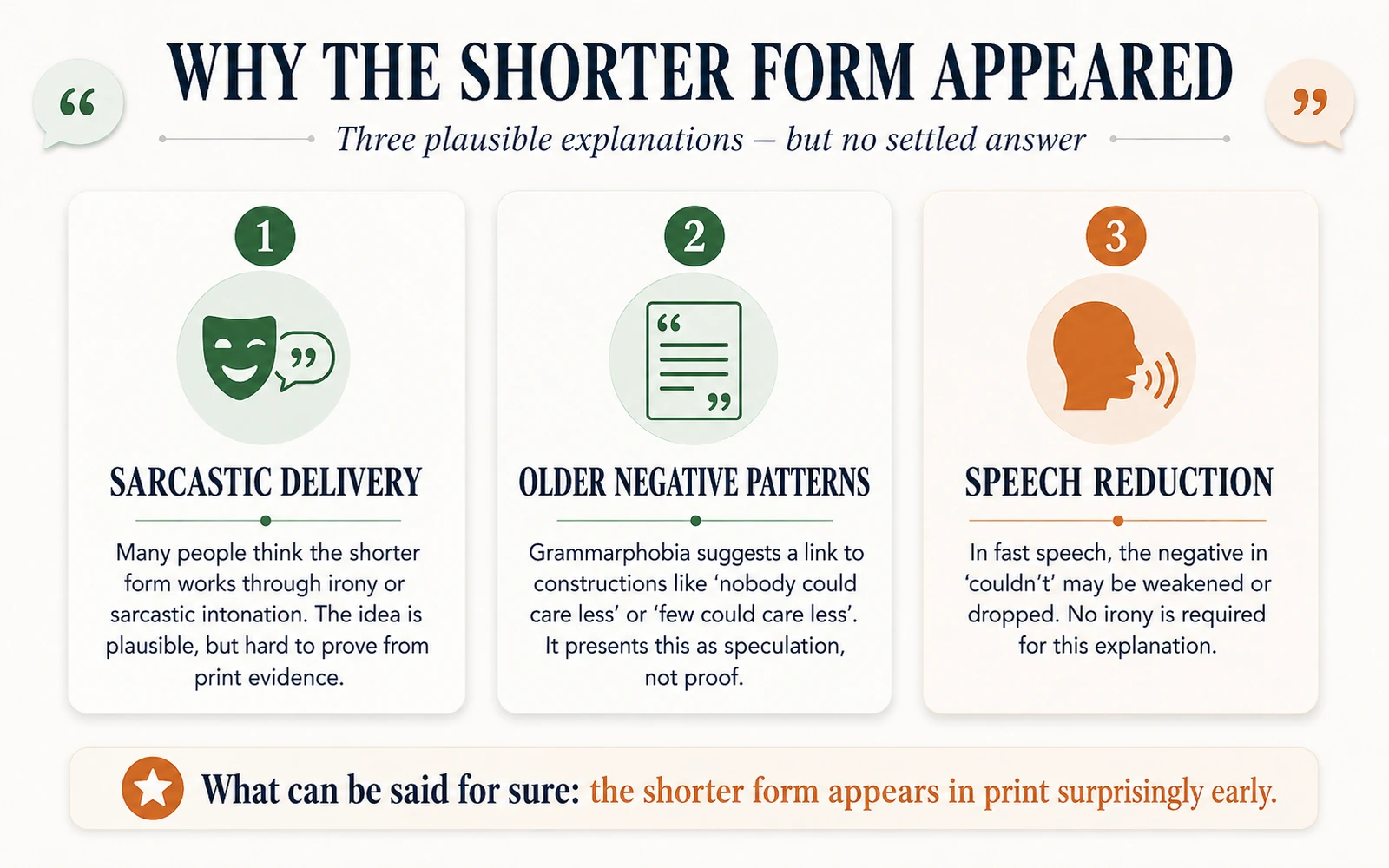
The most commonly repeated is sarcasm: that the phrase is delivered with an ironic intonation which flips the sense, the way "big deal" or "I should be so lucky" do. This is intuitively appealing and hard to test, because intonation leaves no trace in the newspaper archives where the earliest examples live.
Grammarphobia sets out a different possibility. It suggests the shorter form may have grown out of earlier constructions where the negative sat somewhere else in the sentence, in phrases such as "few could care less" or "nobody could care less". From "nobody could care less" to "they could care less" is a smaller step than it looks. The blog is explicit that this is speculation rather than a demonstrated line of descent, and it notes that other writers, the linguist Arika Okrent and the psychologist Steven Pinker among them, have proposed explanations of their own.
A third possibility that needs no theory at all: the negative in "couldn't" is a single unstressed consonant cluster in fast speech, and unstressed material is what English drops first. No irony is required for that. It is the same process that turns "should have" into "should've" and then into something a listener can hear as "should of".
We are not going to pick between those. What can be said is that the shorter form was in newspaper print within a few years of the longer one on Grammarphobia's evidence, which makes any story that requires decades of drift harder to sustain.
Register and region
Worth stating plainly, because this is the part most pages leave out.
| Register | Region | |
|---|---|---|
| I couldn't care less | neutral. Safe in writing, in business email, in anything edited | both US and UK |
| I could care less | casual only. Avoid in edited writing and in professional correspondence | chiefly US, and strongly associated with American speech |
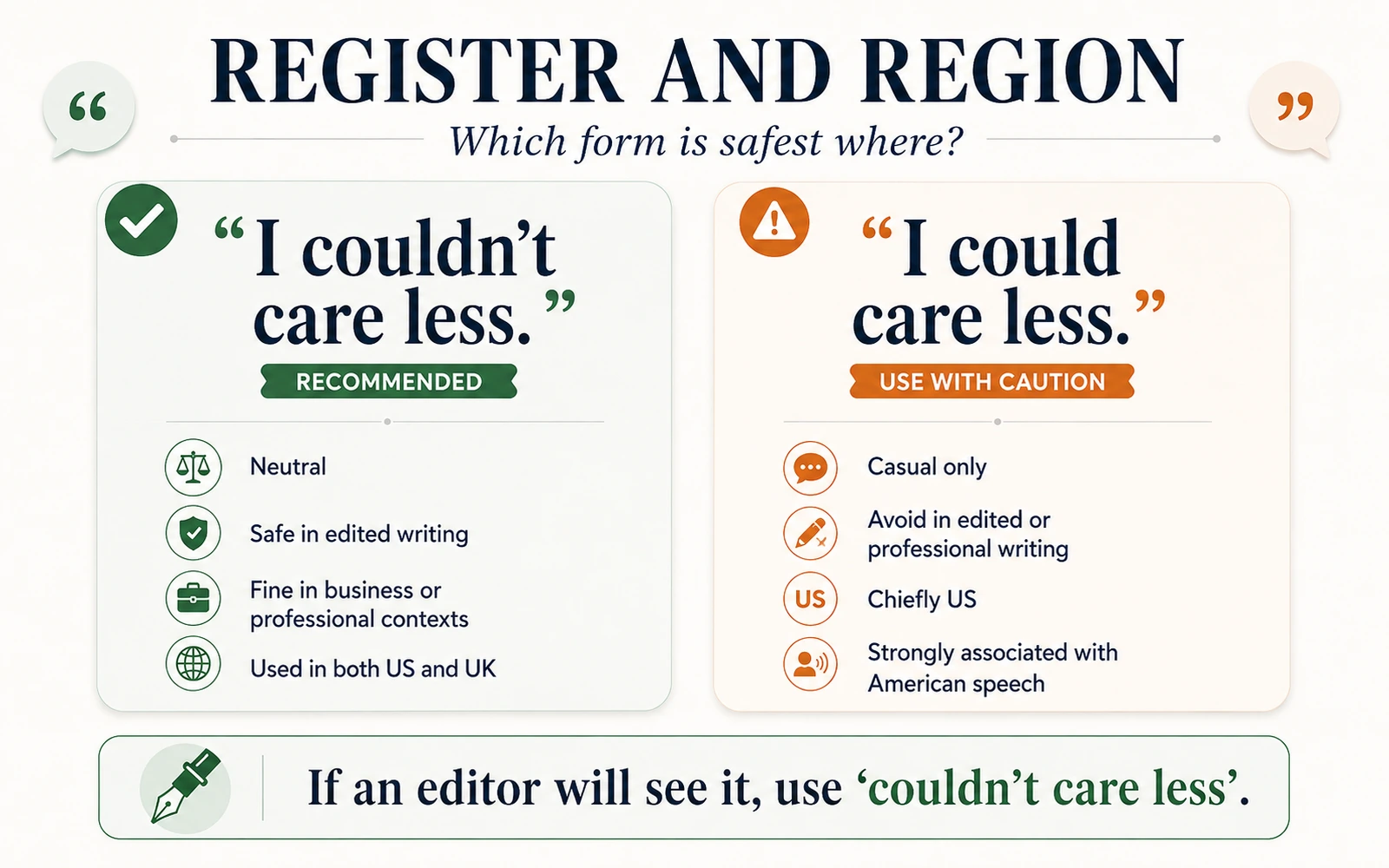
The practical consequence: if you are British, or writing for a British reader, "could care less" will read as an error rather than as a variant, whatever the dictionaries record. If you are American and speaking, nobody will notice either way. If you are writing something that goes past an editor, use the negative and spend your attention elsewhere.
Is "could care less" wrong?
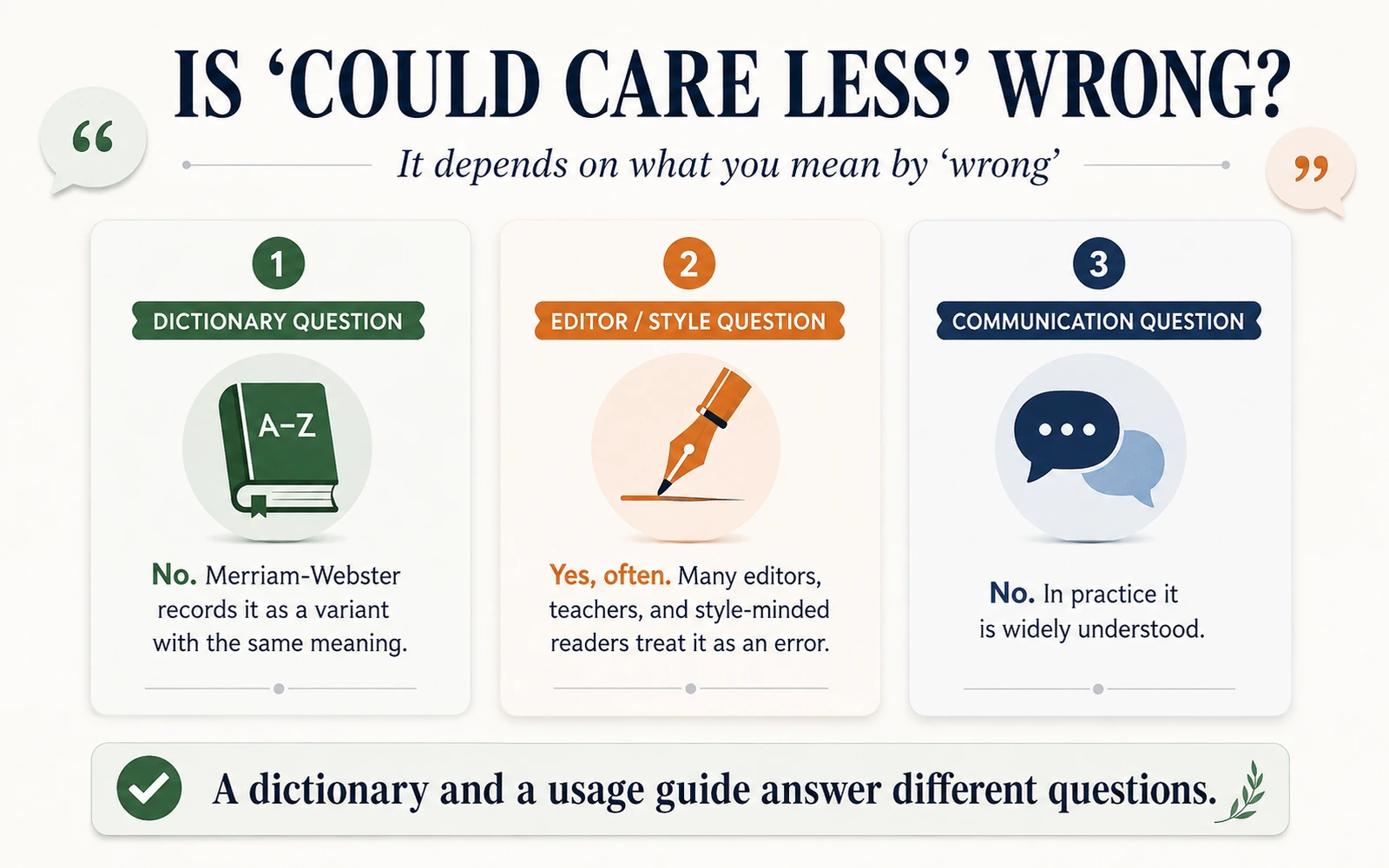
It depends entirely on what you mean by wrong, and this is worth separating out because the same confusion runs through most usage arguments.
If wrong means "not recorded by dictionaries", then no. Merriam-Webster enters it as a variant with the same meaning as the longer phrase. That is a description of what people write and say, and it is accurate.
If wrong means "will be marked as an error", then yes, routinely. Style guides, editors and a great many readers treat it as a mistake, and being able to cite a dictionary entry has never yet persuaded one of them.
If wrong means "fails to communicate", then no. In practice it communicates perfectly, which is precisely why it has survived seventy years of complaint.
A dictionary and a usage guide are answering different questions, and neither is lying to you. The only mistake is expecting one of them to do the other's job.
What is genuinely unknown
Two things, and they should be said rather than papered over.
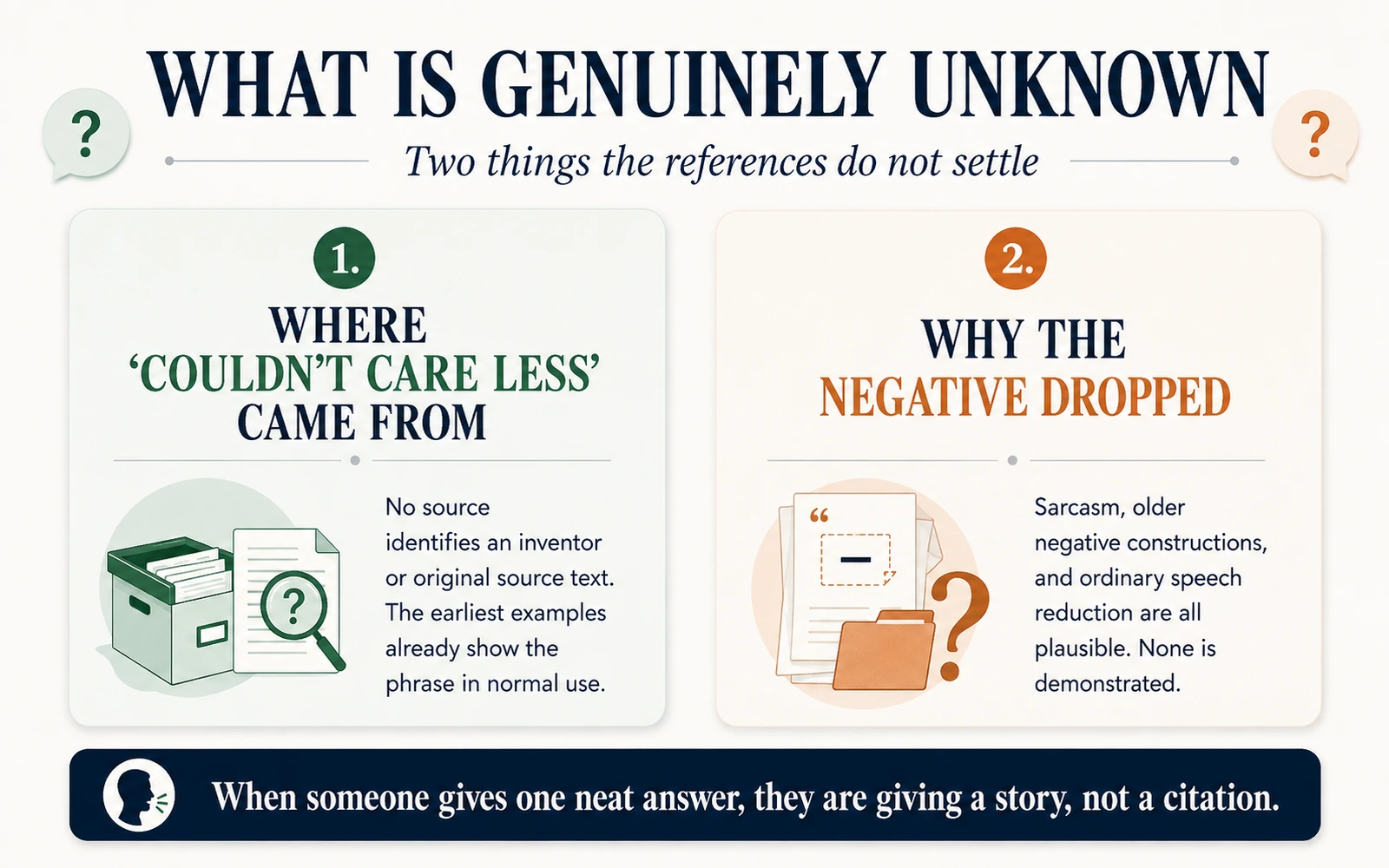
Where "couldn't care less" came from is not known. Merriam-Webster says so directly. The earliest examples anyone has found are already the phrase in ordinary use, with no sign of an inventor or a source text.
Why the negative dropped is not established. Sarcasm, the older negative constructions, and ordinary phonetic reduction are all plausible, none is demonstrated, and the evidence that would decide it, how people said the phrase out loud in the 1940s, was never recorded.
Anyone who gives you one confident answer to either of those questions is giving you a story rather than a citation.