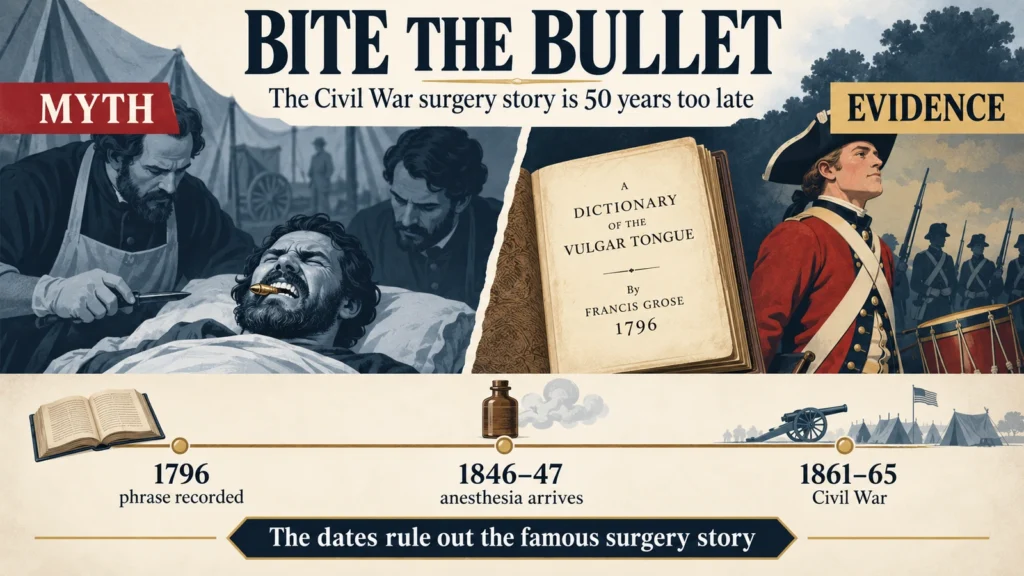
The story everyone has heard is that wounded soldiers were given a bullet to bite on during surgery before anesthesia existed, usually with the American Civil War named as the setting.
The dates rule it out, and they rule it out twice over. Phrase Finder records the phrase in print in 1796, decades before the war in the story. And effective surgical anesthesia, in the form of ether and chloroform, arrived in 1846 and 1847, which is to say before the Civil War rather than after it. The story places the phrase in the wrong century and puts it in a period when its own premise had already stopped being true.
This is the kind of case the tracing method behind these pages exists for, because the check needed to settle it is arithmetic rather than expertise.
The citation trail
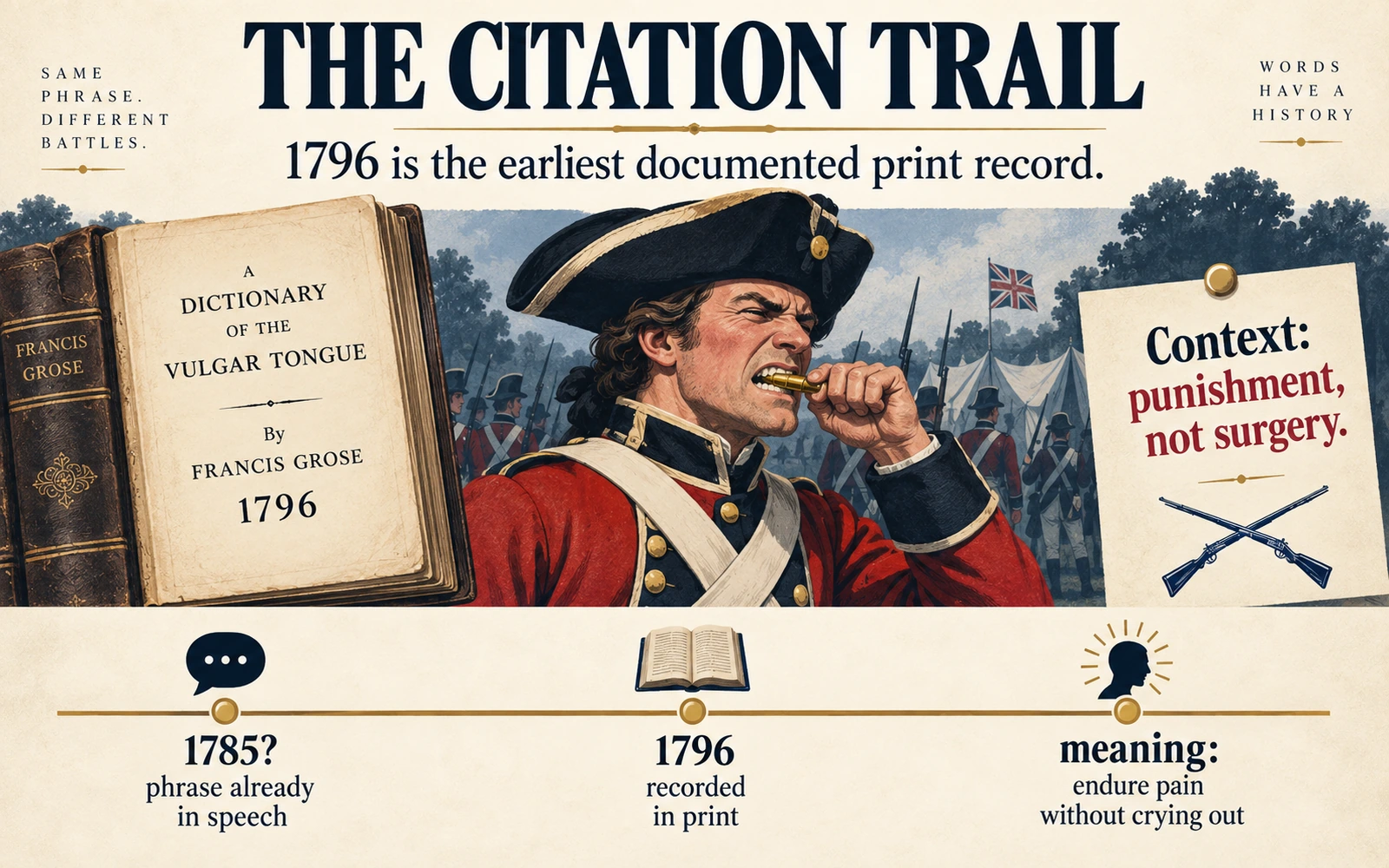
Phrase Finder gives the earliest documented appearance as Francis Grose's Classical Dictionary of the Vulgar Tongue, 1796, where the entry describes soldiers chewing a bullet to avoid crying out. Its context is not surgery. It is punishment: the flogging of soldiers, an entirely routine feature of eighteenth-century military discipline.
That single detail rearranges the phrase. The person biting is not unconscious with pain and being helped through it. The person biting is being punished and is trying not to give the satisfaction of a sound. The figurative sense we use today, which is about enduring something unpleasant with your dignity intact rather than about surviving an operation, follows far more naturally from the flogging scene than from the surgical one.
Kipling and the figurative use
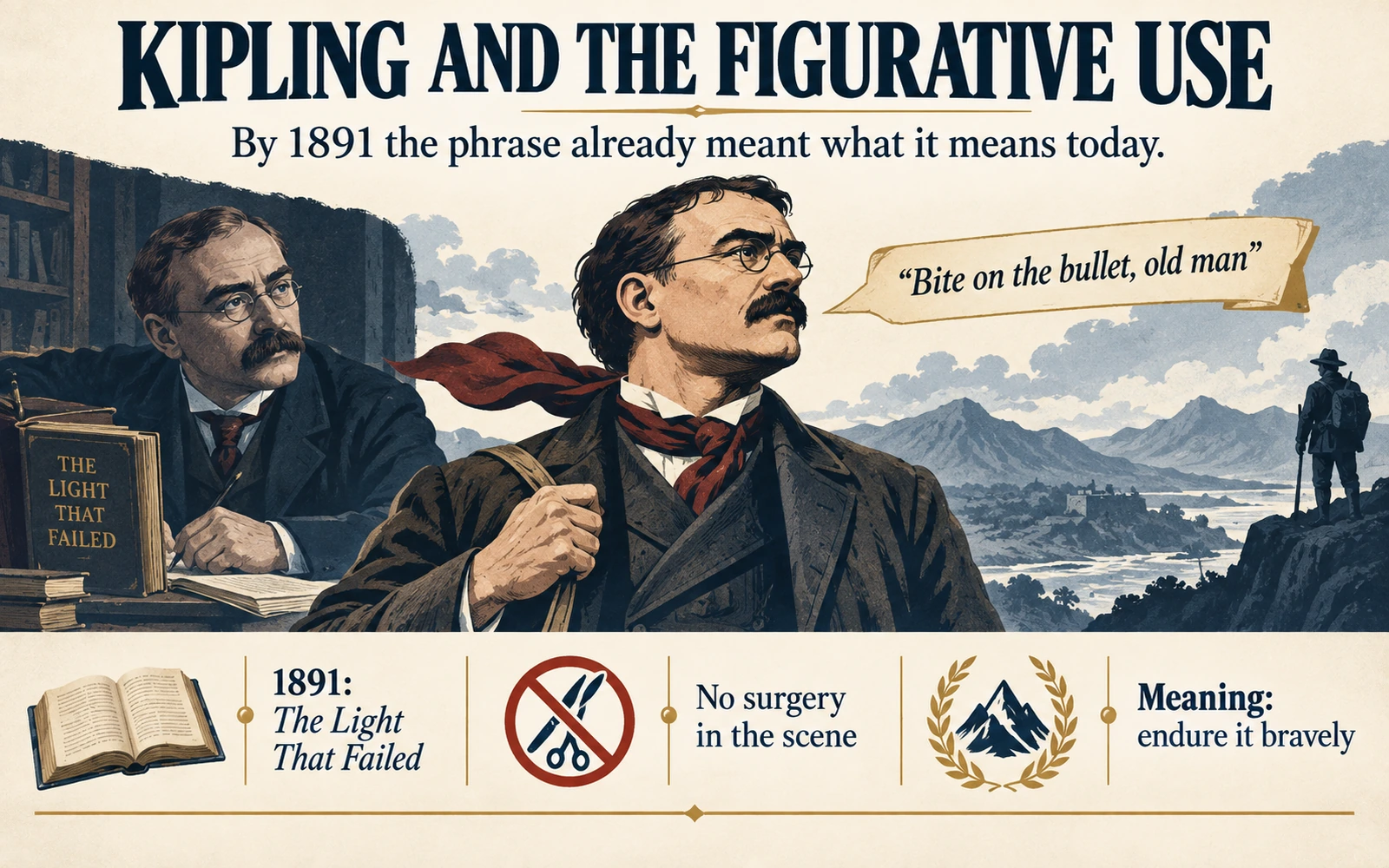
Phrase Finder gives the phrase in clearly figurative form in Rudyard Kipling's The Light That Failed, 1891, in the line "Bite on the bullet, old man, and don't let them think you're afraid."
We quote that as Phrase Finder quotes it and have not opened the novel to confirm it. Read as reported, it does something useful for the dating: the phrase in 1891 already means what it means now, and it means it in a context with no surgery anywhere near it. The sense in that line is precisely the one the flogging citation predicts, which is endurance in front of an audience.
Why the surgery story is so durable
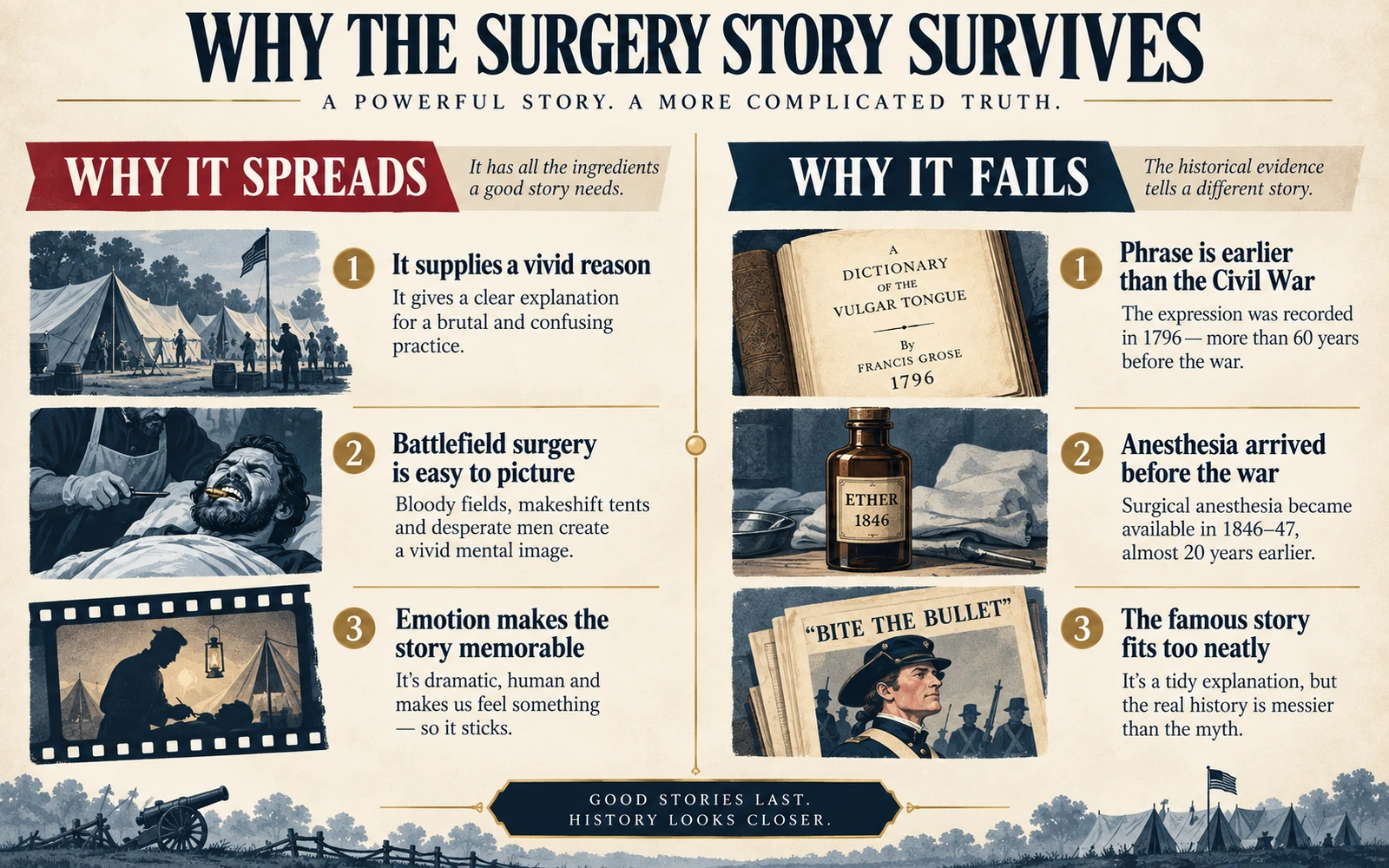
Two features keep it alive, and both are familiar from the other myths on this site.
It supplies a reason. Biting on something hard during agony is a real behavior, so the story sounds like an explanation rather than a guess. The false legal story behind "rule of thumb" works the same way: it names a rule and a court, and a story with specifics in it feels checked even when nobody has checked it.
It is emotionally satisfying. Battlefield surgery is a scene people already carry, largely from film, and a phrase that connects to it acquires borrowed weight.
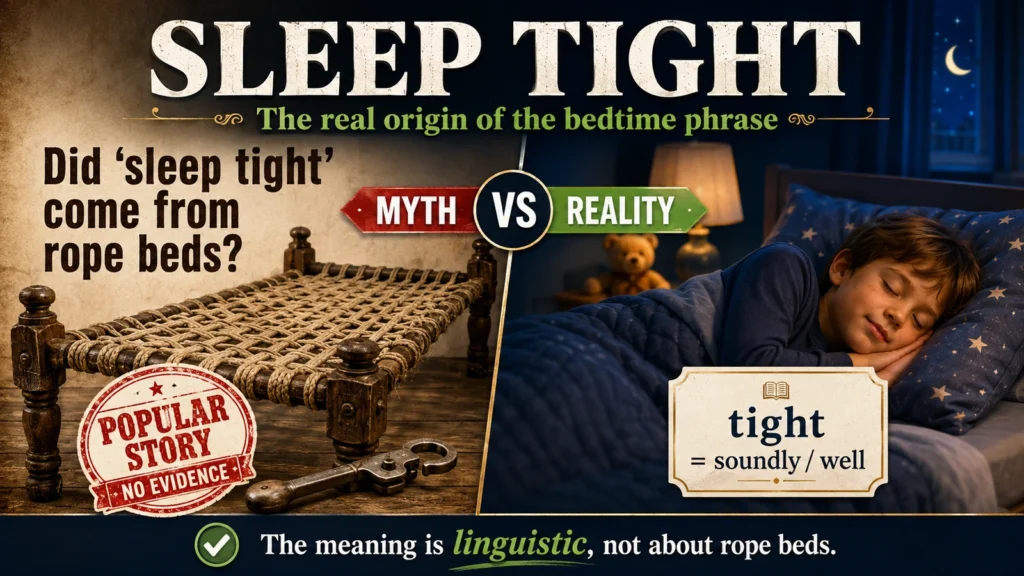
Notice that neither of those is evidence. A story that explains a phrase and a story that is the origin of a phrase are different things, and the gap between them is where nearly all folk etymology lives. That gap is what the rope-bed story attached to "sleep tight" falls into as well.
What is documented and what is inferred
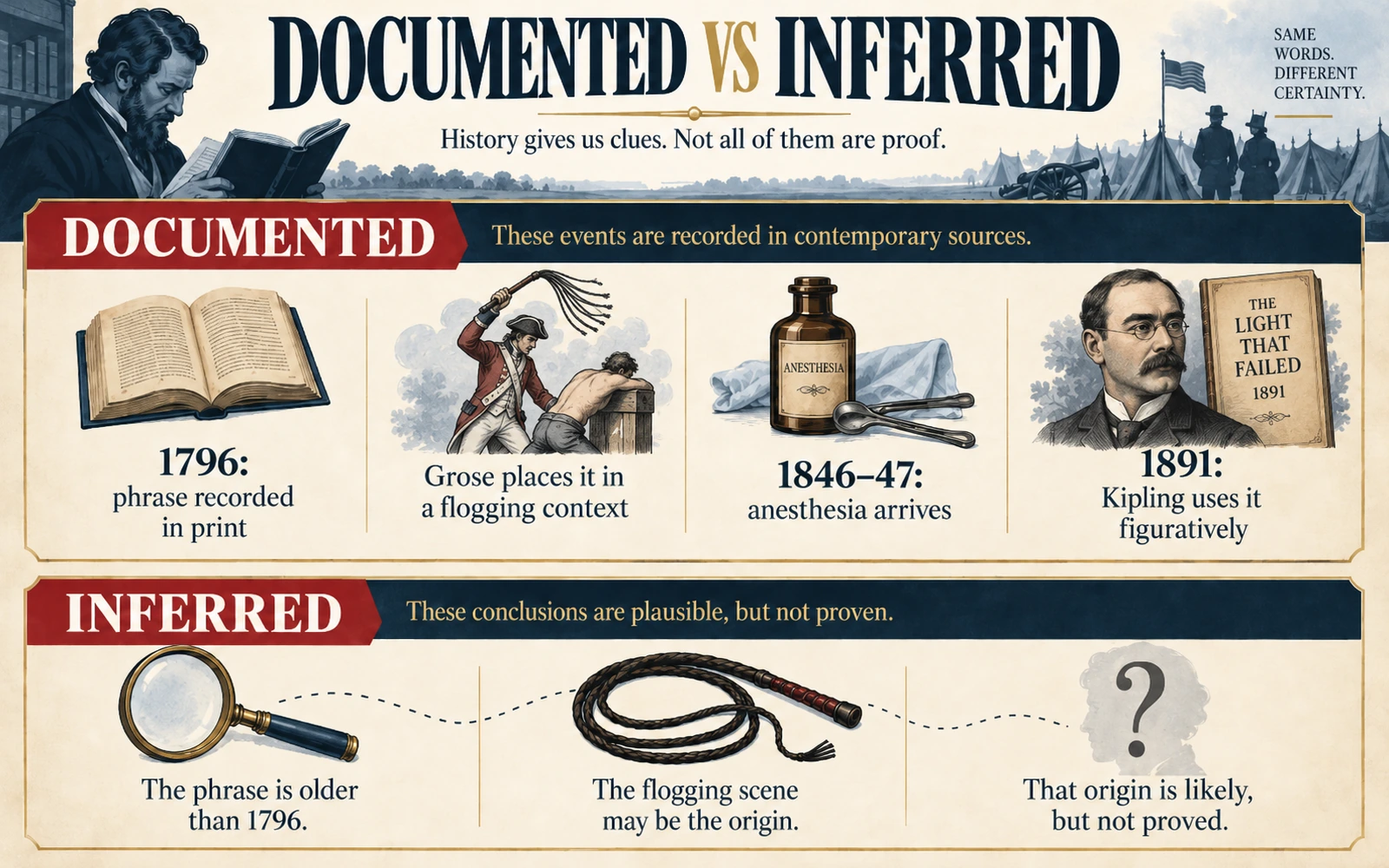
Documented: the phrase existed in print by 1796, and the context in that source is flogging. Documented: anesthesia arrived in 1846 and 1847. Documented: Kipling uses the phrase figuratively in 1891, as Phrase Finder reports.
Inferred: that the flogging context is the origin of the phrase rather than one early use of it. Grose was recording slang already in circulation, so the phrase predates his entry by an unknown margin, and where it started within that margin is not visible from here.
Saying which parts are which is not a formality. A reader who takes "1796 Grose, flogging" as the origin will pass it on as the origin, and the next page will drop the qualification, and in twenty years the flogging story will be as unquestioned as the surgery story is now.
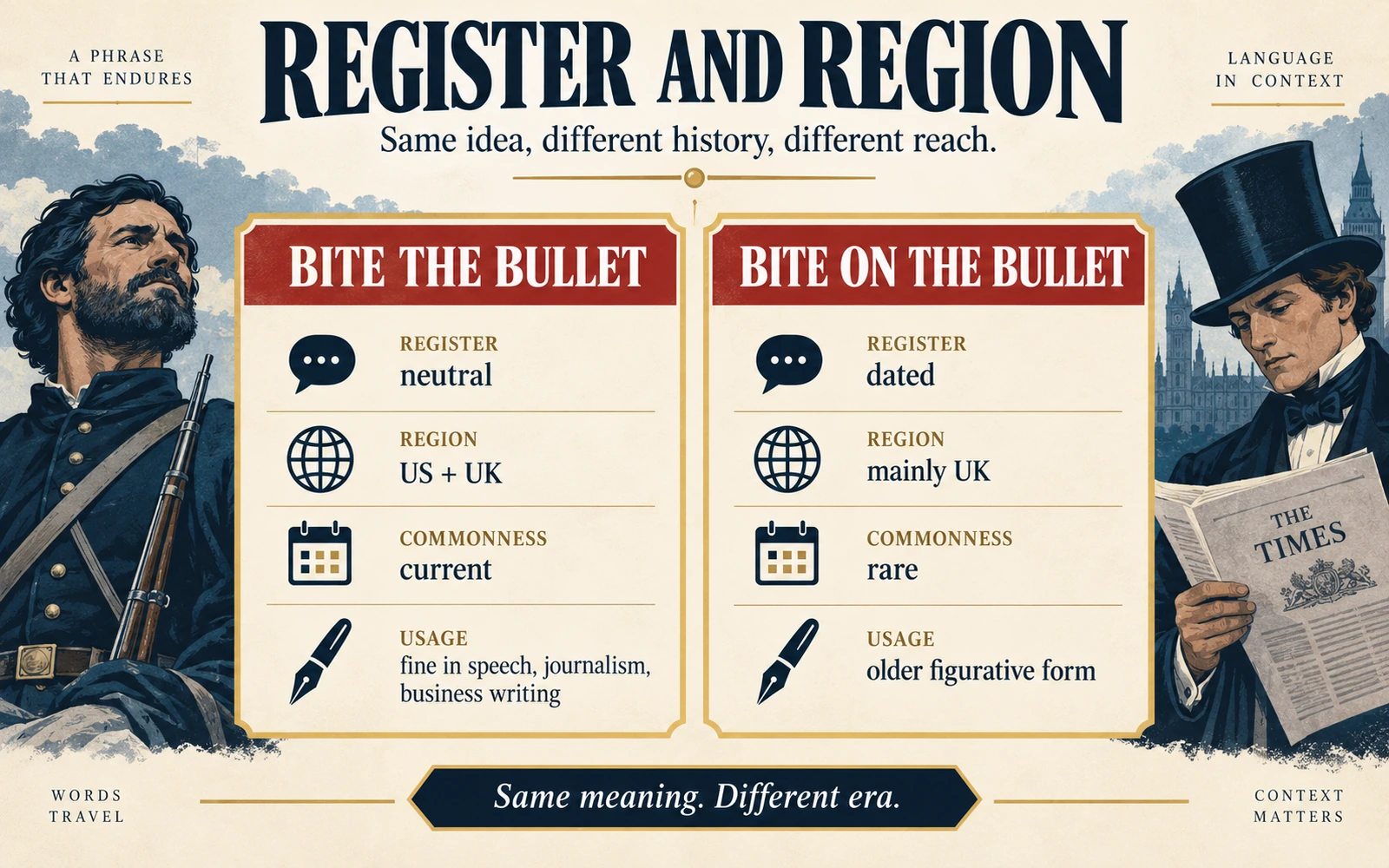
Register and region
| Register | Region | Status | |
|---|---|---|---|
| bite the bullet | neutral. Fine in speech, journalism and business writing | both US and UK | current and very common |
| bite on the bullet | dated, and the form in the Kipling line | mainly UK | rare |
What is genuinely unresolved
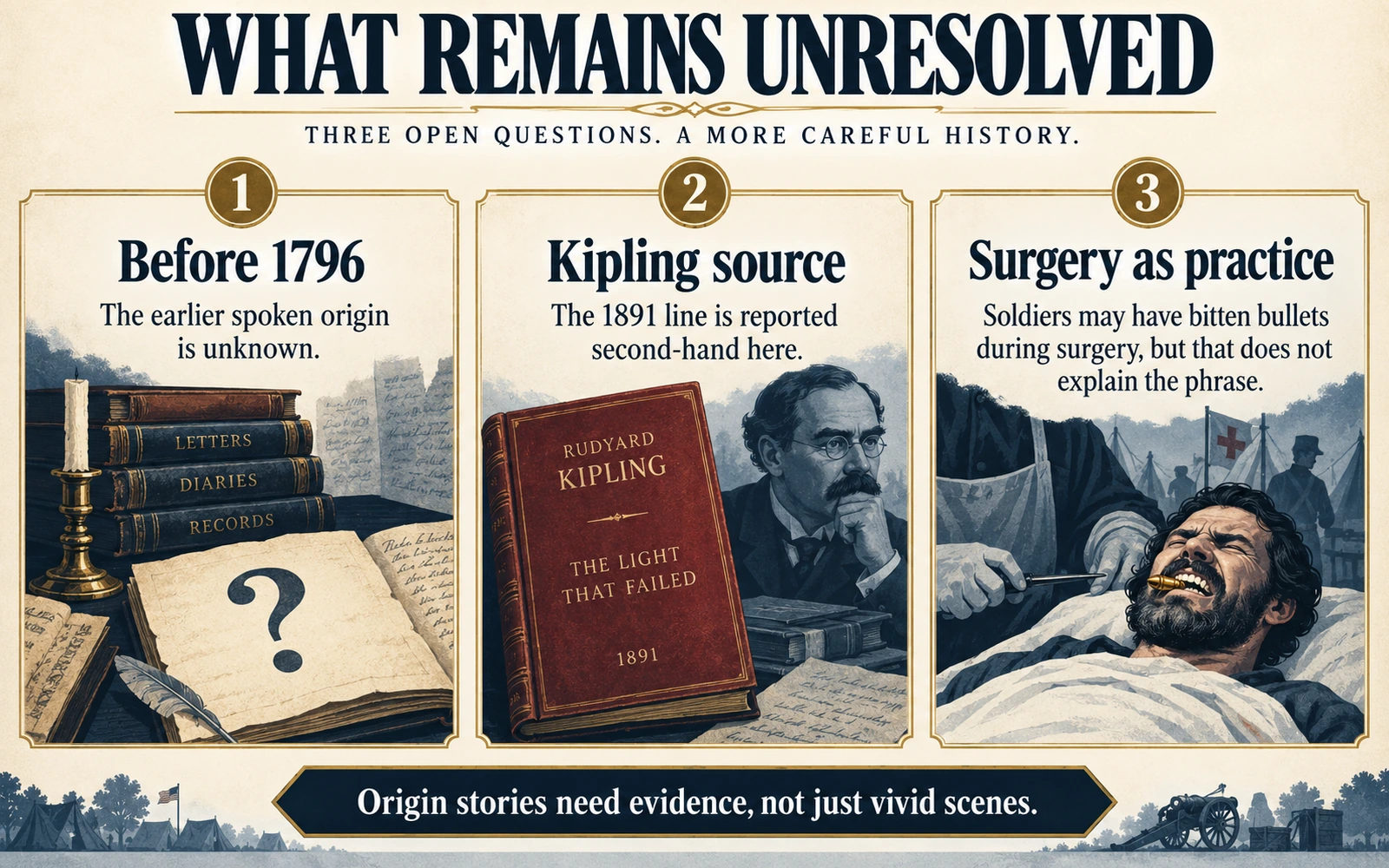
The phrase's origin before 1796 is unknown. Grose recorded existing slang, so the earliest citation is a floor, not a birth date.
The Kipling line is not confirmed at first hand. It is carried here on Phrase Finder's authority.
Whether soldiers were ever actually given bullets to bite during surgery is a separate question this page does not answer. It may well have happened. It would still not be where the phrase comes from, and conflating the two is exactly how the story survives.