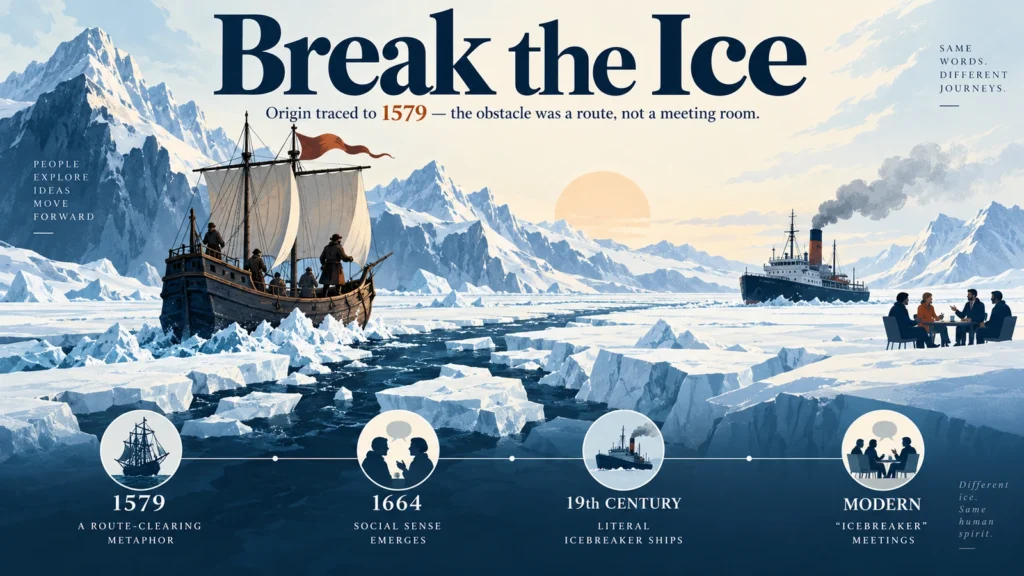
Most people meet this phrase first as a social one, in the form of icebreaker questions at the start of a meeting, and assume it comes from the ships that smash through polar ice. The order is the other way round, and by a long way.
Phrase Finder gives the earliest citation as Sir Thomas North in 1579, in his translation of Plutarch's Lives: "To be the first to break the Ice of the Enterprize." The icebreaking ship is a nineteenth-century thing. The phrase was three hundred years old before those vessels existed, which is a useful demonstration of why the method these origin pages follow starts with dates rather than with explanations.
The citation trail
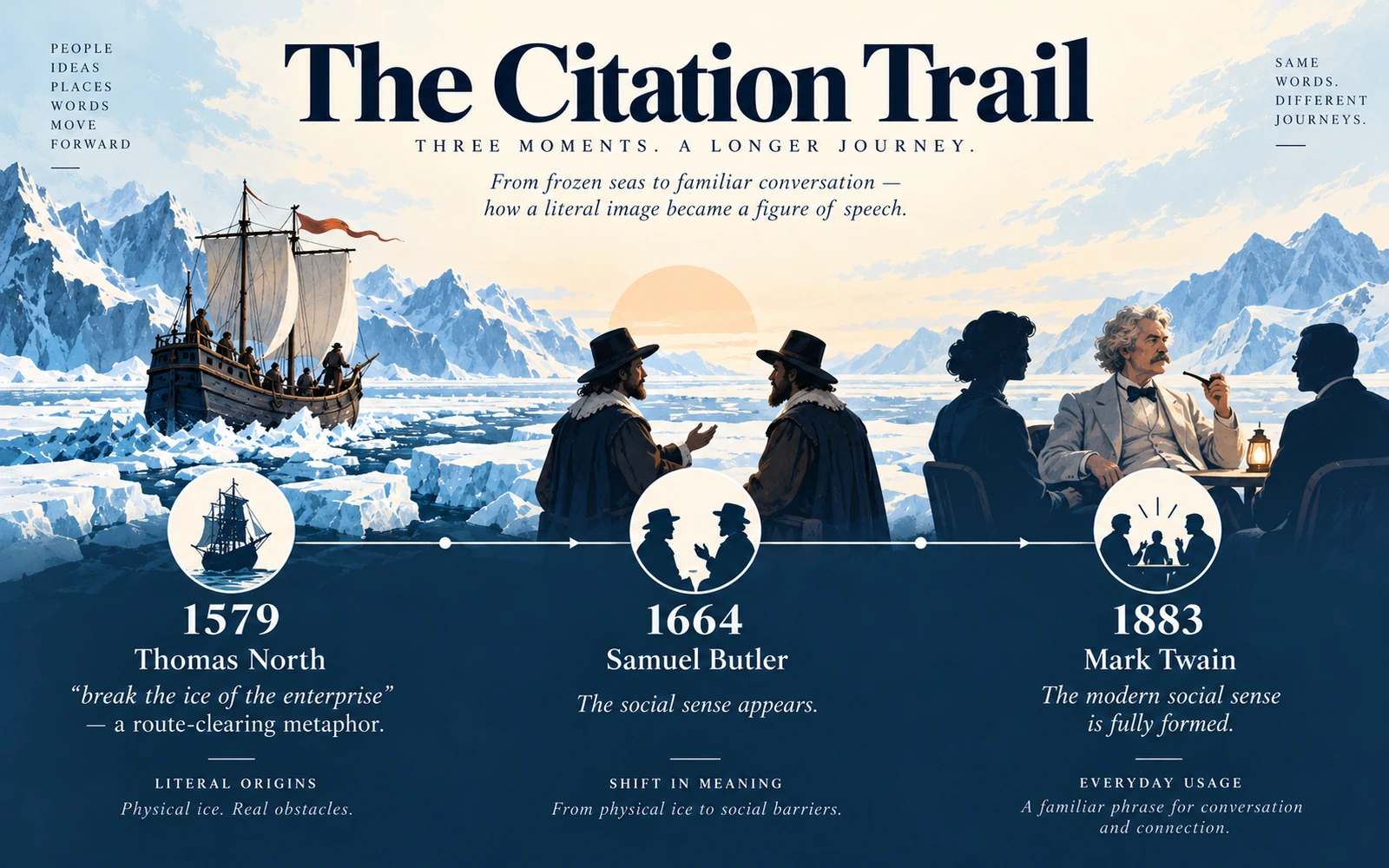
Phrase Finder gives three dated points, and together they show the sense moving.
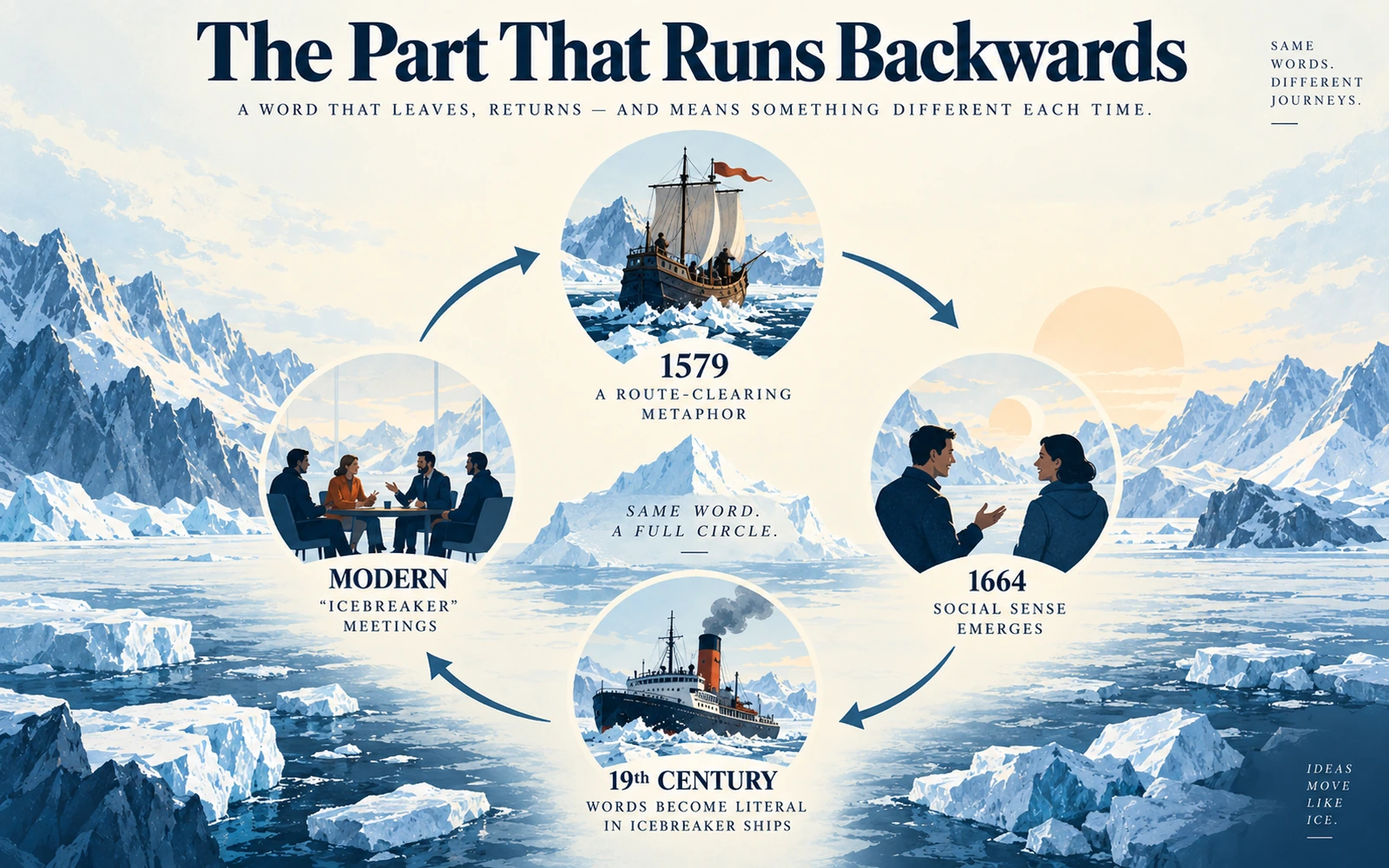
1579, Thomas North, translating Plutarch's Lives. "To be the first to break the Ice of the Enterprize." The image here is already figurative, and it is not social. Breaking the ice means going first into a difficult undertaking, in the sense of a ship or a party clearing a frozen route so that others can follow. What is being broken is an obstacle to travel.
1664, Samuel Butler, Hudibras. "The Oratour, At last broke silence, and the Ice." This is the social sense arriving, and the pairing of silence with ice in one clause is the hinge. The obstacle being cleared is no longer a frozen river. It is the awkwardness in the room.
1883, Mark Twain, Life on the Mississippi. Phrase Finder reports Twain using it for social acquaintance-making, which is the modern sense fully formed.
We quote all three lines as Phrase Finder gives them. We did not open North, Butler or Twain directly.
The part that runs backwards
There is a detail in Phrase Finder's account that is easy to skim past and is the most interesting thing on this page.
The phrase went figurative first, in 1579. The social sense grew out of that. Then, in the nineteenth century, the words went back to being literal, applied to actual reinforced ships built to break actual ice for polar exploration. And those ships gave English the noun "icebreaker", which then returned to the social sense as the name for a warm-up exercise at a meeting.
So the modern conference-room icebreaker is a word that took a route out of metaphor, into engineering, and back into metaphor again. That is unusual. Most idioms travel one way, from a concrete scene to a figurative sense, and stay there. This one made a round trip.
It also explains the confusion this page opened with. The ship really is part of the story. It is just downstream of the phrase rather than upstream of it, and readers who have the pieces in the wrong order are not wrong about the pieces.
What about Erasmus?
The question is worth raising because it circulates, and because our topical map asked it directly.
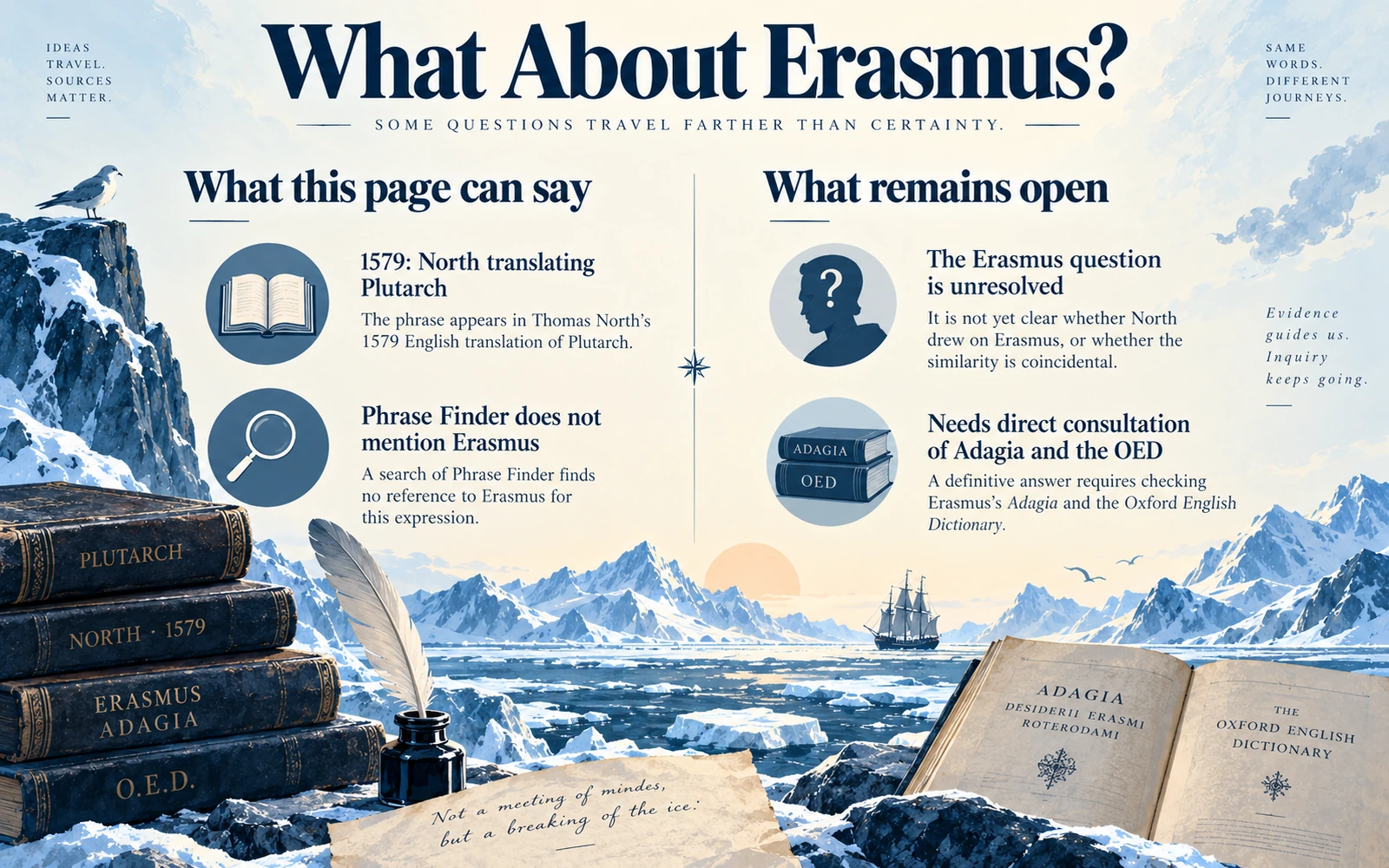
Phrase Finder does not mention Erasmus at all. We are not going to fill that silence with an inference. What can be said is that the 1579 citation is North translating Plutarch, and a Greek biographer rendered into English by an Elizabethan translator is a completely different chain from anything involving Erasmus. The Plutarch connection is not evidence for the Erasmus story, and it is not evidence against it either. It is simply a different source.
Anyone who wants to settle it should go to the Adagia and to the OED rather than to a page that has not read either, and this page has not.
Why this one produced no myth
Almost every phrase in this cluster has a false origin story attached to it. This one does not really have one, and it is worth asking why, because the answer is a useful diagnostic.
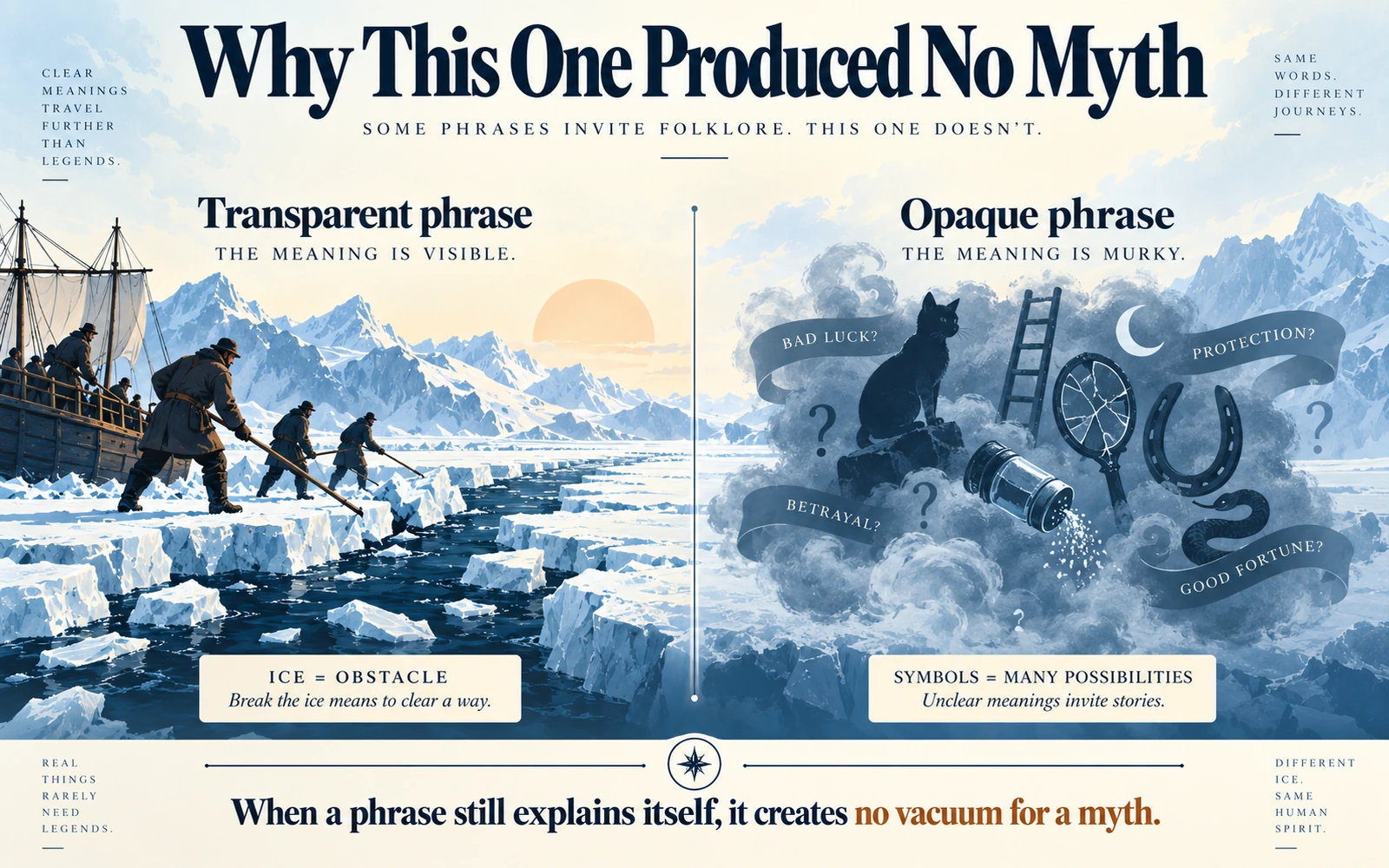
The phrase never stopped explaining itself. Ice is an obstacle, breaking it clears a path, and every generation of English speakers has been able to see that without help. Compare the phrases that attract folklore: they are the ones containing a word that changed meaning or a scene nobody encounters any more, like the pail-that-was-a-beam or the wholly opaque animals in "raining cats and dogs". An opaque phrase creates a vacuum, and a story fills it. A transparent phrase creates no vacuum.
That is the practical version of the point, and it is the same point running underneath the misused-phrases cluster on this site: the phrases people get wrong and the phrases people invent stories about are largely the same phrases, and for the same reason.
Register and region
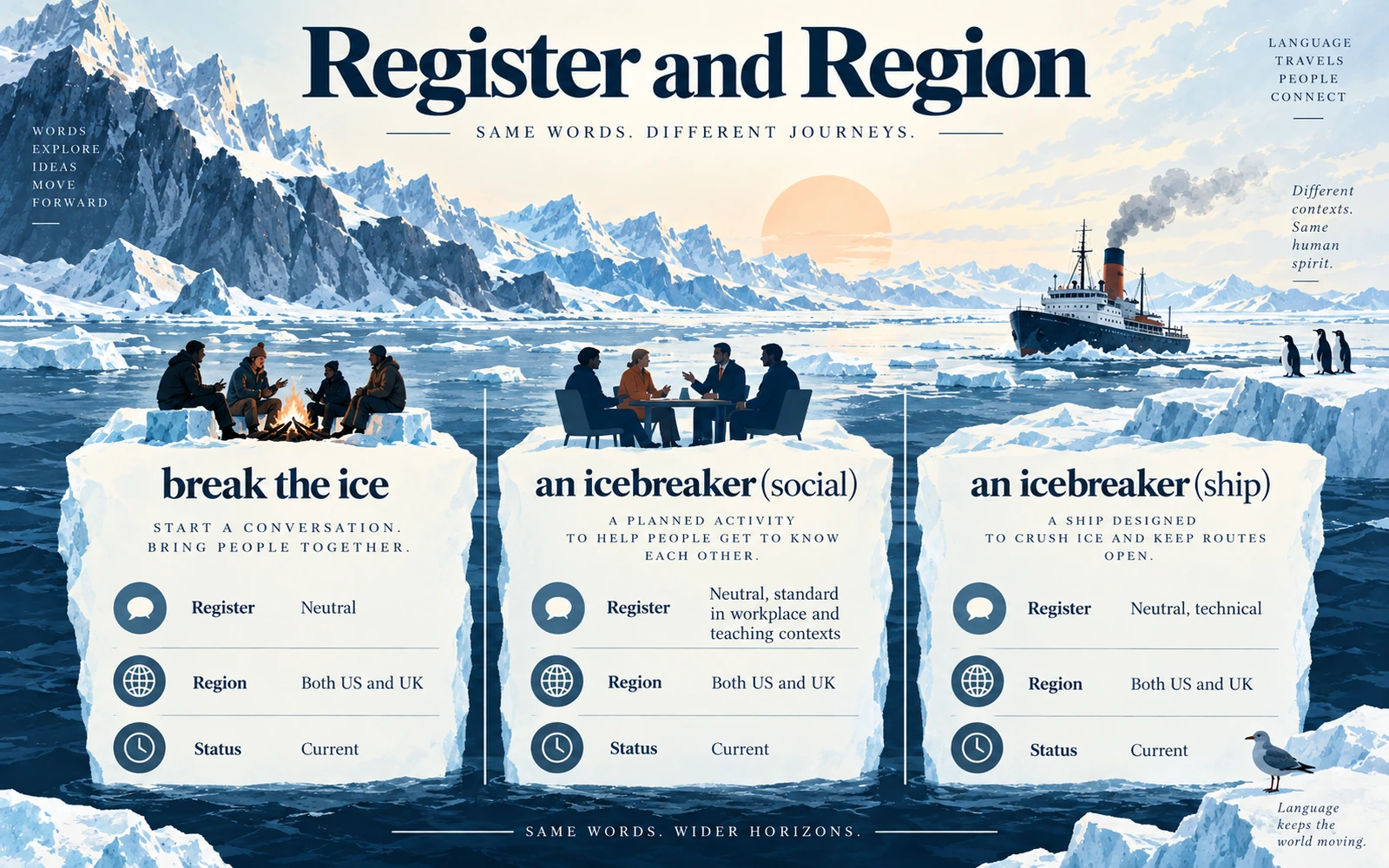
| Register | Region | Status | |
|---|---|---|---|
| break the ice | neutral. Fine everywhere, including formal writing | both US and UK | current |
| an icebreaker (social) | neutral, and standard in workplace and teaching contexts | both US and UK | current |
| an icebreaker (ship) | neutral, technical | both US and UK | current |
What is genuinely unresolved
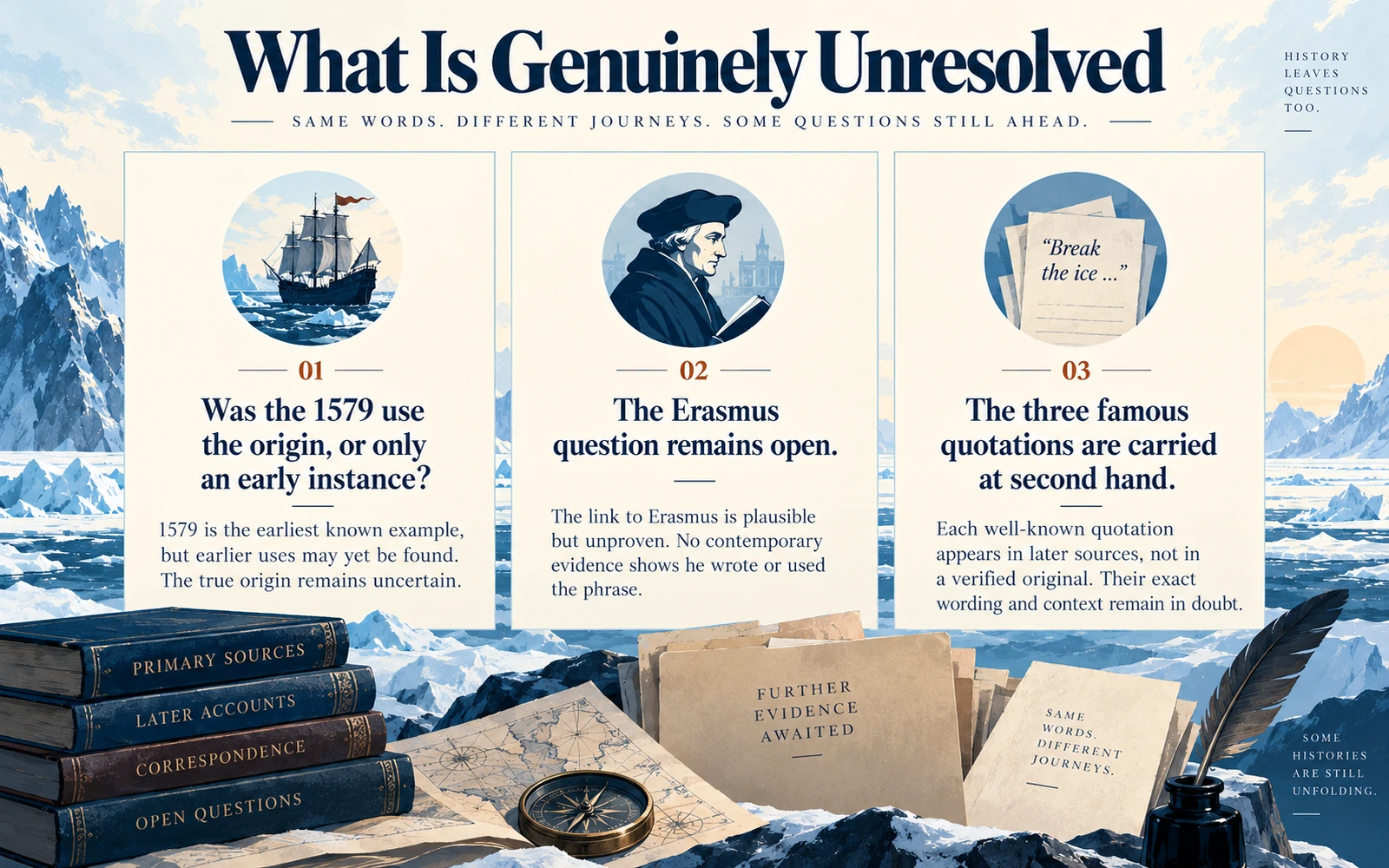
Whether the 1579 use is the origin or an early instance is not established. North was translating, and translators reach for phrases that already exist as often as they coin new ones.
The Erasmus question is open. Phrase Finder does not address it, and we did not consult a source that would.
The three quotations are carried at second hand. None of the three texts was opened for this page.