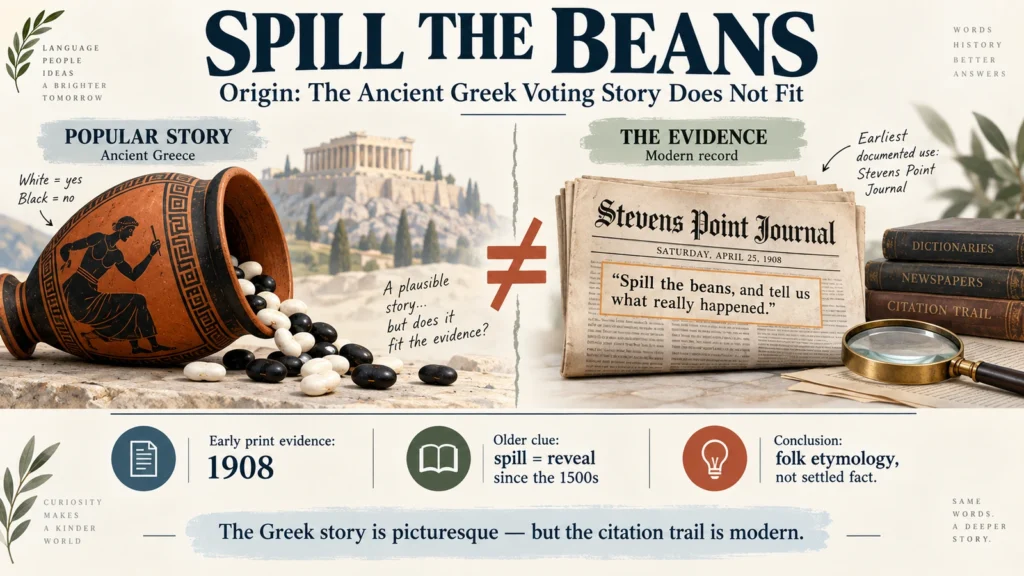
The story attached to this phrase is that ancient Greek voters dropped beans into a jar, white for yes and black for no, and that knocking the jar over spilled the beans and revealed the secret result before it was announced.
Phrase Finder rejects it on a single ground, and the ground is decisive: the phrase is first found in the early twentieth century. A gap of more than two thousand years between a practice and the first appearance of a phrase supposedly describing it is not a difficulty to be explained away. It is a refutation, and it is the cheapest and most reliable test in the whole business of tracing where a phrase actually comes from.
The citation trail
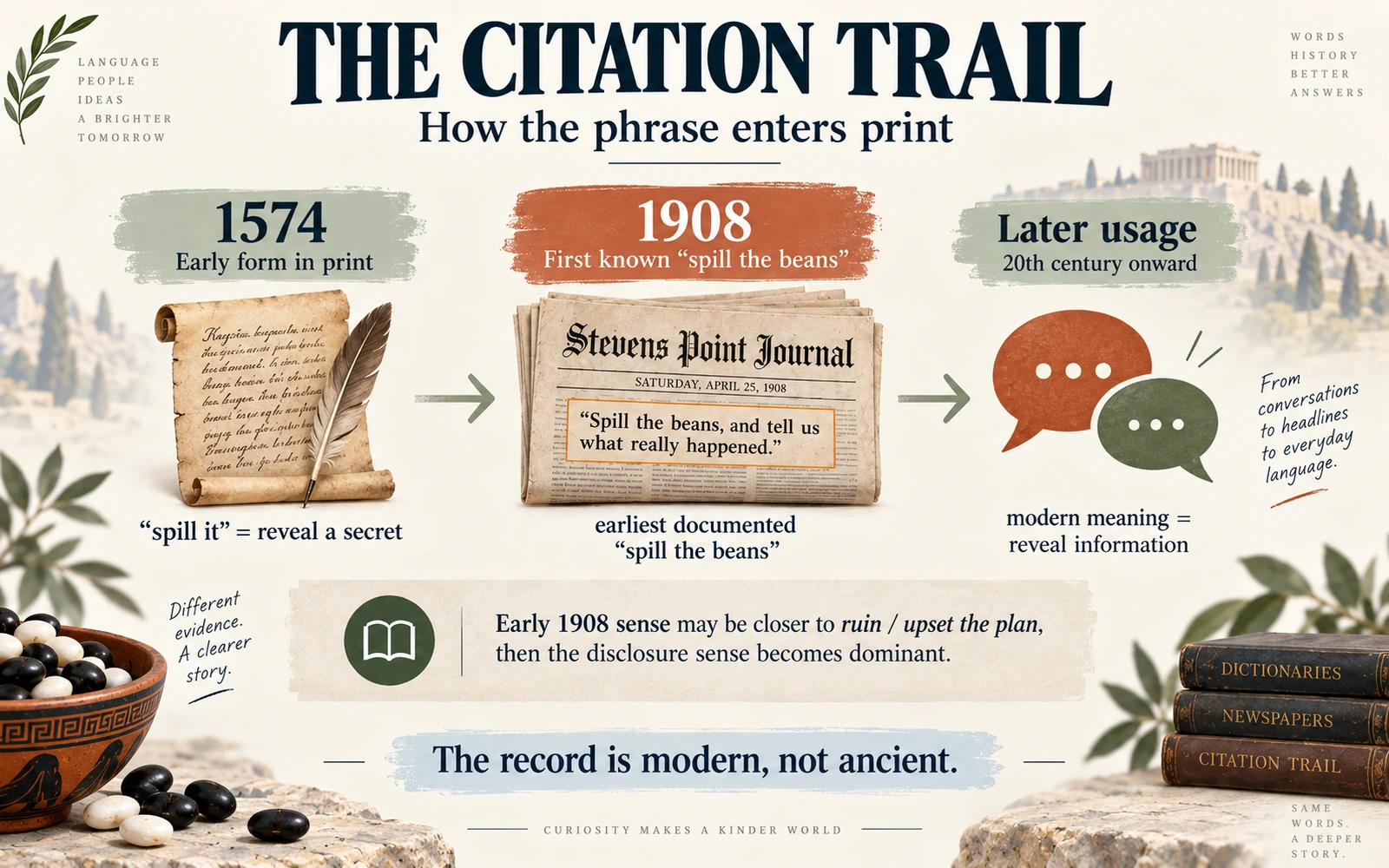
Phrase Finder gives the earliest documented use as June 1908, in the Stevens Point Journal, a newspaper in the United States.
The 1908 sense is worth noting because it is not quite the modern one. Phrase Finder reports the early meaning as closer to "spoil the beans" or "upset the applecart", that is, to ruin something rather than to reveal something. The disclosure sense we use today developed from there.
That is a normal life cycle for an idiom and it is easy to miss. A phrase's earliest citation often shows it meaning something adjacent to what it means now, and a reader who assumes the modern sense was there from the start will misread the citation when they find it.
What "spill" was already doing
The second half of Phrase Finder's account is the part that makes the phrase make sense without any beans at all.
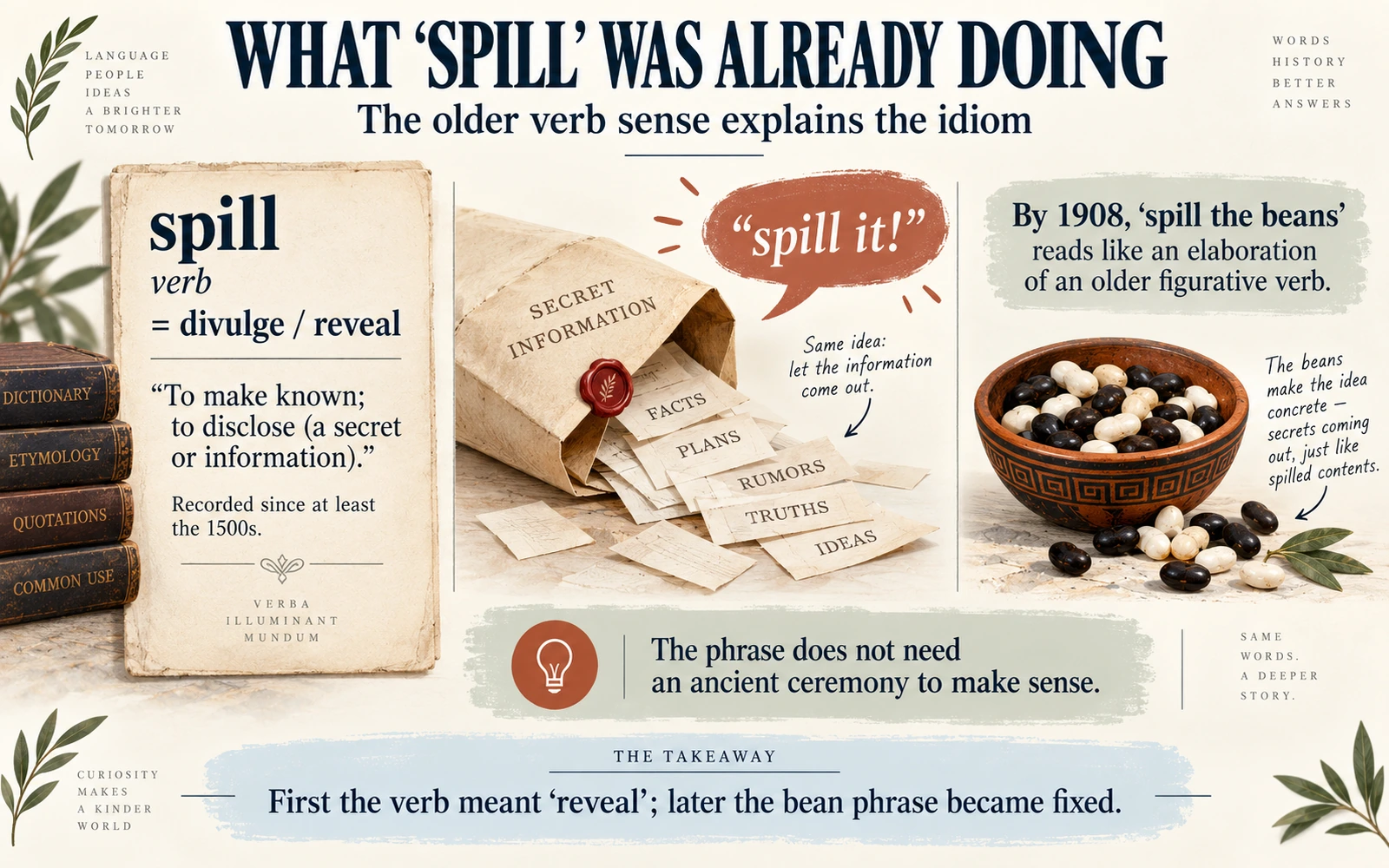
The verb "spill" had carried the meaning of divulging or revealing since at least the sixteenth century. Phrase Finder points to a 1574 use of "spill it" in the sense of revealing a secret. So by 1908 there was already a well-established English idiom of spilling information, and "spill the beans" reads as a concrete elaboration of it rather than as a phrase that needed an origin story to explain how spilling came to mean telling.
This is the ordinary way idioms form. An existing figurative verb picks up a concrete object and the pair becomes fixed. No ceremony, no ancient practice, no jar.
Why the Greek story spreads anyway
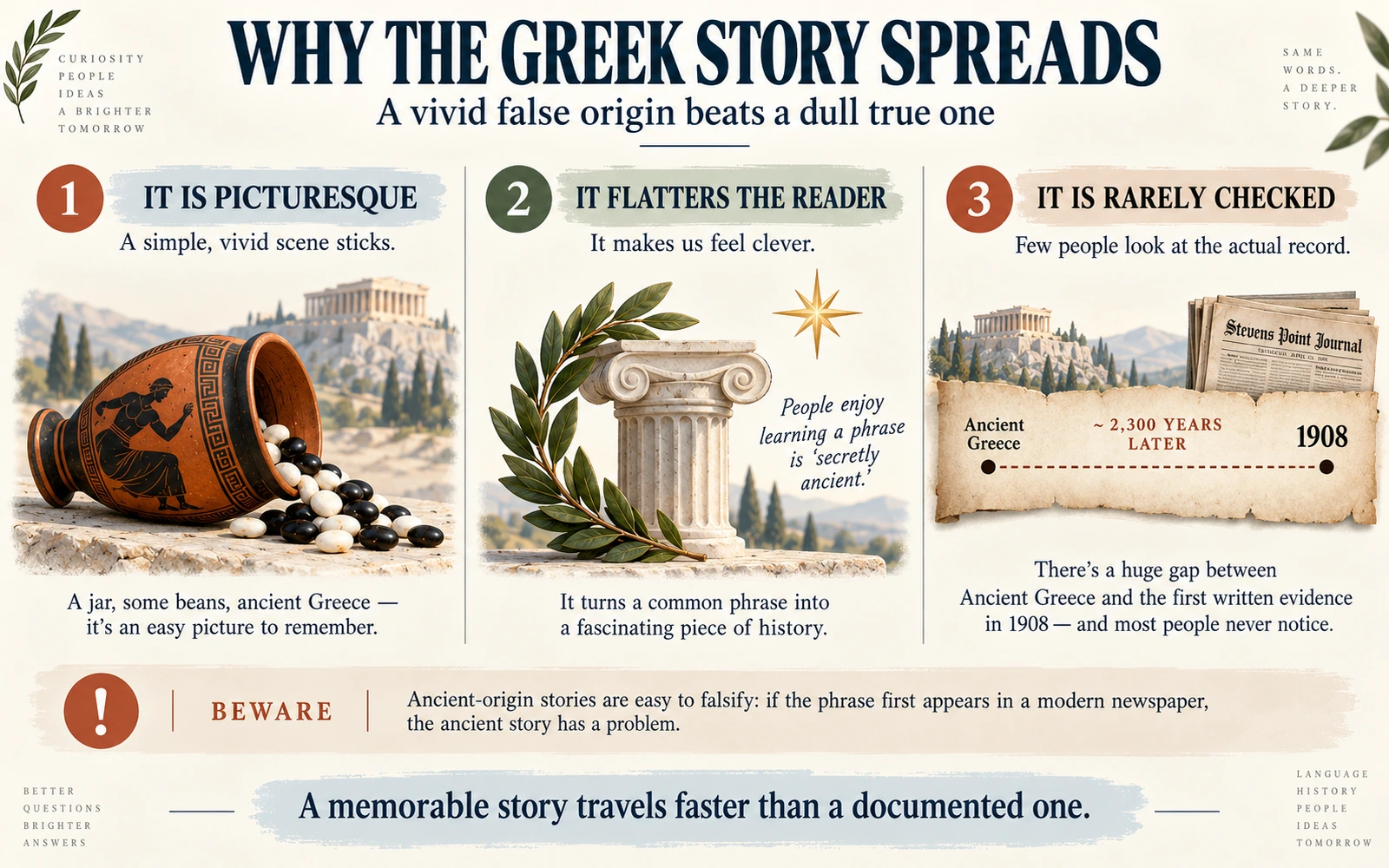
The bean-voting story has the two properties that keep a folk etymology alive.
It is picturesque. You can see the jar tip over. A phrase that comes from an existing sense of a verb gives you nothing to see.
It flatters the reader. Learning that a common phrase is secretly two and a half thousand years old is a small pleasure, and it is the same pleasure that keeps the false legal story behind "rule of thumb" in circulation. A dull true answer competes badly against an interesting false one, which is why the interesting ones need checking first rather than last.
There is a further point worth making about this particular family of stories. Ancient-origin claims are unusually easy to falsify and unusually rarely checked. If a phrase's earliest citation is from a modern newspaper, no amount of classical detail can bridge the gap, and you do not need to know anything about Greek voting procedure to see it.
The check any reader can run
The test that kills the Greek story here is one you can apply to almost any origin claim you meet, and it needs no specialist knowledge.
- Find the earliest date anyone gives for the phrase in print. A reference that will not give you one is telling you something.
- Compare it with the date of the practice in the story. A large gap has to be explained, and "it was spoken for centuries before anyone wrote it down" is a claim that needs evidence of its own.
- Ask whether the phrase needs the story at all. If an ordinary sense of one of its words already explains it, as "spill" does here, the elaborate account is doing no work.
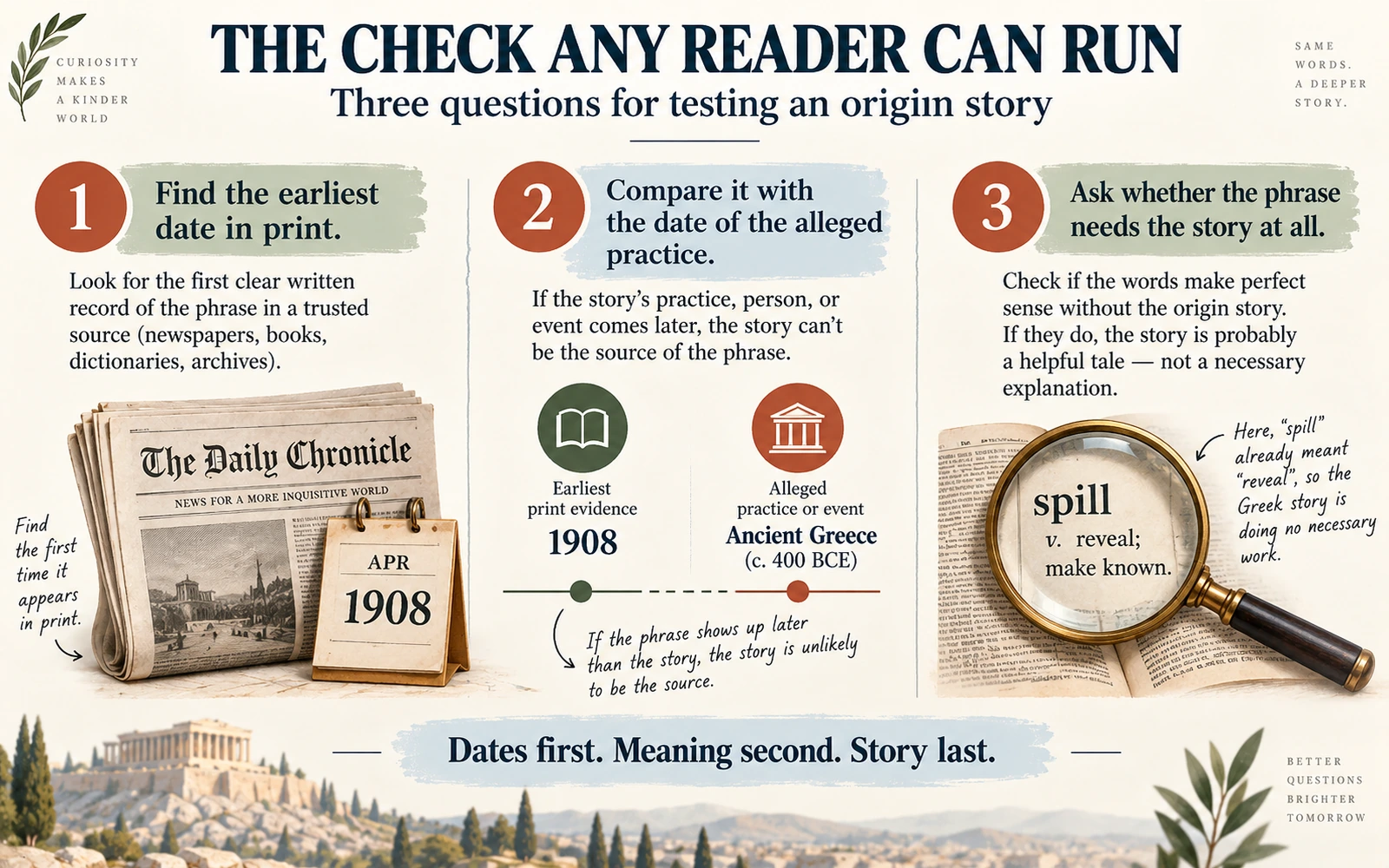
That third question is the one most often skipped, and it is the one that resolves the largest number of cases. It is also what separates a genuinely open question, like the whole nine yards, from a question that only looks open because a good story is standing next to it.
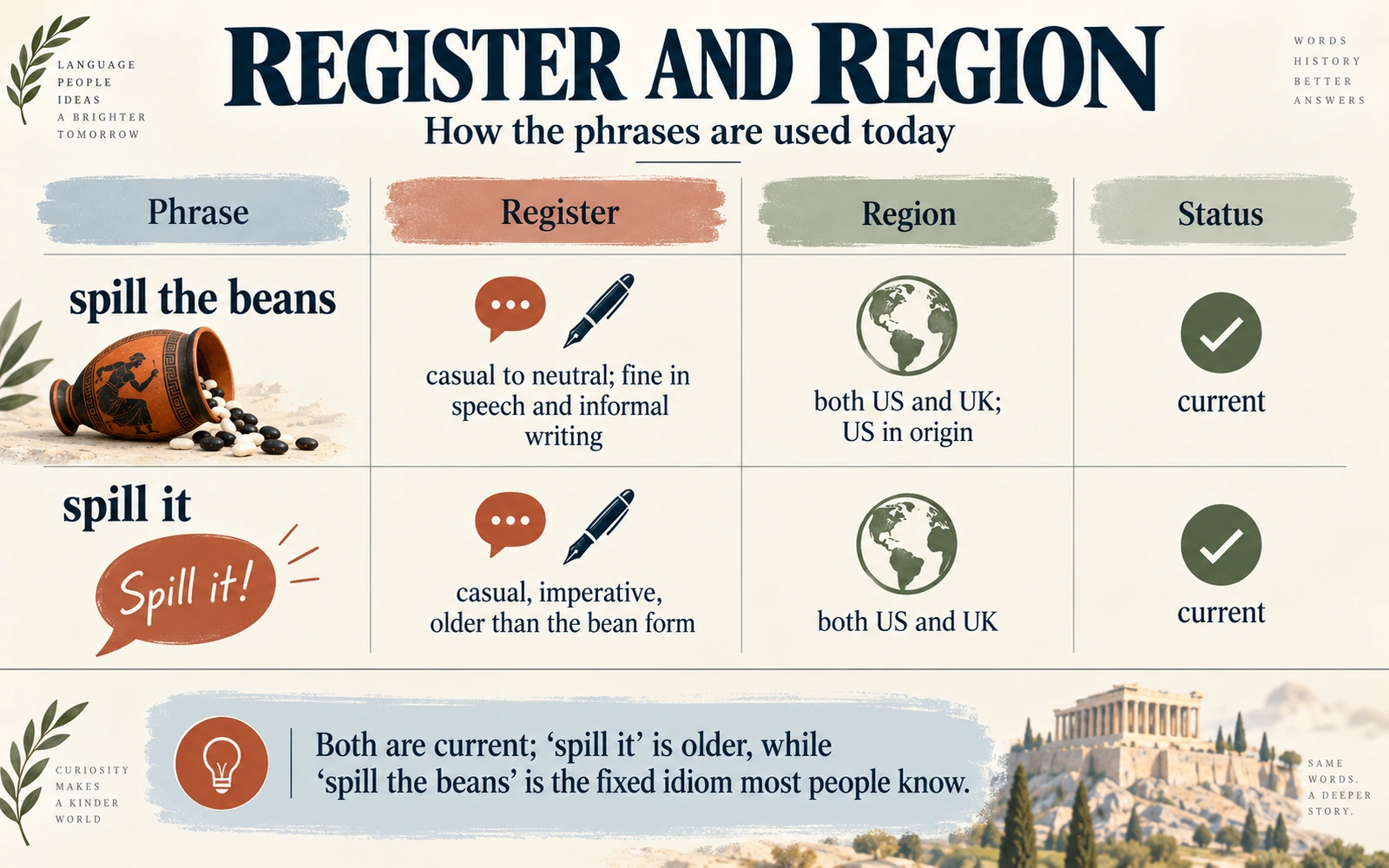
Register and region
| Register | Region | Status | |
|---|---|---|---|
| spill the beans | casual to neutral. Fine in speech and in informal writing, slightly light for formal prose | both US and UK, US in origin | current |
| spill it | casual, imperative, and older than the bean form | both US and UK | current |
What is genuinely unresolved
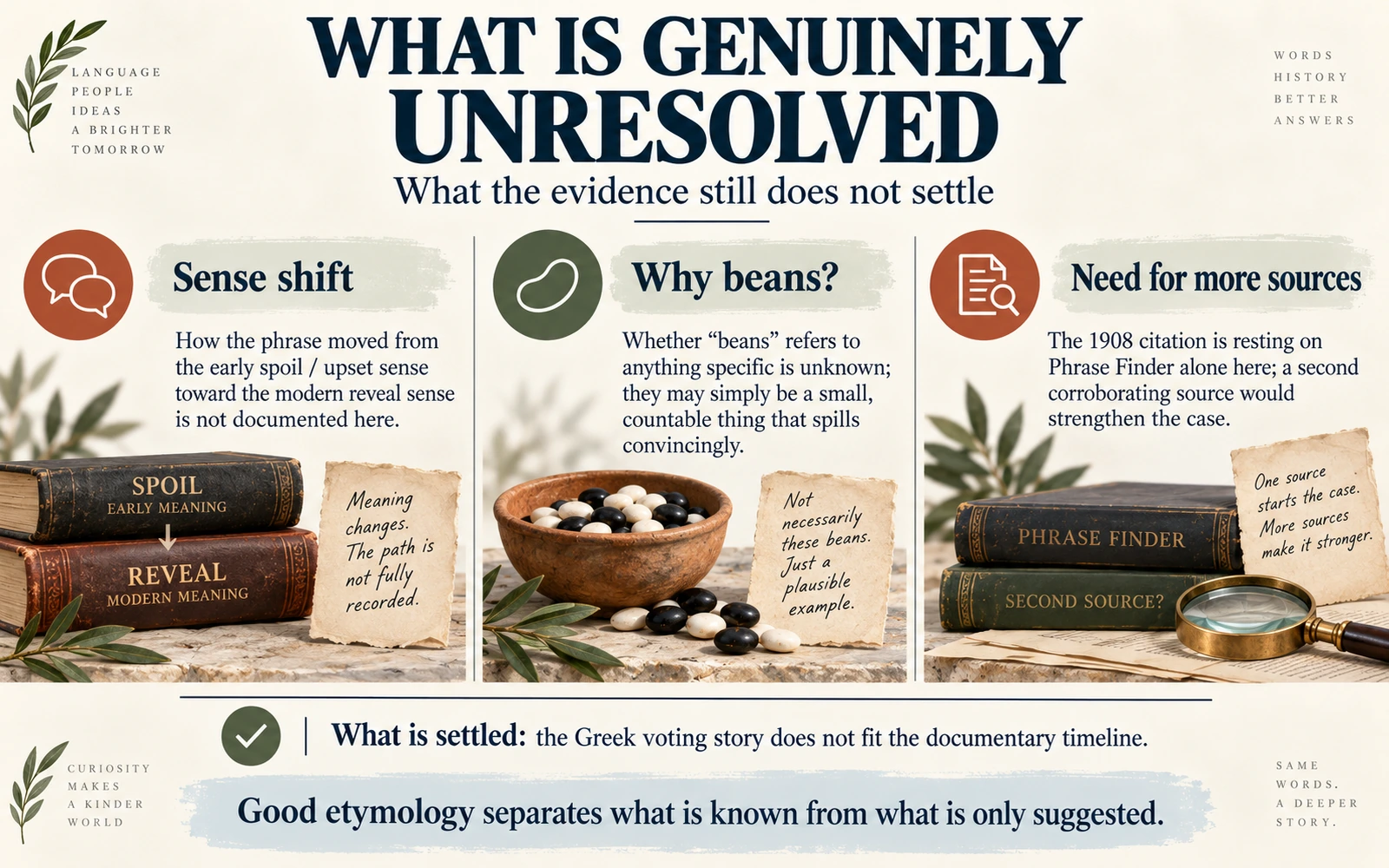
How the phrase moved from the spoil sense to the reveal sense is not documented here. Phrase Finder records both, and the transition between them would need a corpus study we have not run.
Whether beans in the phrase refer to anything specific is unknown. They may simply be a small countable thing that spills convincingly. No reference we read offers more than that.
Only one reference was loaded for this page. The 1908 citation rests on Phrase Finder alone, and a second source would strengthen it.