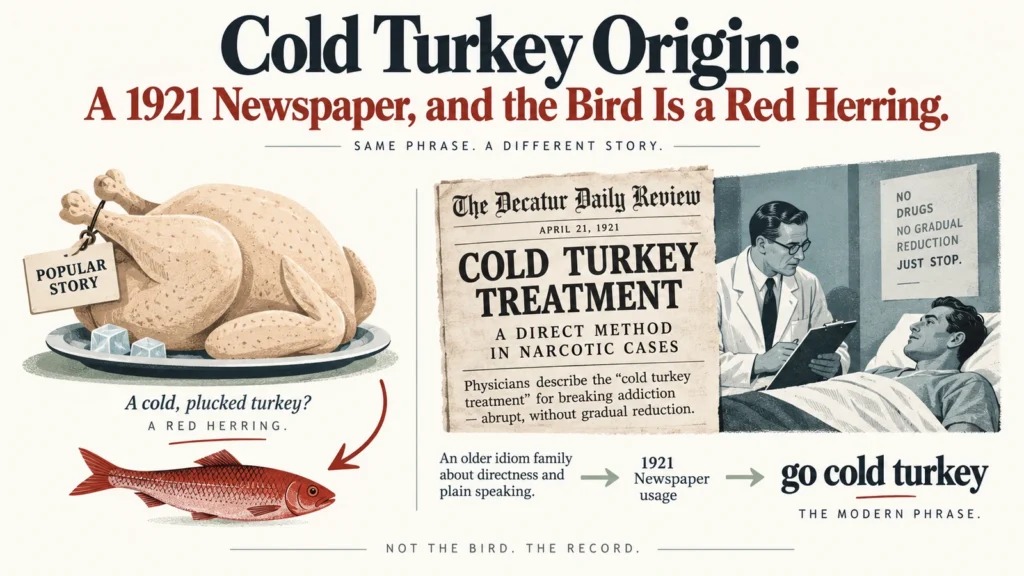
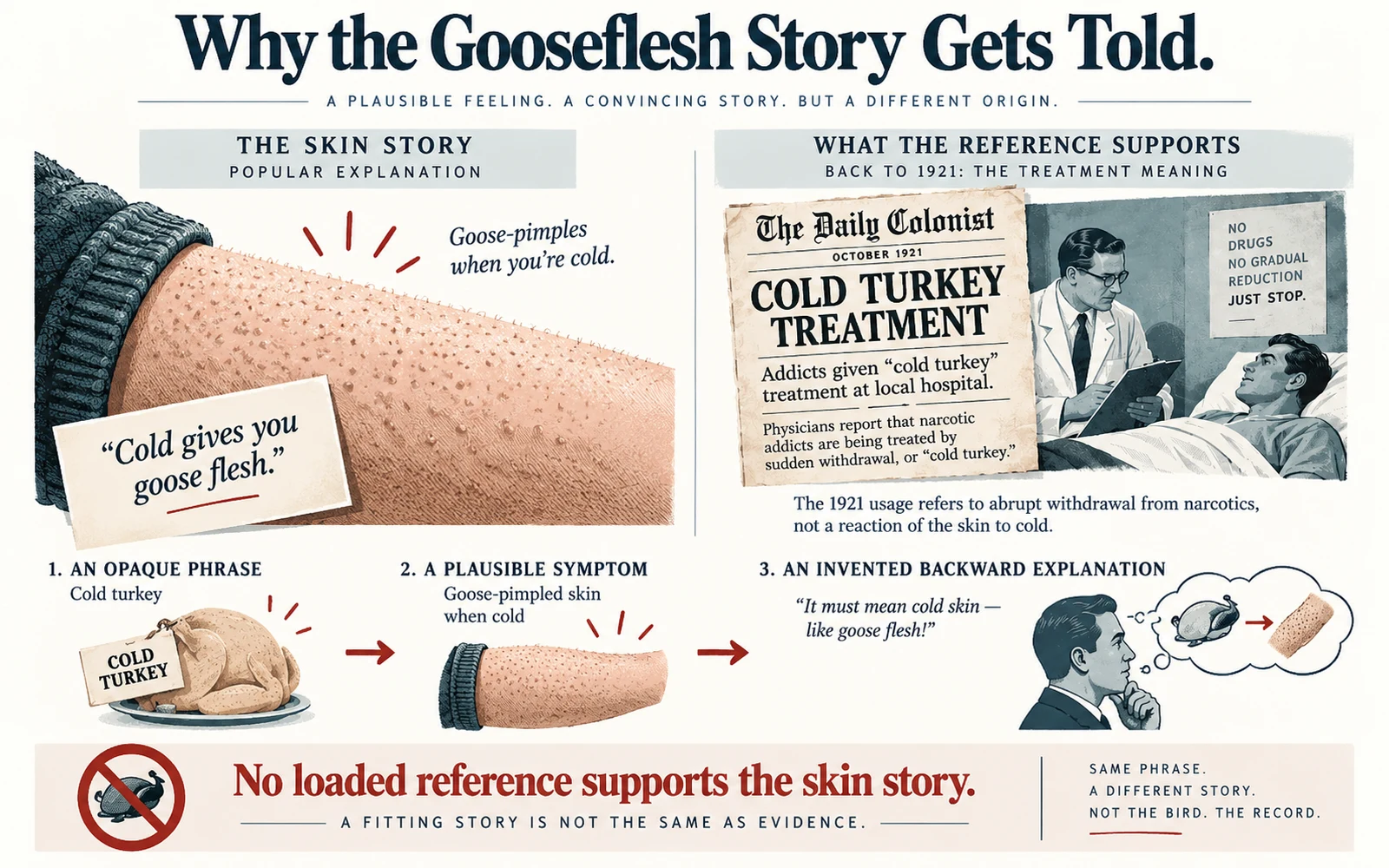
The explanation in general circulation is medical. Withdrawal produces cold, clammy, goose-pimpled skin, the story goes, and that skin was thought to resemble the surface of a cold plucked turkey, so the treatment took the bird's name.
No reference we were able to load supports that. Phrase Finder's account runs somewhere else entirely, and it runs through an older American idiom that has nothing to do with skin, illness or poultry.
The citation trail
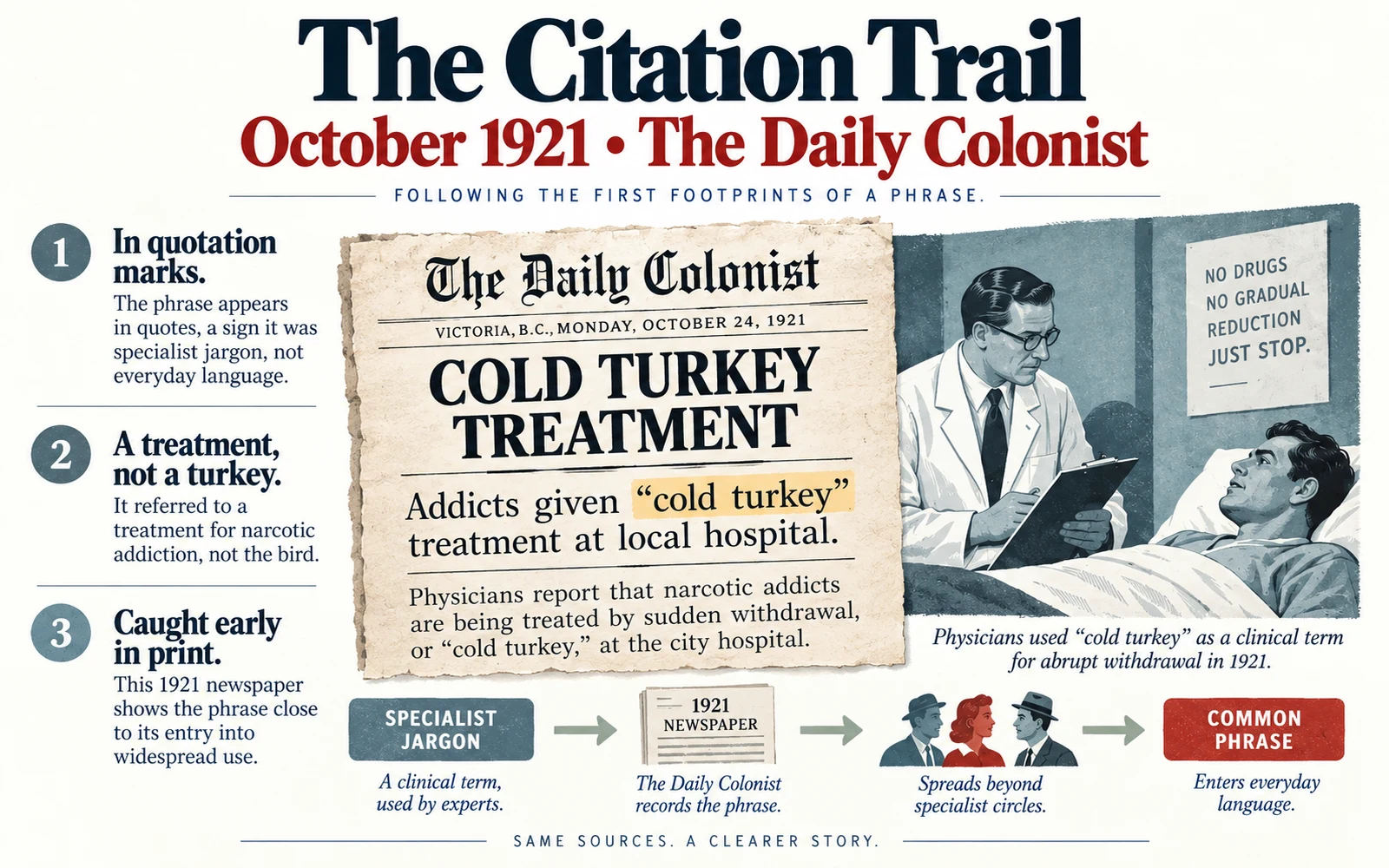
Phrase Finder gives the earliest documented use as October 1921, in The Daily Colonist, a Canadian newspaper, in this passage:
"Perhaps the most pitiful figures who have appeared before Dr. Carleton Simon are those who voluntarily surrender themselves. When they go before him, they [drug addicts] are given what is called the 'cold turkey' treatment."
Two features of that citation are worth stopping on, and both get lost when the phrase is retold.
The quotation marks around 'cold turkey' are doing work. A newspaper putting a phrase in quotation marks and adding "what is called" is signalling that the term is jargon its readers may not know. That places the phrase inside a specialist vocabulary in 1921 rather than in general speech.
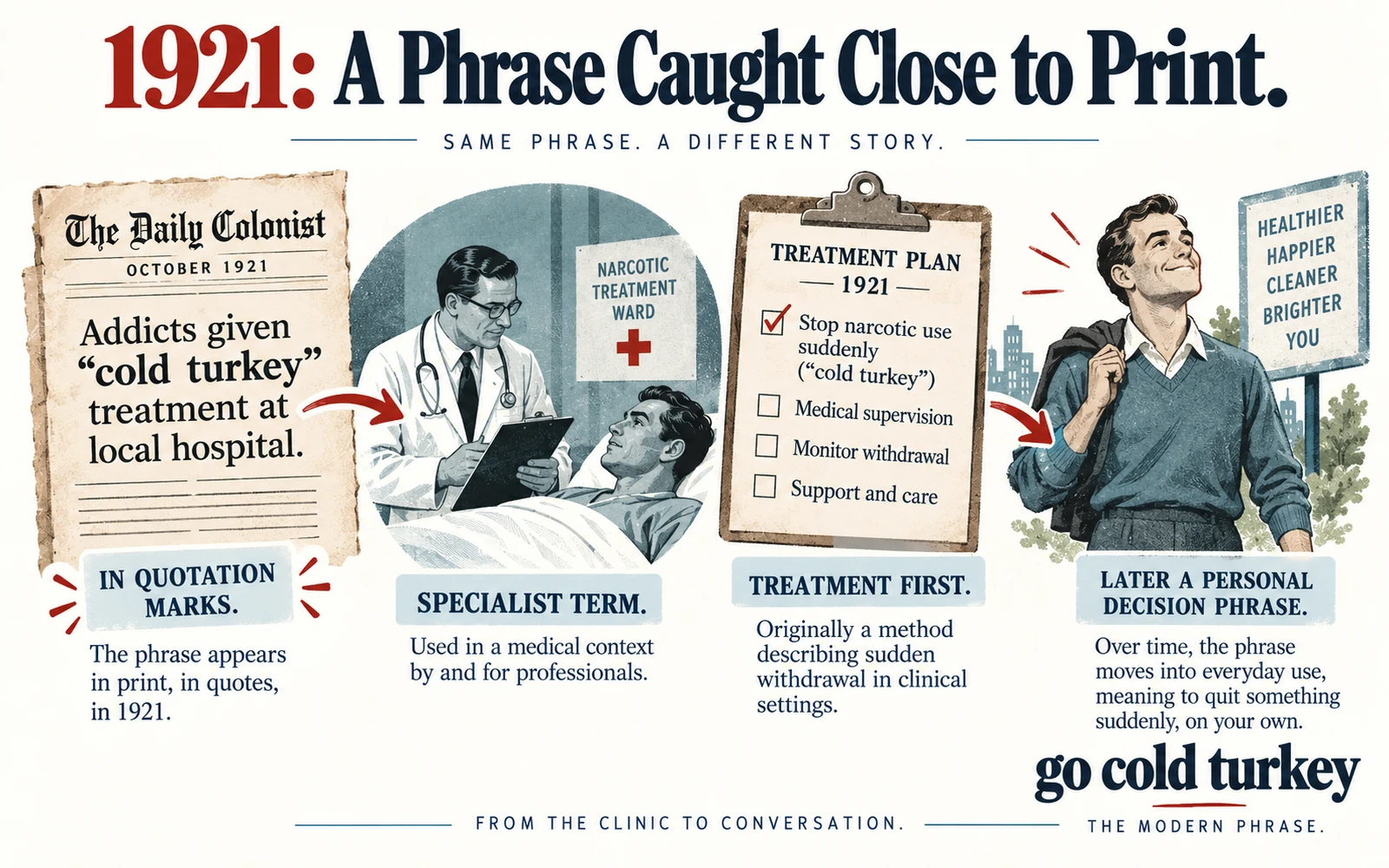
It is a treatment, not an experience. In 1921 the cold turkey is something administered by a doctor, not something a person goes through alone. The modern sense, in which going cold turkey is a decision you make about yourself, is a later development, and it is a good example of how a phrase can keep its words while changing who is doing the acting. This is exactly the kind of drift the tracing method behind these pages is built to catch.
The turkey that is not a bird
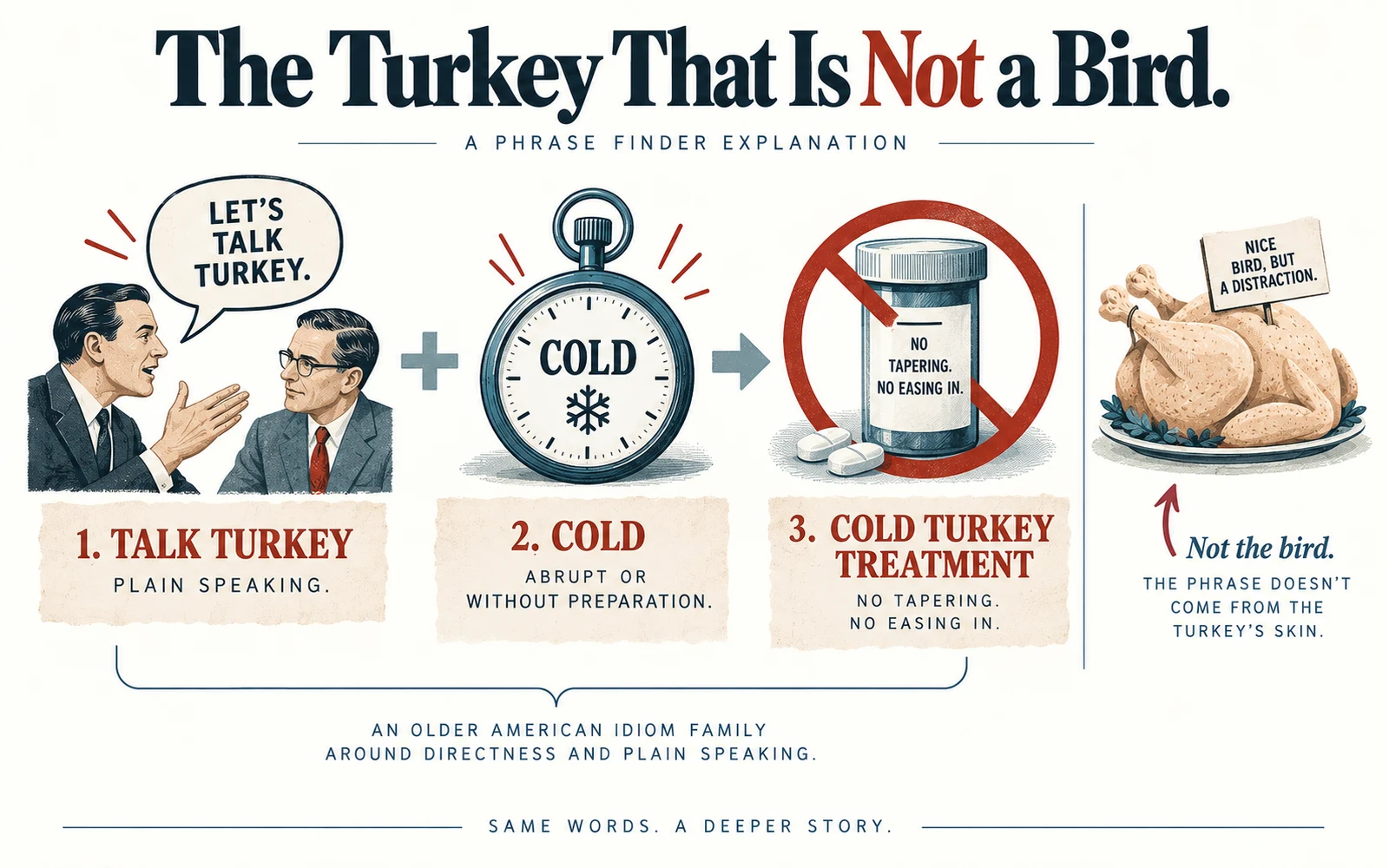
Phrase Finder's explanation connects "cold turkey" to a sense of "turkey" that was already established in early twentieth-century American speech, and which survives today in the phrase "talk turkey", meaning to speak plainly and get to the point.
In that family of usage, turkey carries the idea of directness: no preamble, no softening, straight to the business at hand. Phrase Finder reports "going cold turkey" in the sense of "no nonsense doing" and of getting straight to the scene of the action, and dates that plain-speaking sense earlier than the withdrawal sense.
Read that way the phrase becomes almost self-explanatory. The cold turkey treatment is the no-preamble treatment, the one with no tapering and no easing in, and the word "cold" is doing what it does in "a cold start" or "cold calling": without preparation. The bird is not in the phrase at all except as the ancestor of an idiom about bluntness.
Why the gooseflesh story is worth naming anyway
This page is not asserting that the gooseflesh explanation is false. It is asserting something narrower and more defensible: no reference we could load offers it, and Phrase Finder's account does not need it.
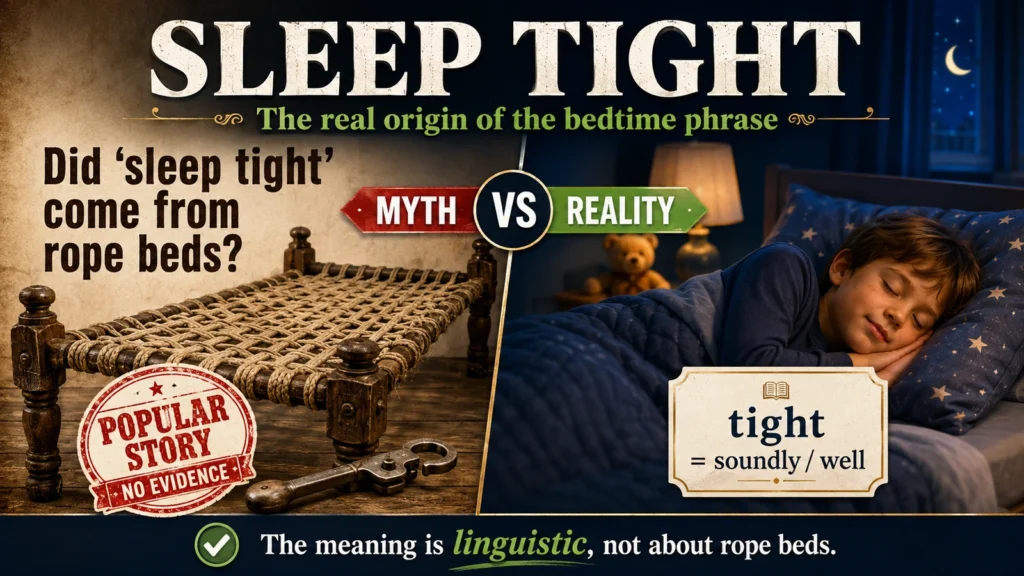
That distinction matters, and it is one this site tries to hold consistently. An unsupported story is not the same as a refuted one. The rope-bed explanation behind "sleep tight" can be argued against on the timeline. The gooseflesh story here simply has nothing behind it that we found, which leaves it in the large category of explanations that are neither proved nor disproved and should not be repeated as fact in either direction.
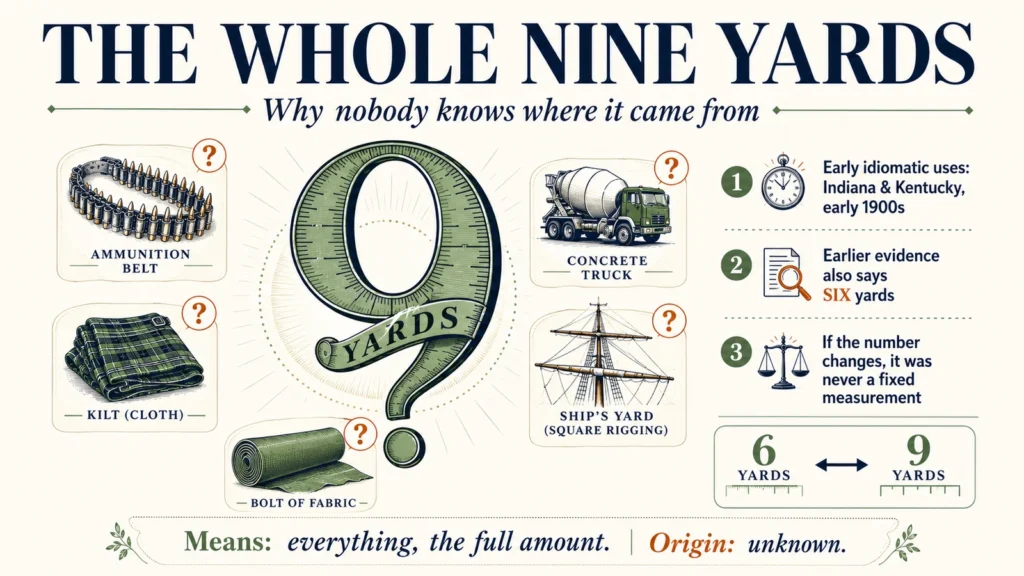
It is also, structurally, a textbook back-formation. Somebody met an opaque phrase, noticed that withdrawal does produce cold pimpled skin, and reasoned backwards from the symptom to the name. That is the same machinery that generates the theories collected around "the whole nine yards", and it produces explanations that fit beautifully and connect to nothing.
The date, and why 1921 is interesting
A phrase attested in 1921 in a Canadian paper, in quotation marks, describing a named doctor's method, is a phrase caught close to its entry into print. That is rare and it is valuable. Most idioms are already old and general by the time anyone writes them down, which is why so many earliest citations tell you nothing about the origin.
Here the citation is close enough to the specialist context to show the phrase in the act of moving from jargon into ordinary speech, and it is the reason this row could be resolved at all when so many in this cluster cannot.
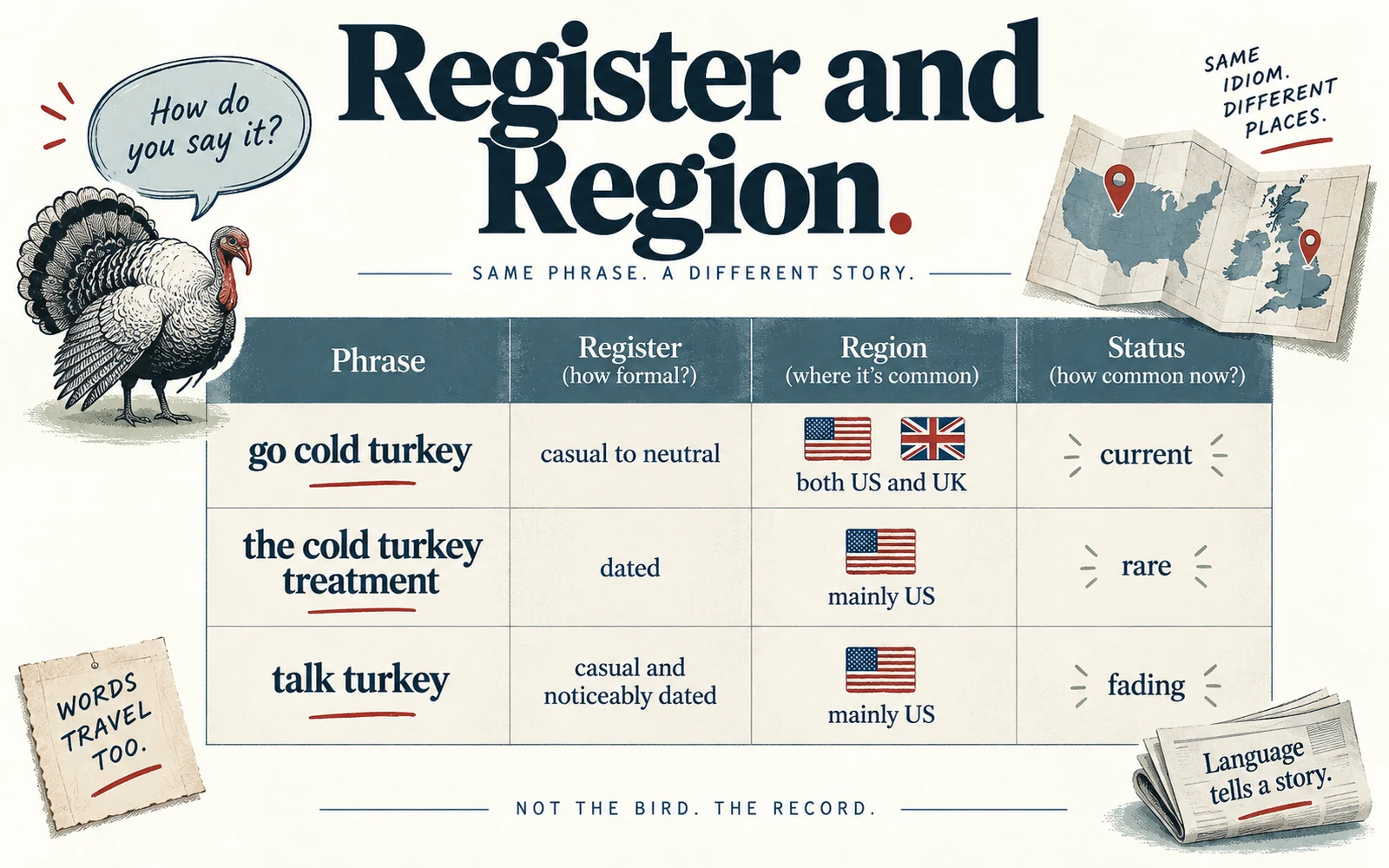
Register and region
| Register | Region | Status | |
|---|---|---|---|
| go cold turkey | casual to neutral. Fine in speech and in most writing, including health journalism | both US and UK, US and Canadian in origin | current |
| the cold turkey treatment | dated. Belongs to the 1920s clinical sense | mainly US | rare |
| talk turkey | casual and noticeably dated | mainly US | fading |
What is genuinely unresolved
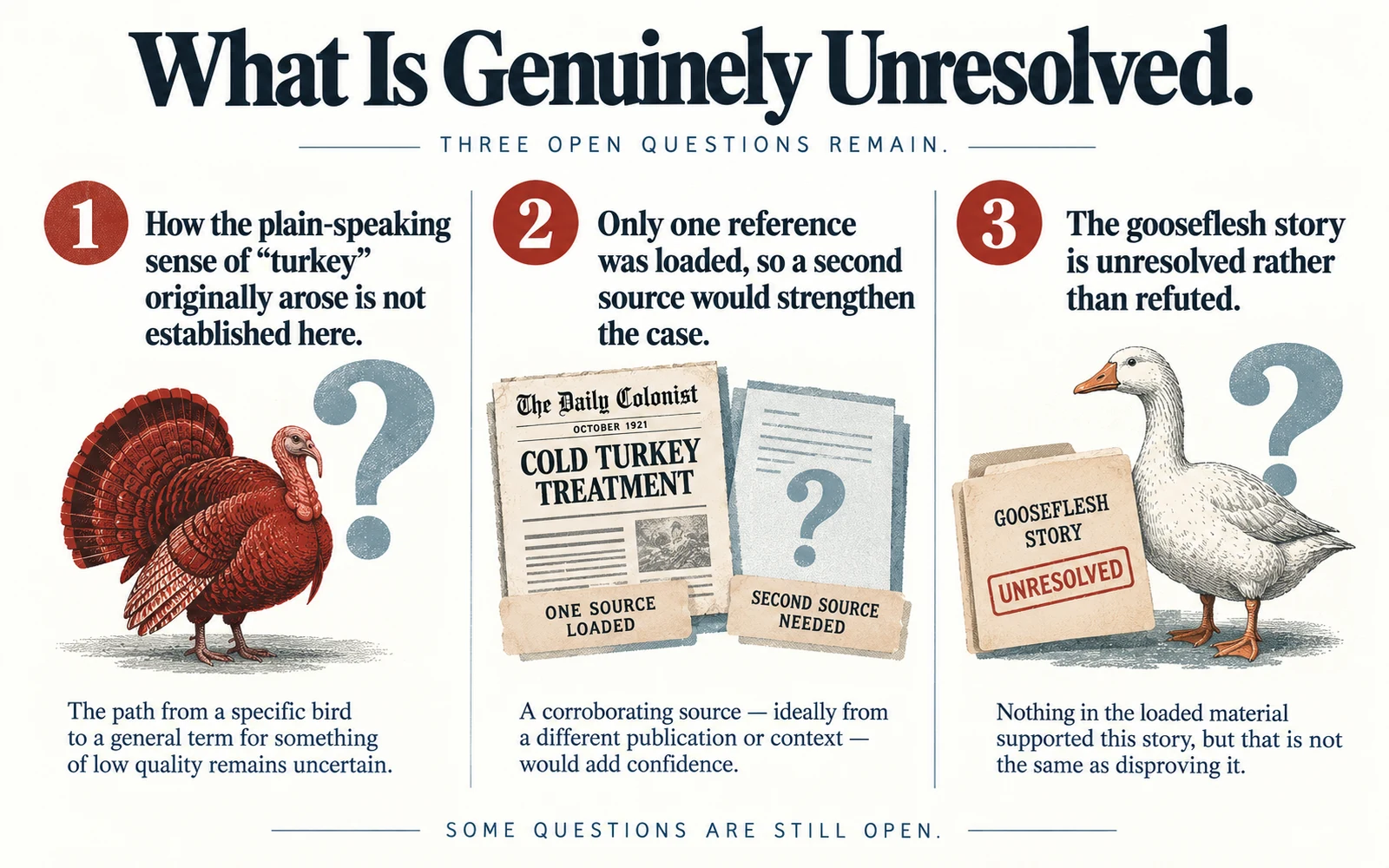
How the plain-speaking sense of turkey arose is not established here. Phrase Finder relates cold turkey to it, and does not settle where that sense itself came from.
Only one reference was loaded. The 1921 citation and the whole account rest on Phrase Finder alone. A second source would strengthen it materially.
The gooseflesh story is unresolved rather than refuted. We found nothing supporting it, which is not the same as finding something against it.