Some of the best-known facts about English idioms are not facts. They are stories: a law about wife-beating, bells in coffins, ropes under a mattress, a flogged sailor struck dumb.
Here are ten idiom origin myths, each set against what the earliest recorded use actually shows and the named reference that rejects the story. The same few tests catch nearly all of them. The phrase first appears in print long after the supposed event, the story has no dated source, or the words used to be different. In most cases the real origin is duller than the myth, and in several it is simply unknown.
Each entry below is one paragraph and one reference. Where this site has a full page, the entry links to it.
The ten myths at a glance
| Idiom | The myth | What the record shows | Reference |
|---|---|---|---|
| rule of thumb | an old law let a man beat his wife with a stick no thicker than his thumb | a 1600s Scottish sermon about builders estimating by guess | Phrase Finder |
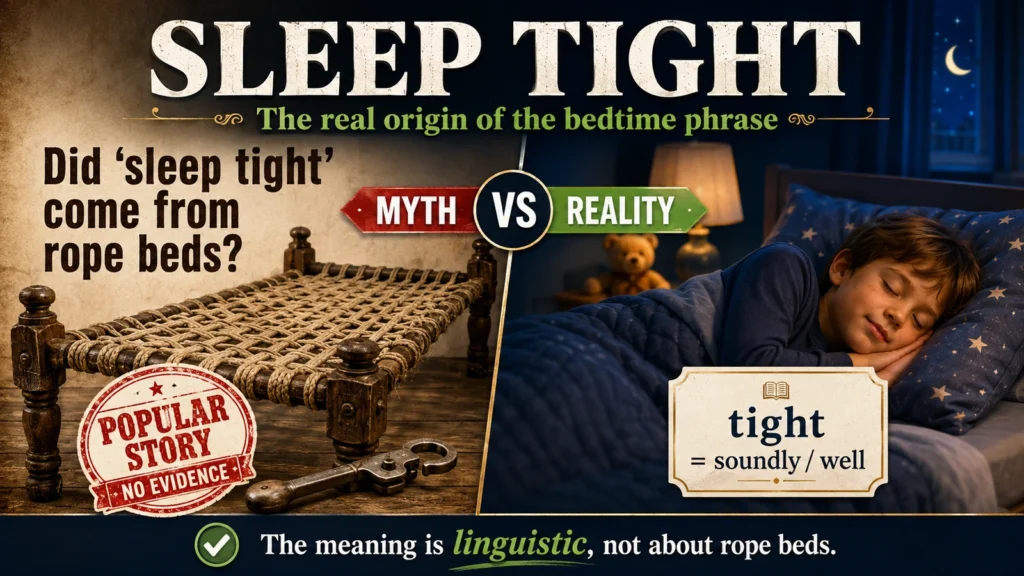
| sleep tight | tighten the bed ropes before sleeping | "tight" was an adverb meaning soundly; the phrase appears in the 1860s | Wordorigins, citing the OED |
| saved by the bell | a bell tied to a coffin saved the buried alive | 1890s boxing slang | Phrase Finder |
| dead ringer | the same coffin bell | a "ringer" is a substituted racehorse; first OED example 1878 | Grammarphobia, quoting the OED |
| kick the bucket | a suicide kicking away a pail | "bucket" was probably a beam; defined as "to die" by 1785 | Phrase Finder |
| spill the beans | ancient Greek voting with beans | first found in the early twentieth century | Phrase Finder |
| raining cats and dogs | animals washed off thatched roofs | origin unknown; the thatch story has no support | Phrase Finder |
| cat got your tongue | a sailor silenced by the cat-o'-nine-tails | first found in an 1859 Wisconsin newspaper | Phrase Finder |
| butter someone up | worshippers threw ghee at statues in India | an English metaphor for smooth speech, from 1618 | CulinaryLore, citing the OED |
| blood is thicker than water | the "full version" is about the blood of the covenant | the covenant version has no source; the family sense goes back to 1412 | Wikipedia |
1. "Rule of thumb" and the wife-beating law
The story is that English law once let a husband beat his wife with a stick no thicker than his thumb. No such statute has been found. Phrase Finder records the phrase in a 1658 sermon by the Scottish preacher James Durham about "foolish builders, who build by guess, and by rule of thumb," which is about measuring, not punishment. The legal story became attached to the phrase in the 1970s. A real 1782 cartoon and some real nineteenth-century American court cases are part of the picture, which is why the rule of thumb origin is really two separate histories that met late.
2. "Sleep tight" and the rope bed
Old beds had rope supports that sagged, the story goes, so "sleep tight" meant tightening them first. The problem is the word "tight." Wordorigins.org reports that the Oxford English Dictionary records "tight" as an adverb meaning soundly or properly from around 1600, and the phrase itself does not appear in print until the 1860s, when rope beds were no longer ordinary furniture. No reference ties the phrase to the bed. The sleep tight page goes through where the references stop agreeing on the first date.
3. "Saved by the bell" and the safety coffin
Victorian inventors did patent coffins with bells so that someone buried alive could signal. That part is real. Phrase Finder says there is no evidence anyone was ever saved by one or that the phrase was ever used in that sense. It is boxing slang: the bell ends the round before a knockout. Phrase Finder's earliest example is from a Massachusetts newspaper in February 1893, where one fighter "was saved by the bell" half a dozen times in the early rounds.
4. "Dead ringer" and the same coffin bell
This myth usually travels with the one above. A "ringer" is a substitute passed off as the real thing, most famously a horse entered in a race under another animal's name, and "dead" means exact, as in "dead on." The earliest example the OED carries, as Grammarphobia quotes it, is from an 1878 Colorado newspaper. The dead ringer page traces the coffin version to a list of invented origins that Grammarphobia says has circulated since 1999.
5. "Kick the bucket" and the suicide
The story is that a person stood on an upturned pail with a noose and kicked it away. Phrase Finder rejects it for the usual reason: no citations. The phrase was defined as "to die" in Francis Grose's slang dictionary by 1785, and Phrase Finder prefers an explanation from an older sense of "bucket" as a beam from which slaughtered animals were hung. That is the better-supported theory, not a proven one, as the kick the bucket page explains.
6. "Spill the beans" and the Greek vote
Ancient Greeks, the story says, voted with beans in a jar, and knocking it over revealed the result early. Phrase Finder rejects it on one decisive ground: the phrase is first found in the early twentieth century. A gap of more than two thousand years between a custom and the first appearance of a phrase supposedly describing it is not a difficulty; it is a refutation. The spill the beans page shows the older sense of "spill" the phrase actually grew from.
7. "Raining cats and dogs" and the thatched roof
Animals sheltering in thatch were supposedly washed out by heavy rain. Phrase Finder calls this nonsense: an animal seeking shelter would be inside the thatch, not sitting on it, and dogs do not live in roofs. The honest answer here is that nobody knows the origin. The first record of the modern phrase is Jonathan Swift's Polite Conversation of 1738, and the references we read decline to name a source.
8. "Cat got your tongue" and the navy whip
The "cat" is said to be the cat-o'-nine-tails and the silent person a sailor too shocked to speak after a flogging. Phrase Finder finds the phrase first in The Racine Democrat of Wisconsin in December 1859, in a domestic setting, and says there is "no shred of evidence" for either the whip story or a story about tongues fed to cats in ancient Egypt. The earliest uses associate it with teasing children, and its true origin is unknown.
9. "Butter someone up" and the temple offering
The story says worshippers in ancient India threw balls of ghee at statues of the gods to win favor. CulinaryLore found no documentation of the practice as described and no link to the English phrase. The OED, as CulinaryLore quotes it, dates "butter" meaning flattering speech to 1618, in a sentence pairing it with oil, and Wordsmarts gives the OED's "butter him up" from 1798. It is an English image of slippery talk.
10. "Blood is thicker than water" and the covenant
A viral "full version" says the saying was once "the blood of the covenant is thicker than the water of the womb," which would reverse its meaning. Wikipedia reports that this version was put forward by the writers Albert Jack and Richard Pustelniak, and that neither cites any source for it. The ordinary family sense has a long record: Wikipedia quotes John Lydgate around 1412 on blood being drawn to blood, notes a 1652 sermon by William Jenkyn, and cites Walter Scott's use in the early 1800s.
What the ten have in common
Line the entries up and the same three weaknesses keep appearing.
The date is wrong. Spill the beans, cat got your tongue and sleep tight all turn up in print long after the custom or object that supposedly created them. If a phrase appears after its "source" has vanished, the source did not produce it.
There is no citation for the story. Rule of thumb, kick the bucket, saved by the bell and butter up all rest on a scene nobody has documented. The phrase has dates; the story does not.
A true detail carries a false link. Safety coffins existed. Ghee is used in worship. Courts did discuss a husband's "switch." Each myth borrows something real and attaches it to a phrase it never touched.
None of this means every colorful origin is false. "Under the weather" really does come from sailing, even though its popular sick-bay anecdote is not documented. The test is always the same: find the dated citation first, then see whether the story fits it.
Frequently asked questions
What are the most common idiom origin myths?
Among the most repeated: the wife-beating law behind "rule of thumb," rope beds behind "sleep tight," safety coffins behind "saved by the bell" and "dead ringer," a suicide behind "kick the bucket," Greek bean voting behind "spill the beans," thatched roofs behind "raining cats and dogs," and the "blood of the covenant" version of "blood is thicker than water."
Why do false idiom origins spread?
Because a vivid story is easier to remember than a date, because the stories are invented to fit the words, and because each one usually borrows a true detail that makes it feel checked. Every retelling also makes the story look better attested.
How can I check whether an idiom origin is true?
Look for the earliest dated use of the phrase in a named reference such as the Oxford English Dictionary or Phrase Finder, then see whether the story fits that date. If the story has no source of its own, or the phrase appears centuries after the supposed event, treat the story as a myth.
Is "origin unknown" a real answer?
Yes. For "raining cats and dogs" and "cat got your tongue," it is the answer the references give, and it is more accurate than any of the stories.