Folk etymology means two related things, and the confusion between them is where most of the trouble starts.
In the narrow sense, folk etymology is the way speakers reshape an unfamiliar word into familiar-looking parts, as when the Spanish cucaracha became English "cockroach." In the broad sense, it is a popular but false story about where a word or phrase came from, such as the claim that "posh" stands for "port out, starboard home." The first kind changes the word. The second changes only what people believe about it. Both come from the same instinct: people expect words to make sense, and when a word or phrase doesn't, they supply a sense of their own.
Wikipedia's article on folk etymology traces the term to the German Volksetymologie, coined by the linguist Ernst Förstemann in 1852.
Folk etymology examples, kind one: the word itself changes
In this kind nobody invents a story. Speakers simply hear a strange word as a string of familiar ones, and the new form sticks. These examples come from Wikipedia's article on folk etymology unless another source is named.
| Today's word | Came from | What speakers heard in it |
|---|---|---|
| cockroach | Spanish cucaracha | "cock" and "roach," two English words |
| crayfish, crawfish | Middle English crevis, related to French écrevisse | "fish," though it is not one |
| sparrowgrass (dialect) | asparagus, from Greek | "sparrow" and "grass" |
| female | Old French femelle | a partner word for "male," which it is not related to |
| belfry | Old French berfrey, a tower | "bell," because belfries often hold bells |
| bridegroom | Old English brydguma, "bride-man" | "groom," once the old word guma for "man" had died out |
| shamefaced | shamefast, "held fast by shame" | "faced," because shame shows on the face |
| hangnail | an older word for a painful corn on the foot | "hang" and "nail," with the meaning shifting to torn skin by a fingernail in the 1600s |
Babbel's magazine adds a food example that became an idiom. "Umbles" were the edible innards of an animal, and umble pie was a humble dish. Once "umbles" was forgotten, an "h" was added to match the meaning people assumed, and "eat humble pie" was the result.
None of these are errors any more. Folk etymology of this kind is an ordinary way words enter English, and the reshaped forms are the standard ones. Eggcorns are a close cousin, still in progress: someone who writes "hone in" for "home in" has reshaped a phrase around a word that seems to fit, which is why dictionaries and usage guides now split over it, as our page on whether to write "hone in" or "home in" explains.
Folk etymology examples, kind two: the story is false
This is what most people mean when they use the term, and it is the kind this site spends most of its time on. The word or phrase is unchanged; a story has been invented to explain it.
Acronym stories. Wikipedia's list of common false etymologies collects several, each with the reference that rejects it:
- posh is said to stand for "port out, starboard home," the shady side of a ship on the route to India. The Oxford Dictionary of Word Origins (2010) traces it instead to nineteenth-century slang, first for money and then for a dandy.
- golf is said to stand for "gentlemen only, ladies forbidden." Merriam-Webster gives its origin as unknown, from the Middle Scots period.
- tip is said to stand for "to insure promptness." The Online Etymology Dictionary dates the word to the 1600s, origin uncertain.
- news is said to stand for north, east, west and south. It is simply the plural of "new," the Online Etymology Dictionary notes, recorded since the early 1400s.
The list adds the single most useful fact for testing any acronym story: words formed from acronyms were nearly nonexistent in English until the middle of the twentieth century. Any acronym origin offered for an old word should be assumed false until proven otherwise.
Latin stories. "Sincere" is said to come from sine cera, "without wax," supposedly praising sculptors who did not hide cracks with wax. The Online Etymology Dictionary, as cited in that list, derives it from Latin sincerus, "pure, genuine." "Snob" is said to come from sine nobilitate, "without nobility," abbreviated to s. nob. in college registers. Wikipedia's article on false etymology gives that story as its example of the type.
Idiom stories. Idioms attract the most elaborate false stories of all, because a phrase gives you more to explain than a word does. Every one of these has a page on this site:
- "Rule of thumb" is said to come from a law letting a man beat his wife with a stick no thicker than his thumb. The phrase is recorded in a seventeenth-century Scottish sermon about builders guessing measurements, and the rule of thumb story was attached to it only in the 1970s.
- "Dead ringer" is said to come from bells tied to coffins so that the buried alive could signal. The OED's earliest example, as Grammarphobia quotes it, is from an 1878 Colorado newspaper, and "ringer" is the fraudulent substitute, most famously a horse. The coffin version travels in a forwarded list of invented origins, as the page on "dead ringer" shows.
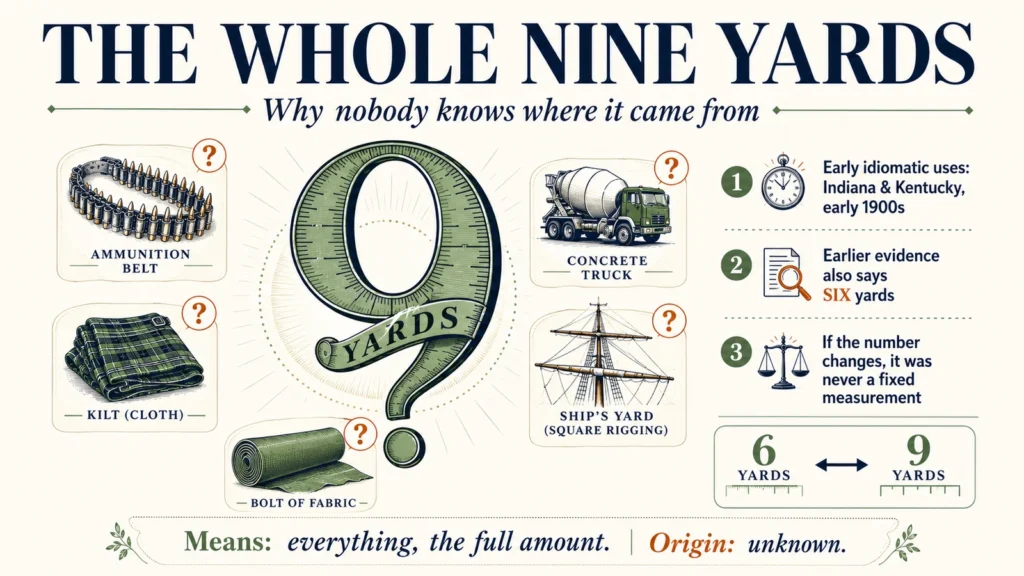
- "The whole nine yards" has been credited to machine gun belts, kilts, concrete trucks and ships' sails. Early versions said "six yards," a detail that sinks every theory at once, and the whole nine yards page concludes that the origin is unknown.
Why false origin stories spread
The reasons are consistent enough to predict.
A story is more memorable than a date. Wikipedia's article on false etymology observes that such stories often have the feel of urban legends and are more colorful than dictionary etymologies. A carpenter estimating an inch is a dull origin for "rule of thumb." A cruel judge is not.
They work backward from the words. A false origin starts with the phrase and invents a scene that would produce it. That is why it fits the words so neatly: it was made to fit them. A real origin often fits badly, because words drift after they are coined.
They borrow a true detail. Safety coffins with bells were real. Cats really were associated with witches. Ghee really is used in Hindu worship. The true detail makes the whole story feel checked, when only one part of it has been.
"Unknown" is an unsatisfying answer. An honest reference often ends with "origin unknown," and a page that has to hold a reader is tempted to fill the gap. Each copy makes the story look better attested, because it now appears in more places.
They flatter the teller. Knowing that a common word secretly hides a sailor's acronym or a medieval law is a small pleasure, and passing it on is a small social reward.
A checklist for spotting a false origin
Use this on any origin you are about to repeat, including ones you read here. It is a short version of the method set out on the page about how a phrase origin is traced.
- Is there a dated citation? A real origin comes with an early example of the word or phrase in print, with a date and a source. A story without a date is a story.
- Does the date fit the story? If the custom is ancient and the phrase first appears in 1908, the custom did not produce the phrase.
- Is it an acronym for an old word? Then it is almost certainly false.
- Does it explain the variants? If the phrase once used a different number or word, as with "six yards," a story that depends on the current wording cannot be right.
- Is the story itself traceable? Sometimes you can date the legend instead of the phrase, and find it is recent.
- What does a named reference say? The Oxford English Dictionary, Merriam-Webster, Phrase Finder and similar sources say "unknown" when that is the truth. If the only support is other blogs, the support is repetition.
- Is it too good? A single vivid image that explains every word of the phrase is a warning sign, not a recommendation.
What folk etymology is not
It is not a synonym for "wrong." Kind-one folk etymologies produced perfectly standard words, and nobody needs to go back to crevis.
It is also not the same as an unknown origin. "Raining cats and dogs" has no known origin; the false part is only the confident stories told about it. And a debunked story does not always mean a debunked source: "under the weather" really is a sailors' phrase, even though the popular sick-bay anecdote about it is unsupported.
Frequently asked questions
What are some examples of folk etymology?
In the sense of a reshaped word: cockroach from Spanish cucaracha, crayfish from Middle English crevis, dialect "sparrowgrass" for asparagus, and bridegroom from Old English brydguma. In the sense of a false story: "posh" as "port out, starboard home," "golf" as "gentlemen only, ladies forbidden," and the wife-beating law behind "rule of thumb."
What is the difference between folk etymology and false etymology?
Many writers use them as synonyms. When they are separated, folk etymology is a change to the word itself, as when cucaracha became "cockroach," and false etymology is a mistaken belief about a word's origin that leaves the word unchanged, as with the "posh" acronym.
Who coined the term "folk etymology"?
Wikipedia's article traces it to the German Volksetymologie, coined by Ernst Förstemann in 1852.
How can I tell if a word origin story is true?
Look for a dated early citation from a named reference, check that the date fits the story, distrust acronym origins for any word older than the mid-1900s, and check whether the story explains older variants of the phrase. If the only sources are other retellings, treat it as unproven.