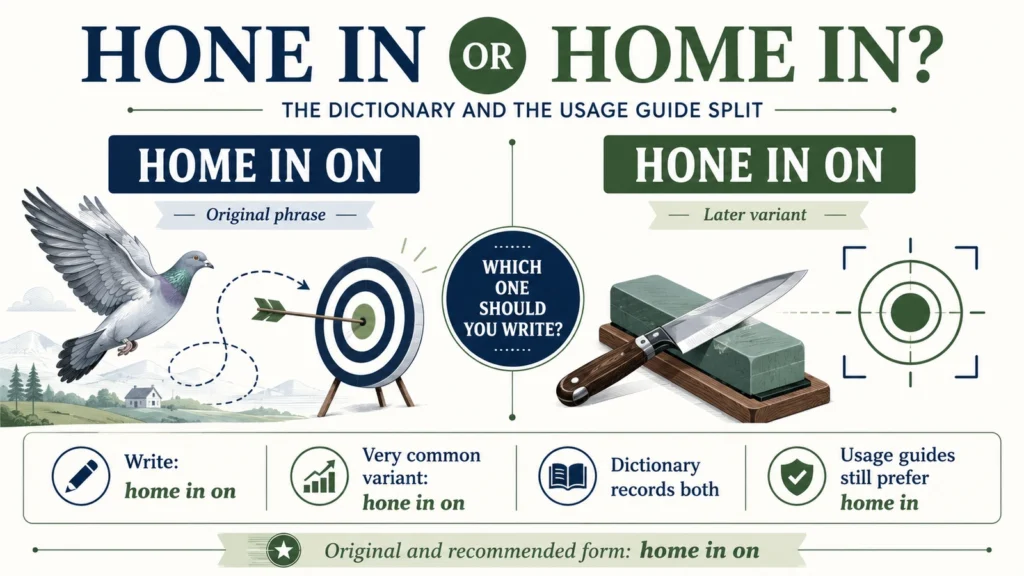
"Home in on" is the original phrase and the one to write. "Hone in on" is a later variant, it is now extremely common, and whether you should call it an error depends on whether you are holding a dictionary or a usage guide. Those two kinds of book are answering different questions, and this particular phrase is the clearest place in modern English to watch them come apart.
Where "home in" comes from
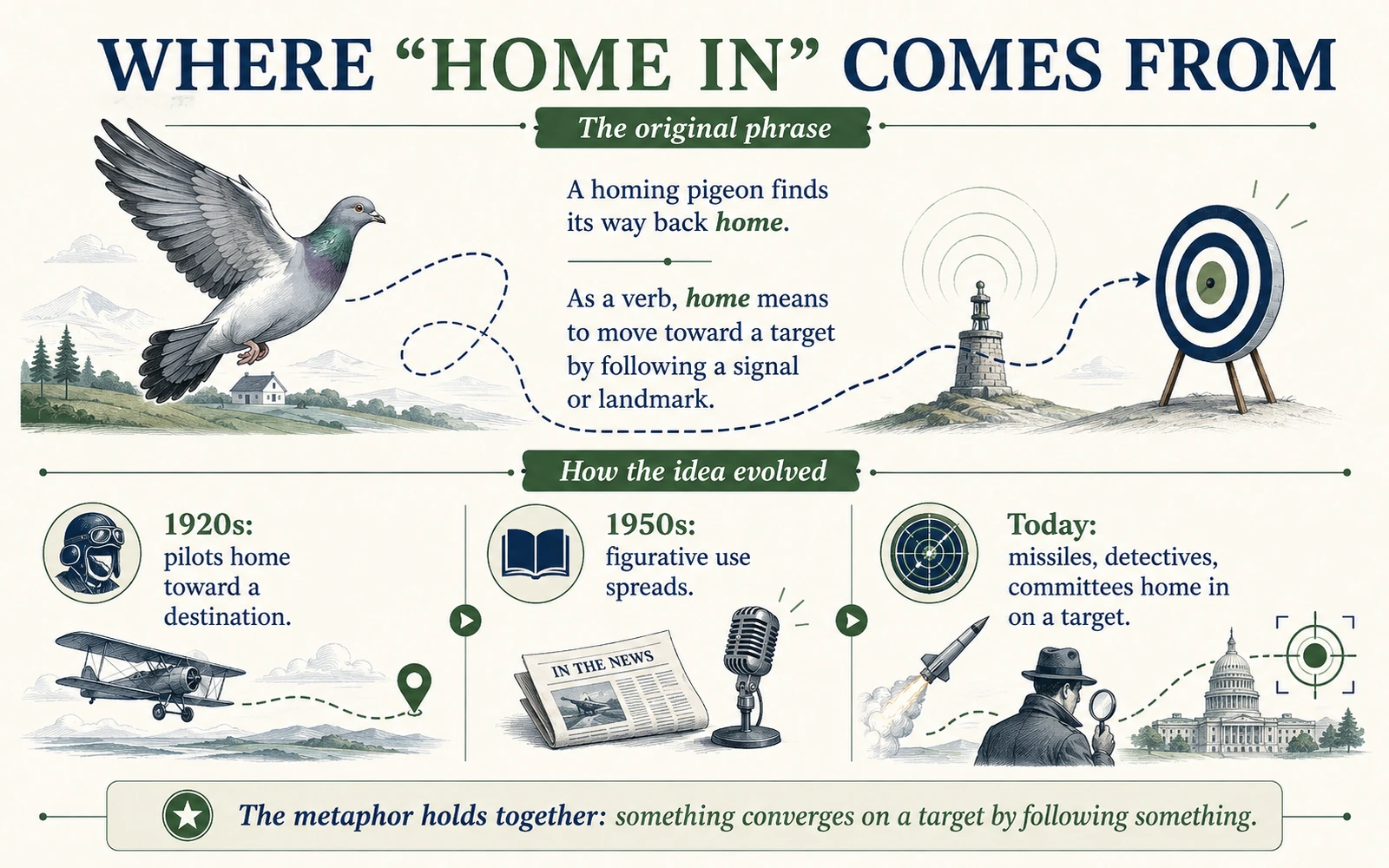
A homing pigeon finds its way back. That is the sense: home, used as a verb, means to move toward an objective by following a signal or a landmark. Merriam-Webster gives that definition and traces the modern usage from it.
The timeline the dictionary sets out runs roughly like this. The pigeon sense comes first. By the 1920s, pilots were homing toward their destinations, following a beacon or a radio signal. By the 1950s the word had gone figurative, and anyone directing their attention toward an objective could be described as homing in on it. A missile homes in on a heat source; a detective homes in on a suspect; a committee homes in on the one clause everybody was avoiding.
Notice what all of those have in common. Something is being converged on, by following something. That is the whole metaphor, and it holds together perfectly.
Where "hone in" comes from
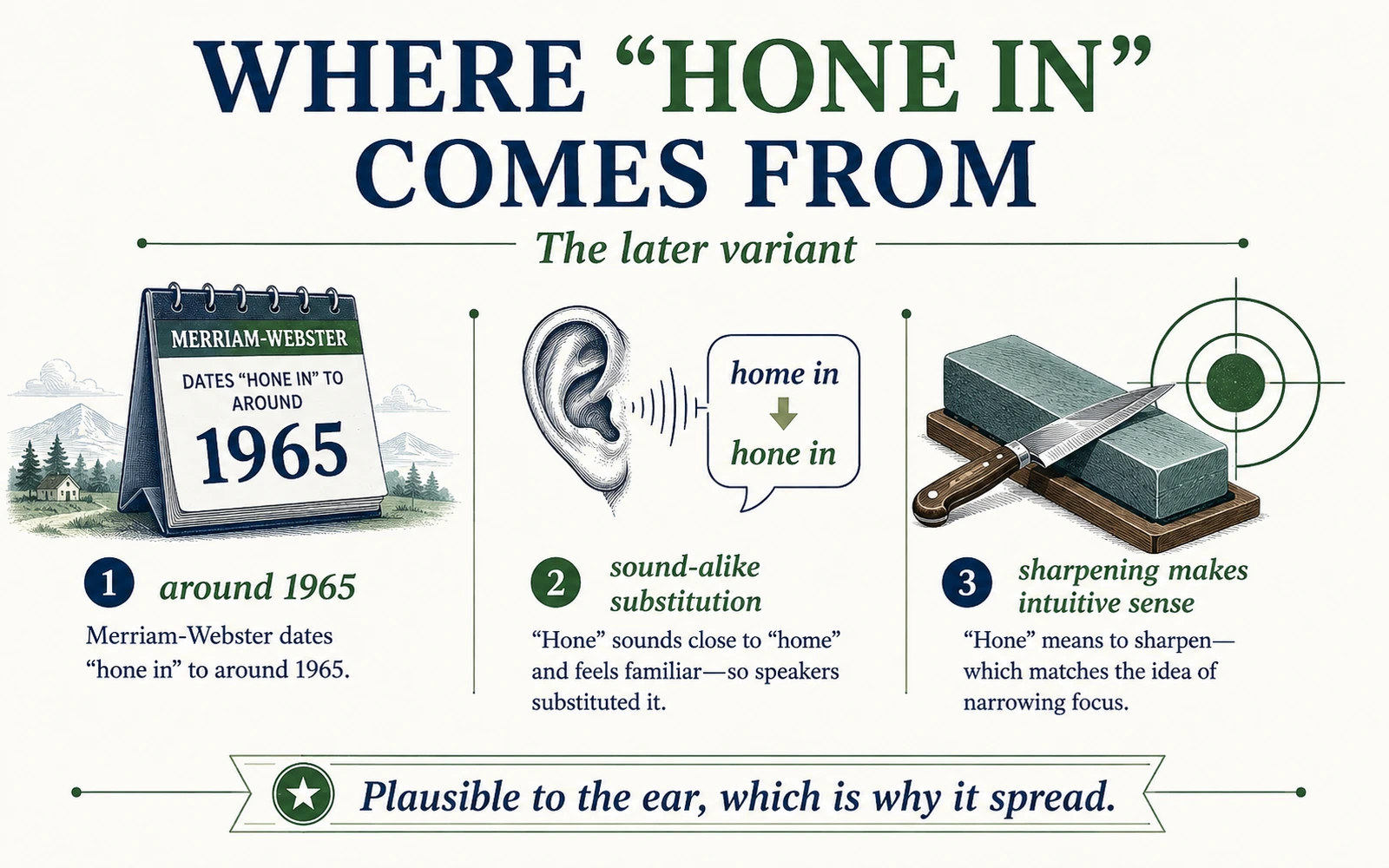
Merriam-Webster dates "hone in" to around 1965, which makes it roughly a decade younger than the figurative use of "home in". So this is not a case of an old form and a new form competing. Both are twentieth-century, and they arrived close together.
Why the substitution happened is not mysterious. In ordinary connected speech the two words are close to indistinguishable, and hone is by far the more familiar verb to most speakers. Almost nobody uses home as a verb in any other context. When the ear has to choose, it picks the word it already owns.
There is also a meaning available that seems to fit. To hone is to sharpen, and sharpening one's focus is a thing people do. So "hone in on the problem" reads, to someone who has not thought about it, as narrowing and sharpening the attention. That plausibility is why the form spread rather than dying out.
The two verdicts, and why they differ
Here is the interesting part, and it is worth understanding rather than just picking a side.
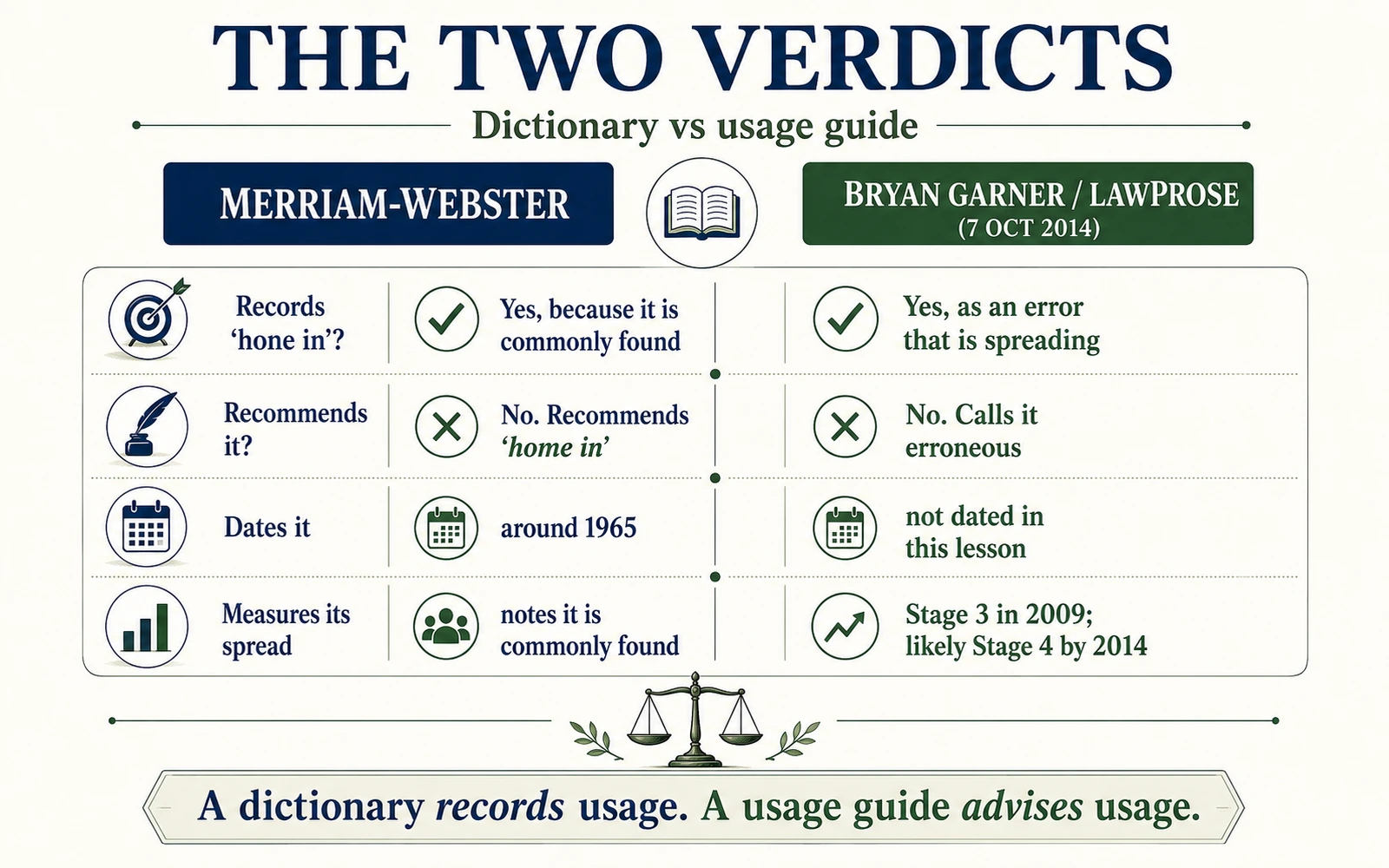
Merriam-Webster enters both. Its position is that both "home in" and "hone in" are found commonly enough in print to be recorded, so both appear in the dictionary. It notes, in the same breath, that most usage commentators regard "hone in" as a mistake, and it identifies "home in" as the original and recommended form.
Bryan Garner rejects it flatly. In a LawProse lesson published on 7 October 2014, Garner calls "hone in" erroneous, and gives two separate grounds. The first is grammatical: home in this sense is intransitive, taking no object, while hone is transitive and needs one. The second is metaphorical, and it is the sharper argument. "Sharpen in" is not an action. You can hone a blade or hone a skill, but there is nothing for the in to attach to. He calls the result a faulty metaphor and a grammatical gaffe.
Garner also puts a number on how far it has travelled. His Language-Change Index tracks how widely a disputed form has spread, and the third edition of Garner's Modern American Usage, published in 2009, placed "hone in" at Stage 3, "widespread but". Writing in 2014, he suggested that Merriam-Webster's recognition of the form had probably pushed it to Stage 4, "ubiquitous but".
Read those two positions carefully and they are not actually in conflict. A dictionary reports what is written. A usage guide advises what to write. Merriam-Webster is telling you that a great many people say "hone in"; Garner is telling you that a great many of your readers will think less of you for it. Both statements are true at the same time, and neither one cancels the other.
| Merriam-Webster | Bryan Garner, LawProse, 7 October 2014 | |
|---|---|---|
| Records "hone in"? | Yes, as an entry, because it is commonly found | Yes, as an error that is spreading |
| Recommends it? | No. Identifies "home in" as the original and recommended form | No. Calls it a faulty metaphor and a grammatical gaffe |
| Dates it | around 1965, about a decade after figurative "home in" | not dated in this lesson |
| Measures its spread | notes most usage commentators call it a mistake | Stage 3 in the 2009 third edition; likely Stage 4 by 2014 |
How to remember which is which
The trick that works is to drop the in and see whether the sentence survives.
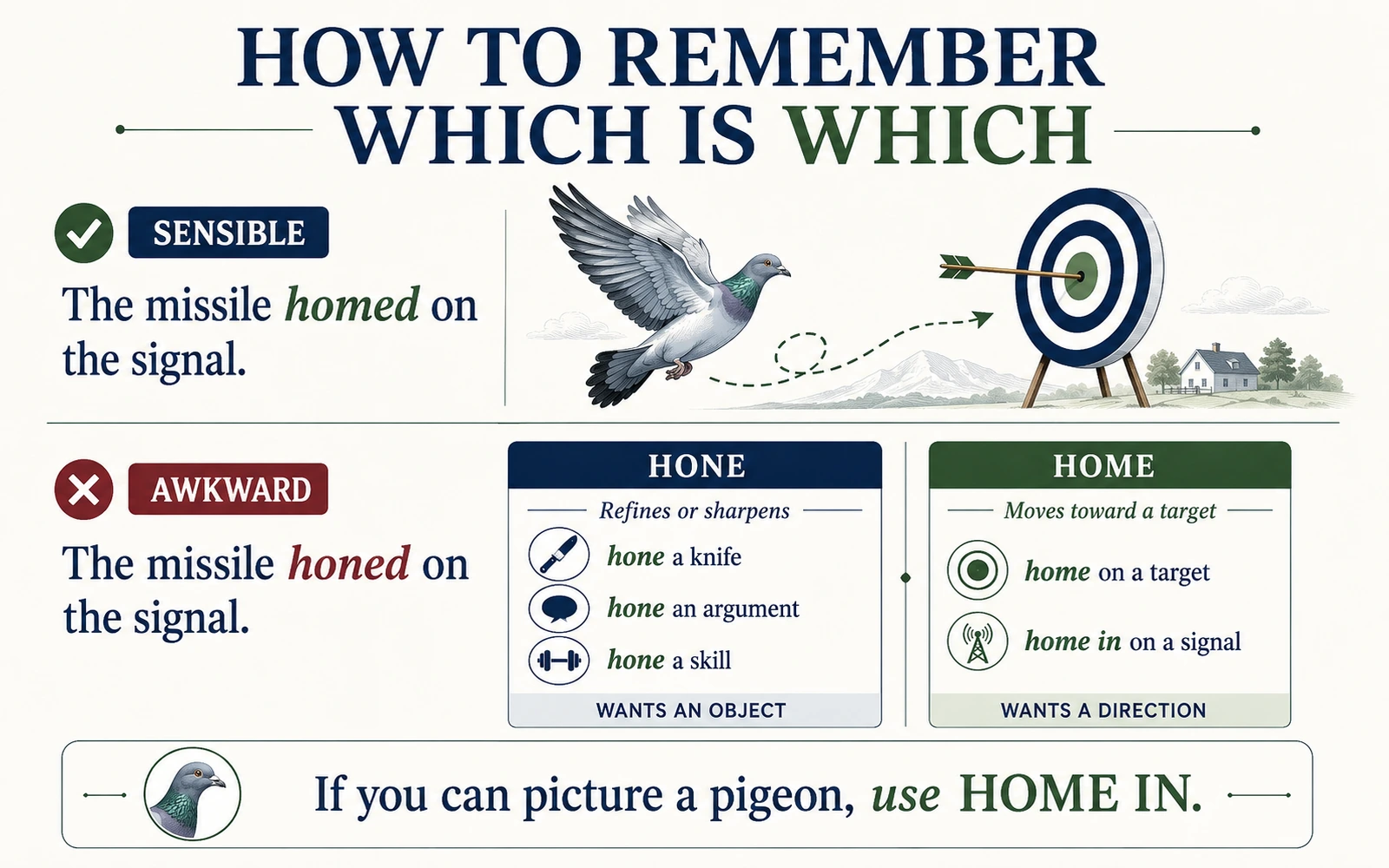
The missile homed on the signal. Odd but comprehensible: something converged. The missile honed on the signal. Nothing. Honed what?
Or run it the other way. Ask what the verb needs.
- Hone wants an object. You hone a knife, hone an argument, hone your technique. Something is being sharpened.
- Home wants a direction. Something moves toward a target by following a signal. Nothing is being sharpened at all.
If you can picture a pigeon, you are on the right phrase.
Register and region
| Register | Region | |
|---|---|---|
| home in on | neutral. Safe everywhere, including business writing and anything edited | both US and UK |
| hone in on | casual, and widely flagged as an error. Avoid in edited writing | both, and common in both |
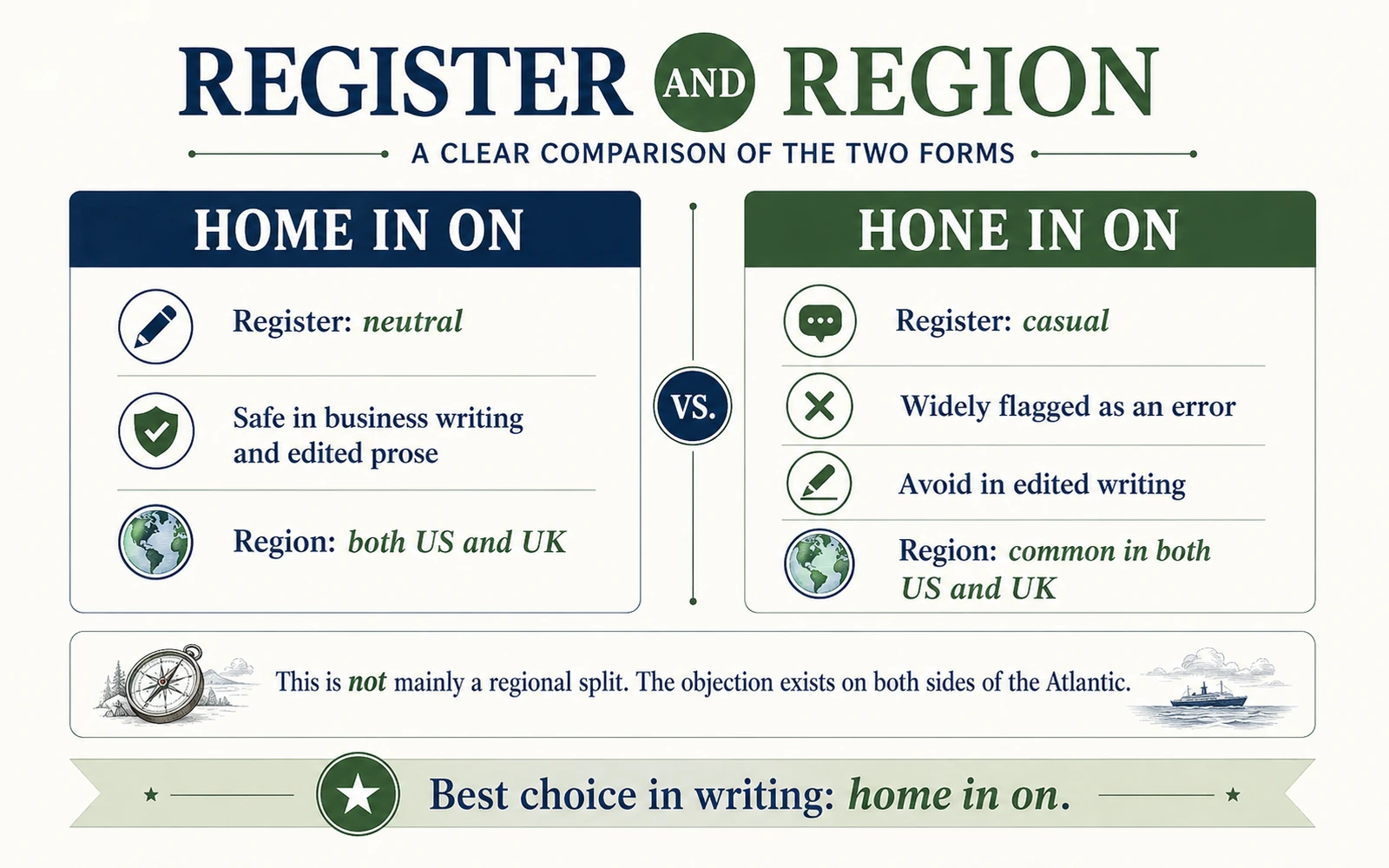
Unlike some of the pairs in this cluster, this one is not a regional split. "Hone in" is common on both sides of the Atlantic, and it is objected to on both sides too.
What is worth taking away
Two things, and the second one matters more than the phrase.
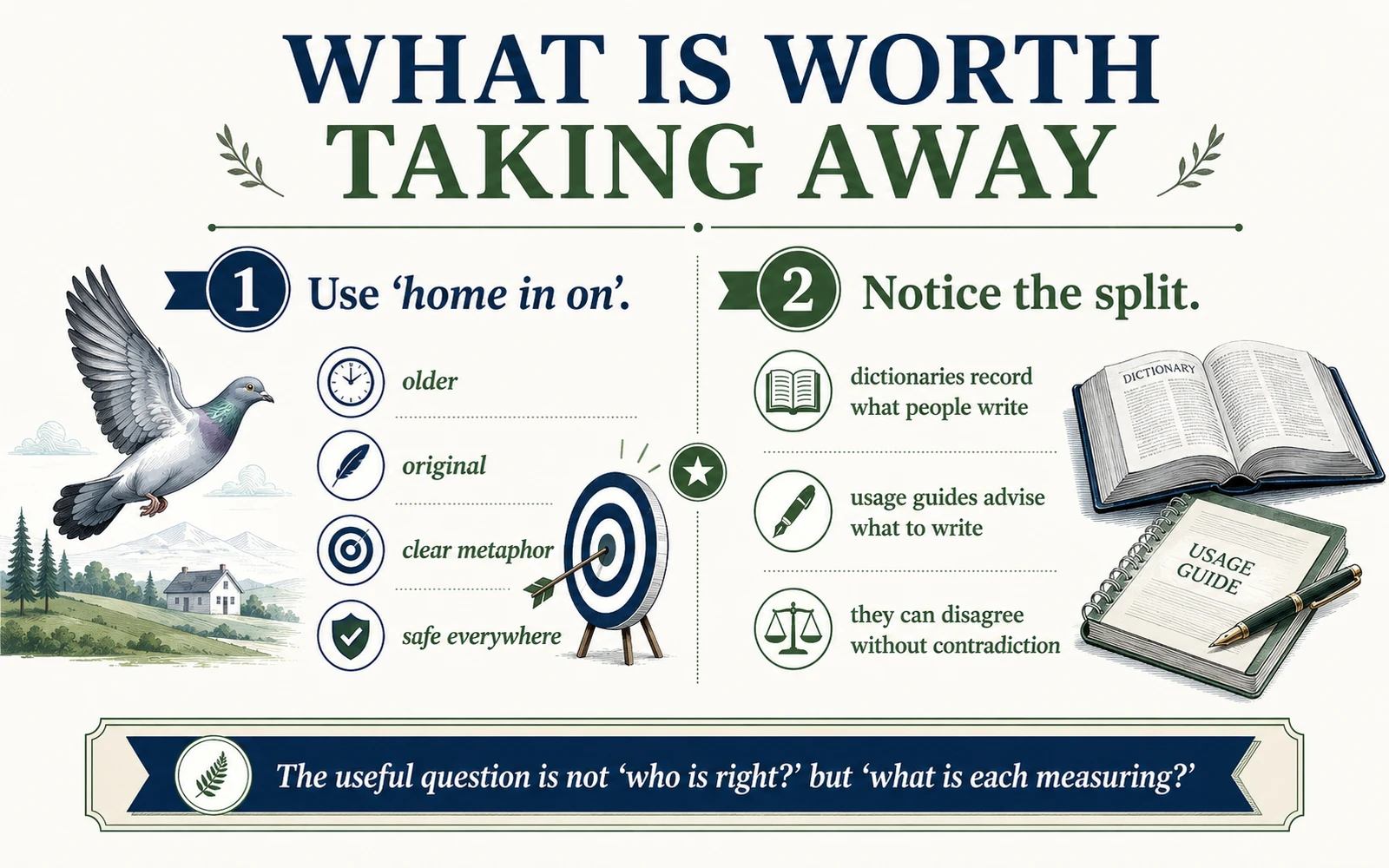
Use "home in on". It is older, it holds together as a metaphor, no reader will object to it, and it costs you nothing.
And notice what happened here. A form appeared around 1965, spread until a major dictionary had to record it, and got recorded, and the usage guides went on objecting anyway. That is not a system breaking down. That is exactly what a dictionary and a usage guide are each for. When you see them disagree, the useful question is never "who is right". It is "what is each of them measuring", and once you ask that, most usage arguments stop being arguments.