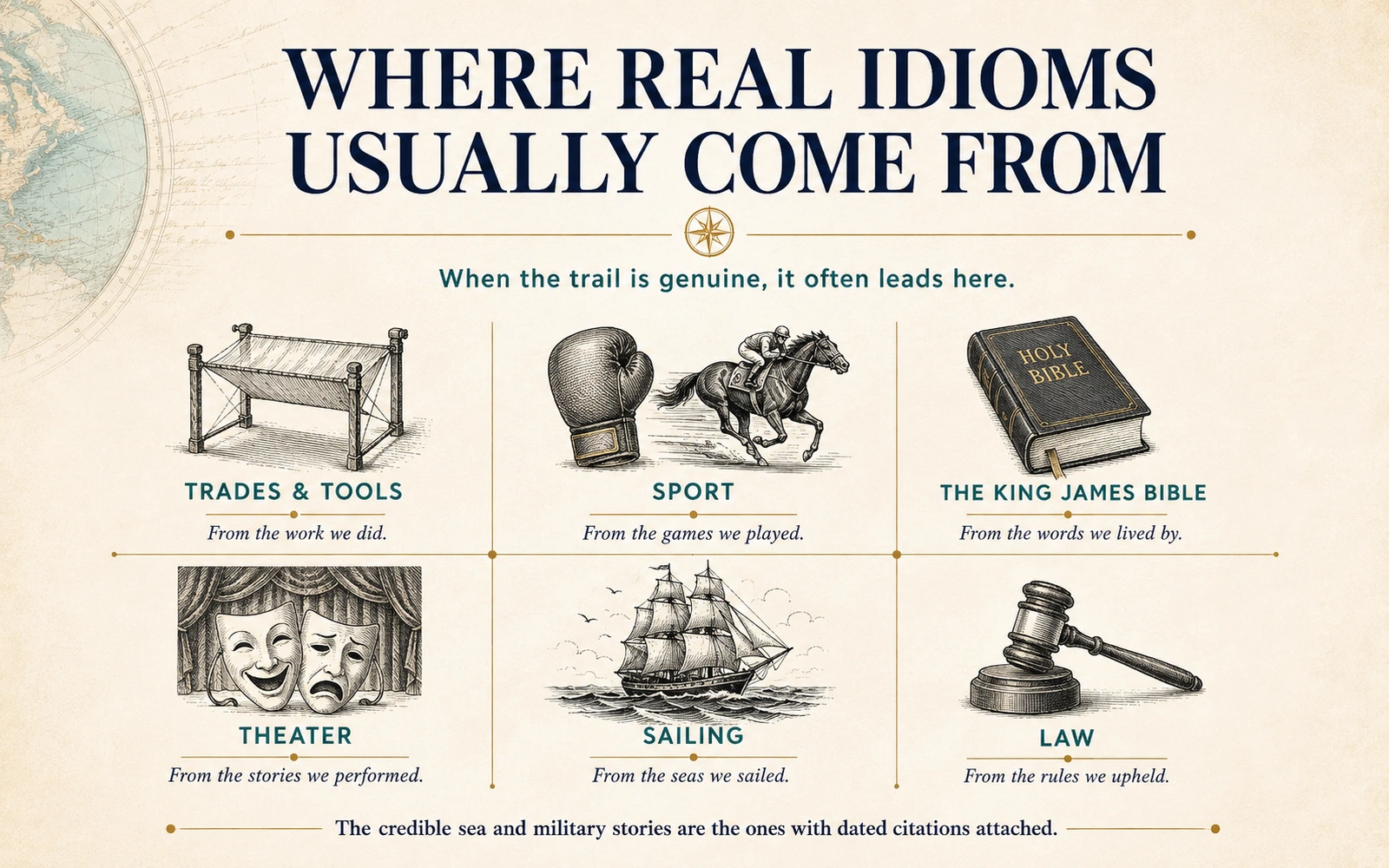
English idioms come from ordinary places: trades and tools, sport, the King James Bible, the theater, sailing and the law. But for a large share of them the true origin is not known, and many of the confident stories in circulation were invented long after the phrase itself. This page explains how a phrase origin is actually traced, so you can judge any origin story you meet.
Search almost any famous idiom and you will find a tidy explanation involving a coffin, a ship, a judge or a butcher. A good number of those explanations are supported by nothing at all. Below is the method, the three buckets every origin claim falls into, and a checklist for telling them apart.
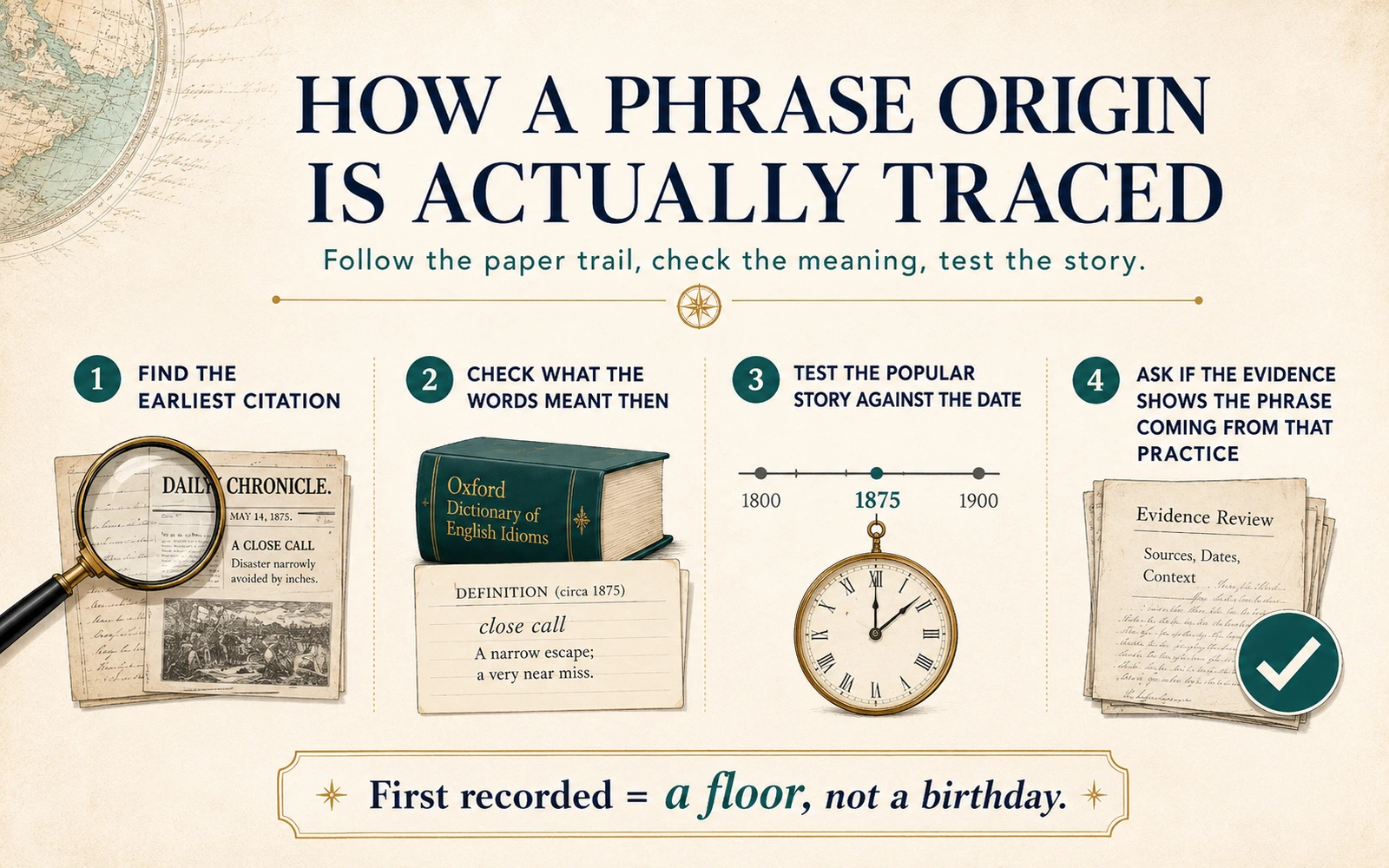
How a phrase origin is actually traced
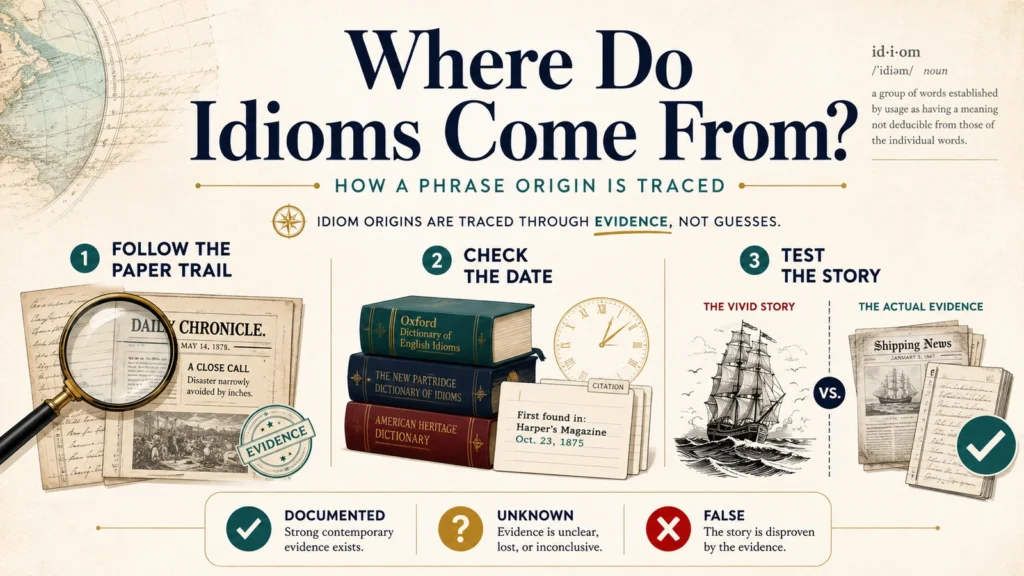
Etymologists do not reason from how well a story fits. They look for paper. The work is a hunt for the earliest surviving use of a phrase in print, then a check on what those words meant at that moment, then a test of whether the popular explanation fits the date and the meaning.
The tools are dated records: the Oxford English Dictionary's citation files, dictionaries such as Merriam-Webster, specialist references like Phrase Finder (phrases.org.uk) and Michael Quinion's Worldwide Words, plus digitized book and newspaper archives that let a researcher search millions of pages for one string of words. When somebody finds an earlier example than the one on record, the date moves. That happens often, which is why an origin claim should always name its source.
The test itself is easy to state. Does the story explain a phrase that already existed, or does the evidence show the phrase coming out of that practice? Those are very different things.
What "first recorded" actually means
A first citation is the earliest surviving example in print that anyone has found so far. It is a floor, not a birthday. People say things for years before anyone writes them down, and much of what was written down has not survived or has never been digitized.
So when a reference says a phrase is first recorded in 1866, read it as: the paper trail starts here. It does not mean the phrase was coined that year.
The floor still does real work, because it sets a limit in the other direction. If a story claims a phrase came out of a practice that ended a century before the phrase appears anywhere in print, and no earlier citation has ever surfaced, the story has a problem it needs to answer. That one test disposes of most popular origin legends.
Folk etymology and back-formed stories
Two terms are worth knowing, because writers use them loosely.
Folk etymology has a narrow sense and a broad one. Narrowly, it is speakers reshaping an unfamiliar word into a familiar-looking one, which is how "asparagus" turned into "sparrowgrass" in some dialects. Broadly, and in most articles you will read, it means a false origin story that sounds convincing.
Back-formation also has a technical sense: making a new word by cutting what looks like an ending off an old one, the way the verb "edit" came from "editor". When people call an origin story back-formed, they mean something looser but useful. The story was worked backward from the words, invented later to explain a phrase whose real source had been forgotten.
A back-formed story has a signature. It explains every word too neatly, it involves a vivid scene, and it shows up in print long after the phrase does.
The three buckets: documented, unknown, and false
Every origin claim belongs in one of three buckets, and the honest thing is to say which one.
| Bucket | What the evidence looks like | Example on this page |
|---|---|---|
| Documented | A dated citation connects the phrase to a real practice, text or trade, and the timeline fits | Pull out all the stops (pipe organ) |
| Unknown | Early citations exist, but no theory about the source has evidence behind it | The whole nine yards |
| False | A widely repeated story is unsupported, or the dates contradict it | Saved by the bell (the coffin version) |
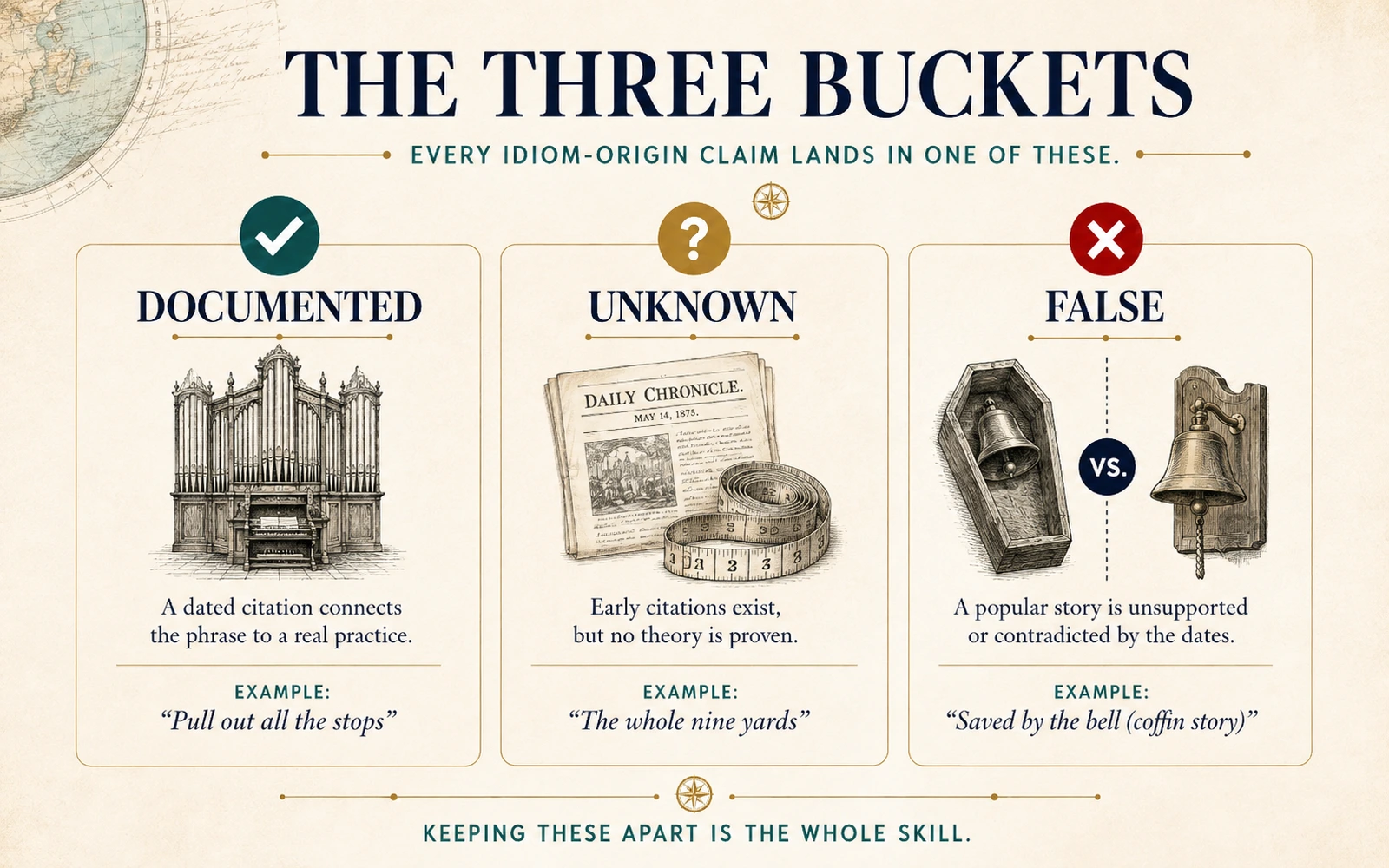
Notice which bucket the most famous stories land in. The vivid ones are usually the weak ones, and the phrases with a solid trail tend to have dull, workmanlike origins: a tool, a rope, a knob on an instrument. Most pages about idiom origins collapse all three rows into the first and present everything as settled. Keeping them apart is the whole skill.
Documented origins, and what the reference actually says
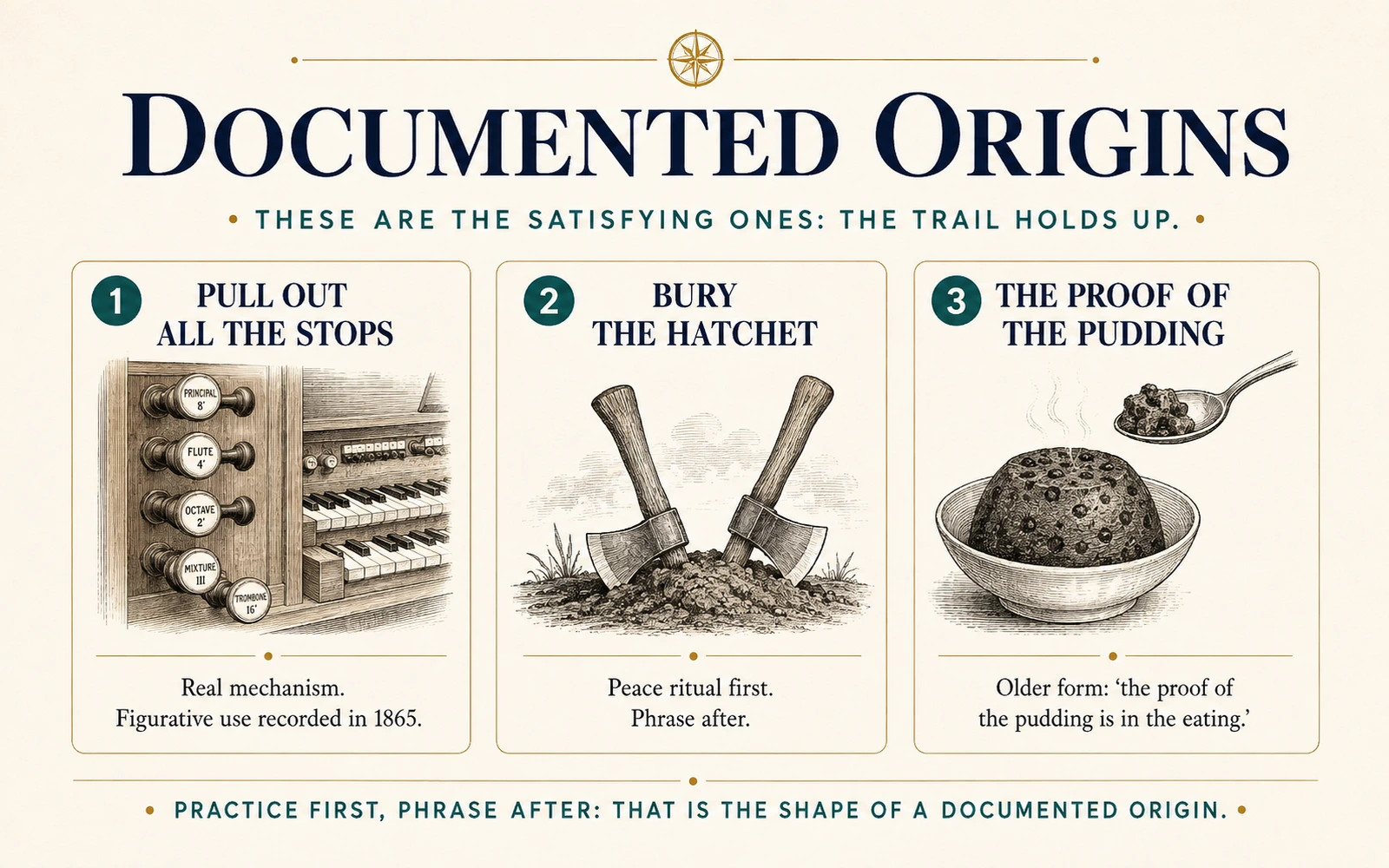
These are the satisfying ones, where the trail holds up.
Pull out all the stops
The stops on a pipe organ are the knobs that let air into each rank of pipes. Pull them all out and the instrument plays at full force. Phrase Finder gives the first figurative use as Matthew Arnold in Essays in Criticism, 1865, writing about pulling out "a few more stops" in that "somewhat narrow-toned organ, the modern Englishman". The mechanism is real, the meaning follows from it, and the citation carries a date. Register: neutral, and used on both sides of the Atlantic.
Bury the hatchet
Phrase Finder points to an Iroquois peacemaking ceremony in which weapons were literally buried, and to Samuel Sewall's 1680 account of a meeting where two axes were put in the ground as a binding sign of peace. The figurative phrase appears in print in Cadwallader Colden's history of the Five Nations, 1747, and by the nineteenth century it had spread to ordinary quarrels between individuals. Practice first, phrase after: that is the shape of a documented origin.
The proof of the pudding
Merriam-Webster explains that the modern short form, "the proof is in the pudding", is a shortening of an older sentence, "the proof of the pudding is in the eating", whose records begin in the early 1600s. The key word is "proof", which carried the sense of a test rather than evidence. A pudding of that period was a savory, sausage-like dish that could genuinely make you ill, so eating it was the only test available. The short modern form is standard usage today, not an error.
Origins nobody knows, and why that is a real answer
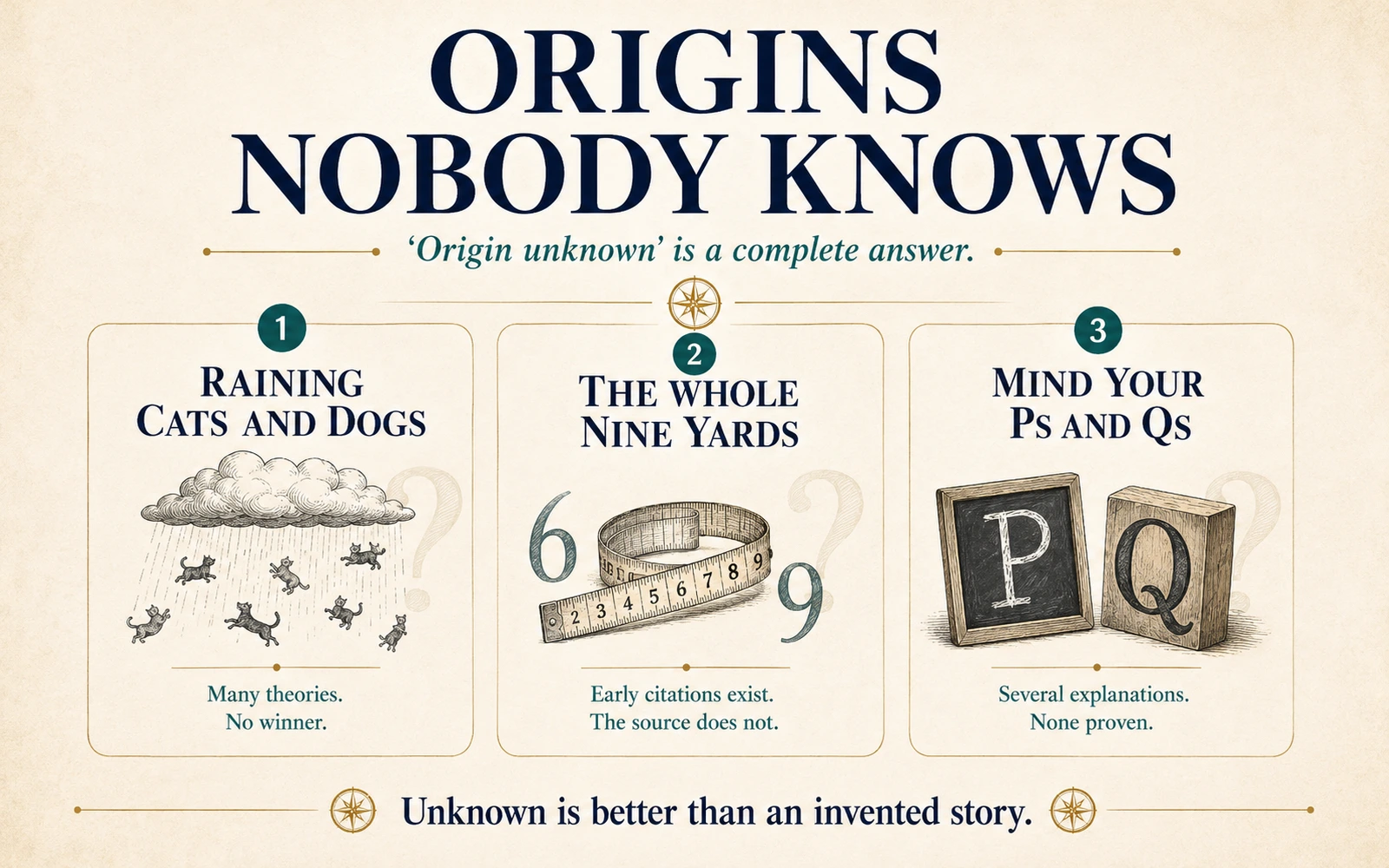
"Origin unknown" is a complete answer. Here are three phrases everyone assumes has a story.
Raining cats and dogs
The Library of Congress, in its Everyday Mysteries series, gives the earliest similar wording as Henry Vaughan's 1651 collection Olor Iscanus, which mentions a roof secure against "dogs and cats rained in shower", and notes a character in Jonathan Swift's A Complete Collection of Genteel and Ingenious Conversation, 1738, who fears it will "rain cats and dogs". As for where the image came from, the Library of Congress lists candidates including Norse mythology, the obsolete word "catadupe" meaning a waterfall, and dead animals carried along by storm water in old city streets. It supports none of them.
The whole nine yards
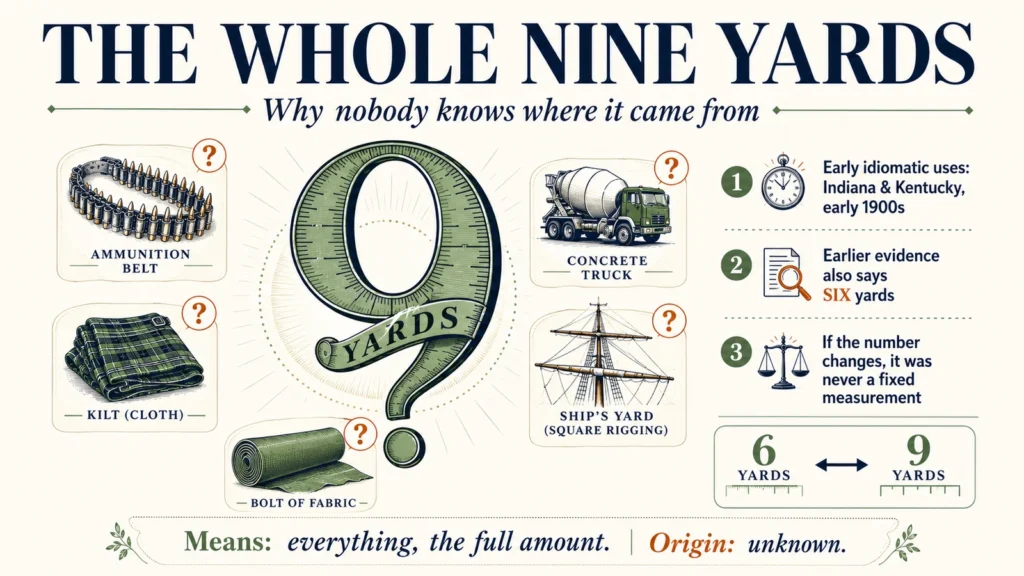
Wikipedia's article and Snopes reach the same conclusion: nobody knows. The earliest idiomatic-looking use turns up in an Indiana newspaper, the Mitchell Commercial, in a 1907 item about a baseball game, and a "whole six yards" variant appears in a Kentucky paper a few years later. That 1907 date is awkward for the most repeated theory, which places the phrase's birth in the Second World War, decades after it was already in print.
Mind your Ps and Qs
The Oxford English Dictionary's entry, as quoted by Wiktionary, calls the origin unknown, and adds that the familiar explanation about confusing the letters p and q in a schoolroom or a print shop does not fit the order in which the phrase's senses appear. Pints and quarts, printer's type, minding your pleases and thank-yous: several theories, no winner.
Origins that are false, and how the story spread
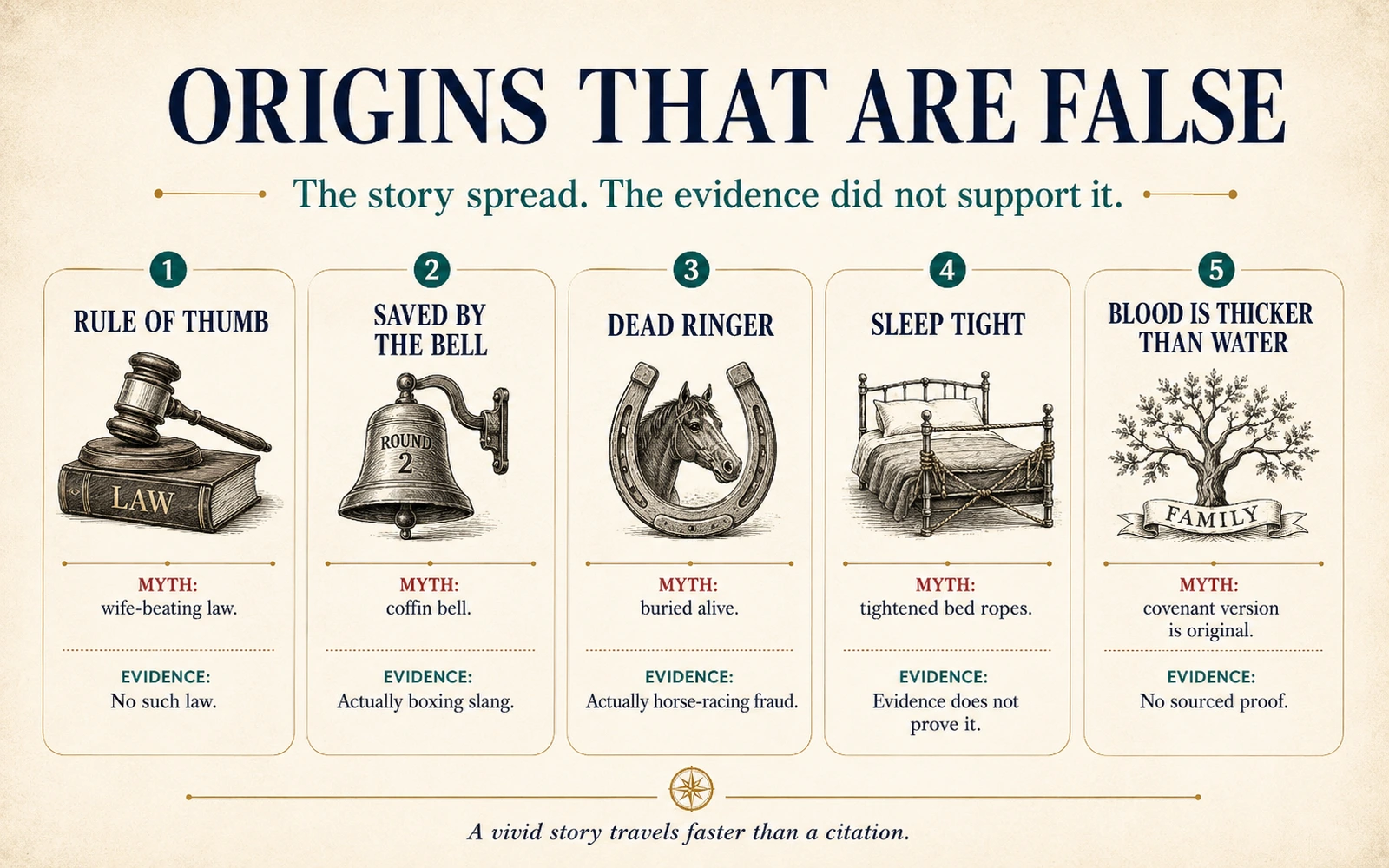
These are the ones worth knowing, because sooner or later you will be told them.
Rule of thumb
The story says an English judge ruled that a man could beat his wife with a stick no thicker than his thumb. No such law existed in England, and there is no evidence Sir Francis Buller ruled any such thing, though caricaturists mocked him as "Judge Thumb" in 1782 on the strength of a rumor. Phrase Finder gives the earliest known printed use of the phrase in a sermon by the Scottish preacher James Durham, printed in Heaven Upon Earth, 1658, about builders who "build by guess, and by rule of thumb and not by Square and Rule". Wikipedia dates the same Durham quotation to 1685, a fair reminder that the paper trail has loose ends of its own. The legal story lay quiet until the 1970s, when writing on domestic violence repeated it as history. The real origin, Phrase Finder says, is unknown, most likely one of the many ways a thumb has been used to estimate a measurement.
Saved by the bell
The popular version has a bell on a string inside a coffin, rung by someone buried alive. Phrase Finder traces the phrase to boxing slang of the late nineteenth century, with an early example in the Fitchburg Daily Sentinel of February 1893 describing a fighter saved by the bell in the early rounds. Safety coffins with bells were genuinely patented in the nineteenth century, which is why the tale survives, but there is no evidence anyone was ever saved by one and no citation connecting the phrase to them. AAP FactCheck examined the burial claim and called it wrong.
Dead ringer
Usually offered as the companion to the coffin story. Worldwide Words and Phrase Finder both trace "ringer" to American horse racing at the end of the nineteenth century, where a ringer was a horse substituted for another of similar appearance in order to defraud the bookmakers, while "dead" here means exact, as in "dead center". Nothing to do with bells or graves.
Sleep tight
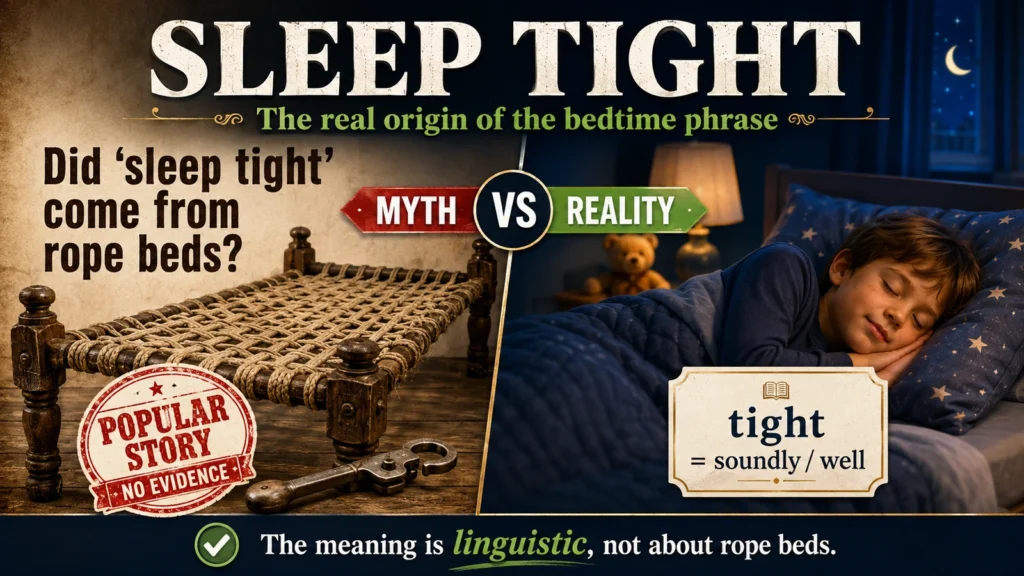
The favorite explanation is that old beds had rope supports needing regular tightening. Here the references disagree, and that is worth seeing. Phrase Finder rejects the rope story, arguing that "tight" in this phrase means soundly, that the rope version has you wishing the bed a good night rather than the sleeper, and that the OED's listing postdates the era of rope-strung beds. Michael Quinion at Worldwide Words treats the rope explanation as plausible but unproven, and notes an 1866 diary use, "Sleep tight and wake bright". Two careful sources, one unresolved question. That is an honest state of knowledge, and it is not the same thing as a confirmed origin.
Blood is thicker than water
The viral claim is that the full version runs "the blood of the covenant is thicker than the water of the womb", meaning chosen bonds beat family ones. Wikipedia's article traces the documented history instead: John Lydgate's Troy Book, 1412, has "For naturelly blod wil ay of kynde / Draw unto blod, wher he may it fynde"; the modern wording appears in a 1652 sermon by William Jenkyn; the first United States attestation is dated 1821. The covenant version is attributed to the writer Albert Jack and to Richard Pustelniak, and Wikipedia states plainly that neither cites any sources for the claim.
Where do idioms come from when the origin is real?
When a trail is genuine, it usually leads to one of a handful of places.
Trades and tools. A tenter is a frame that holds wet cloth stretched while it dries, and its hooks are tenterhooks. Worldwide Words records "on the tenters" in John Ford's play The Broken Heart, 1633, with "on the tenterhooks" arriving later that century.
Sport. Boxing gave us "saved by the bell". Horse racing gave us "ringer".
The King James Bible. "Ye are the salt of the earth" is Matthew 5:13, word for word, which is part of why the phrase still sounds formal.
Theater. "A foregone conclusion" appears in Othello, Act 3, Scene 3, and the OED's earliest example comes from that play. Careful sources add that an earliest recorded use is not proof Shakespeare coined it, only that his is the first surviving instance.
Sailing. "By and large" is a real sailing term, sailing by the wind and sailing large being two different points of sail. Phrase Finder cites William Bourne's Inventions or Devices, 1578, and the OED's earliest citation in Samuel Sturmy's The Mariner's Magazine, 1669.
Law. Phrase Finder traces "red hand" to Scottish legal language of the 1400s, describing a person caught with blood still on them, and "taken red-handed" to Walter Scott's Ivanhoe, 1819.
Notice the pattern: the credible sea and military origins are the ones with dated citations attached. The invented ones are often sea and military too, because those settings make the better story.
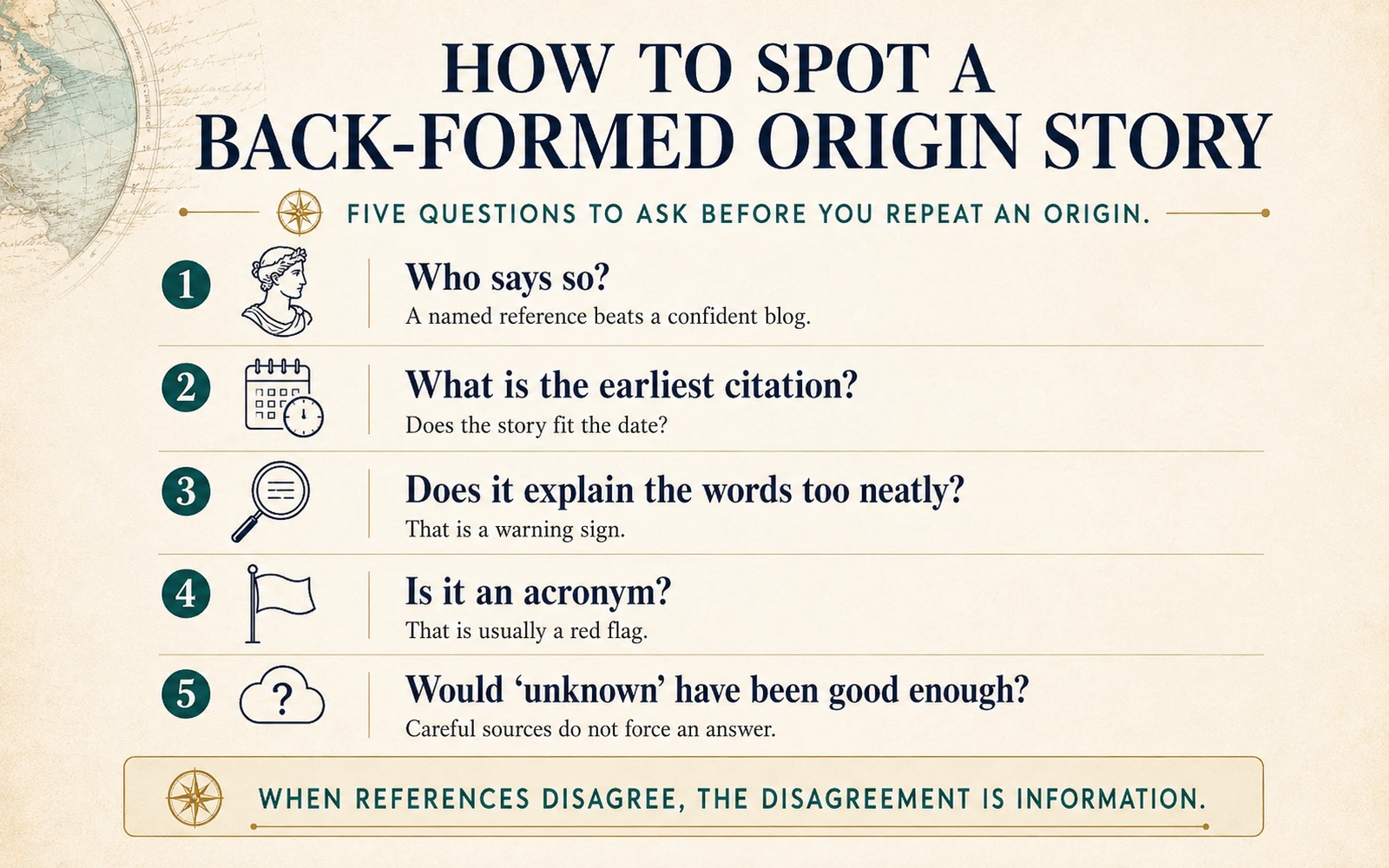
How to spot a back-formed origin story
Five questions to ask before you repeat an origin.
- Who says so? A named reference beats a confident blog. The OED, Merriam-Webster, Phrase Finder, Worldwide Words, Grammarphobia, the Library of Congress, Snopes, and Wikipedia when you follow its footnotes are all checkable. "Experts say" is not a source.
- What is the earliest citation, and does the story fit it? If the practice ended in 1750 and the phrase first appears in 1907, the story owes you an explanation for the gap.
- Does the story explain the words too neatly? Real idioms drift and blur. A story in which every word maps onto an object in one vivid scene was usually built later.
- Is it an acronym? Almost no everyday English idiom comes from an acronym. An acronym origin is a red flag by itself.
- Would "unknown" have been a good enough answer? A source with a confident answer for every phrase, including the famously unsettled ones, is not being careful.
Deep dives in this series
Each phrase below gets its own page, with the references and the dates laid out. Links appear here as each one publishes.
Rule of thumb. Saved by the bell. Sleep tight. Blood is thicker than water. The whole nine yards. Raining cats and dogs. The proof is in the pudding. The exception that proves the rule. Kick the bucket. Spill the beans. Let the cat out of the bag. Bite the bullet. Break the ice. Dead ringer. Mind your Ps and Qs. Cold turkey. Bury the hatchet. Pull out all the stops. Cat got your tongue. Turn a blind eye. Butter someone up. Under the weather. Folk etymology and how false origins spread. The idiom origins everyone repeats that the references do not support.
Frequently asked questions
How do we actually know where an idiom came from? By finding the earliest surviving uses in print and checking whether the popular explanation fits them. The OED and Merriam-Webster keep dated citation files, and researchers search digitized books and newspapers for earlier examples. If the dates and the sense of the words at that time both line up with a practice, the origin is documented. If not, it stays a theory.
Do most idioms come from sailing or the military? Some genuinely do, and "by and large" is a well documented sailing example. But nautical and military explanations are also the most common shape for invented origins, because they make vivid stories. The test is the same either way: is there a dated citation connecting the phrase to that setting, or only a story that sounds right?
Is the "rule of thumb" wife-beating story true? No. There was no English law permitting a man to beat his wife with a stick as thick as his thumb, and no evidence that Sir Francis Buller ruled any such thing, though he was mocked as "Judge Thumb" in 1782 caricatures. Phrase Finder's earliest printed use of the phrase is a 1658 sermon by James Durham about builders working by guess. The phrase's real origin is unknown.
Why do so many idiom origin stories turn out to be false? Because a phrase outlives the world that produced it. Once the original sense is forgotten, people fill the gap with a story that explains the words, and a vivid story travels faster than a citation. Nothing dishonest has to happen for a folk etymology to take hold. It only needs to be more memorable than "origin unknown".