The Nelson story is the best-known origin anecdote in English. At Copenhagen in 1801, ordered by signal to break off the attack, Horatio Nelson raised a telescope to the eye he had lost and announced that he could not see the signal. The phrase "turn a blind eye", the story concludes, comes from that moment.
Phrase Finder records the phrase in print in 1800, the year before Copenhagen. It also notes that Nelson did not use the words "turn a blind eye" at all. Both halves of the story fail, and they fail in ways worth separating, because the anecdote is not simply false. It is misfiled.
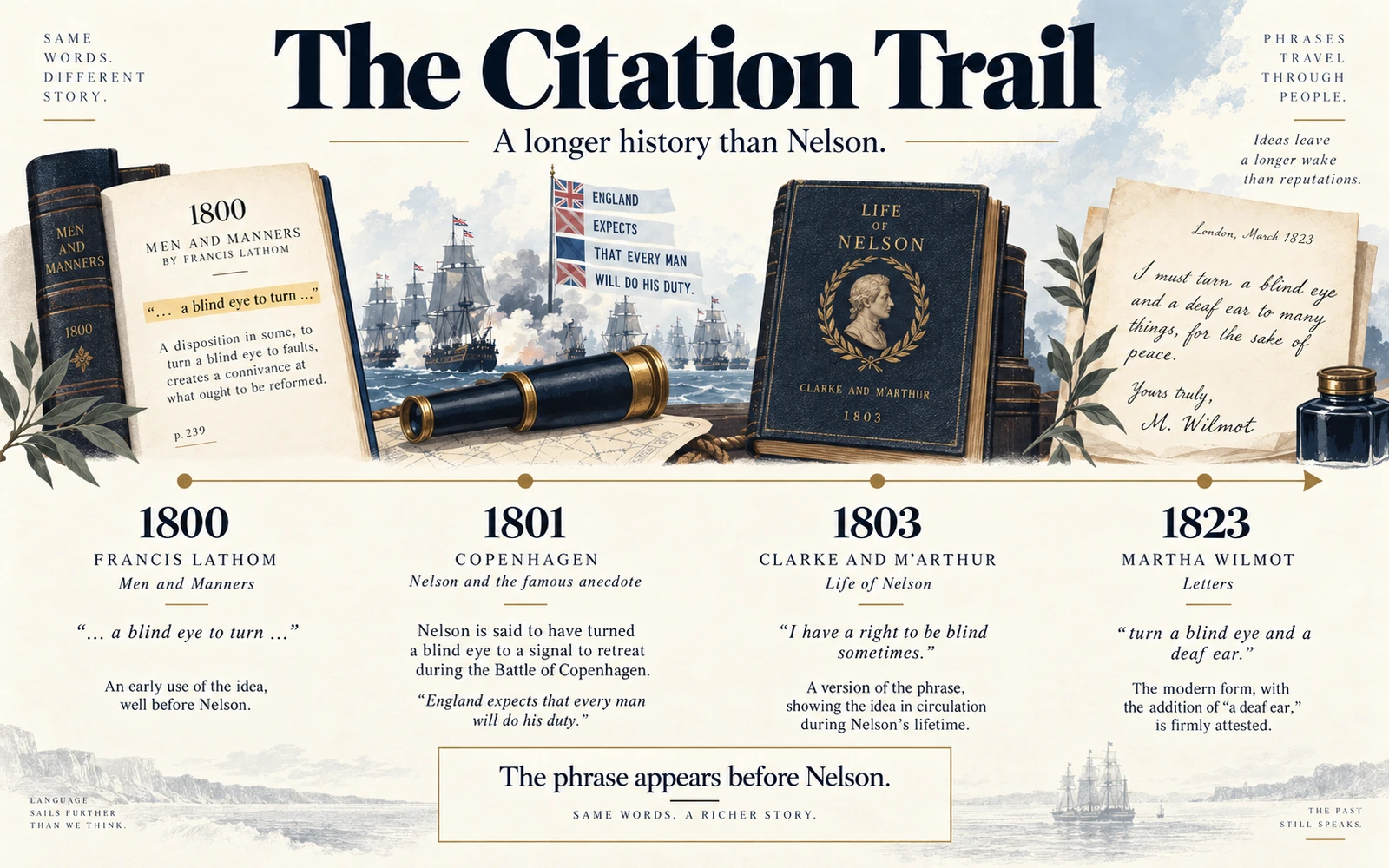
The citation trail
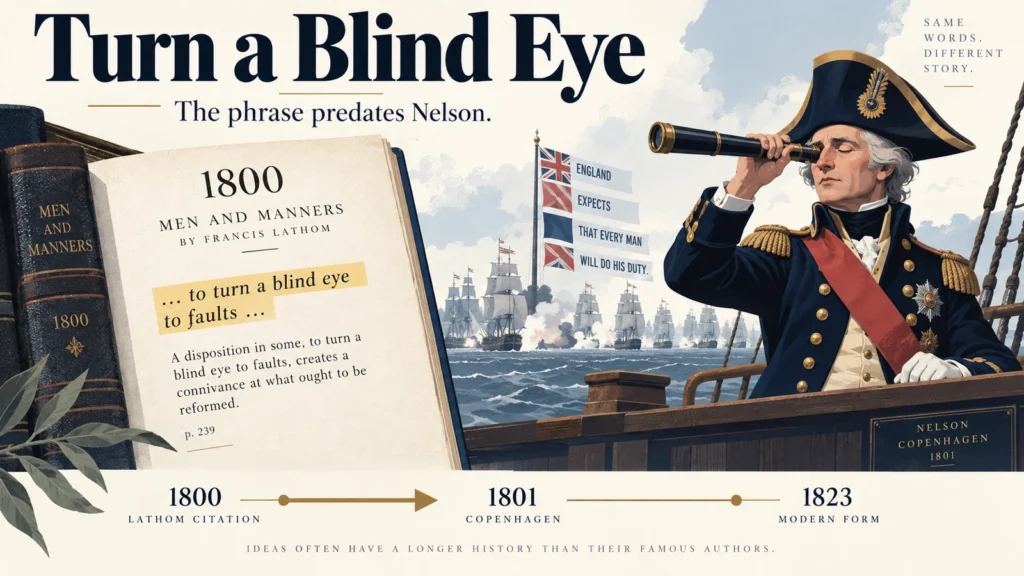
1800, Francis Lathom, Men and Manners. A character says: "It is lucky for the poor man he has a blind eye to turn to her." This predates Copenhagen. The construction is not yet the modern fixed form, but the image is fully present and being used figuratively.
1801, Copenhagen. The battle. What Nelson actually said, or whether he said anything of the kind, is a separate question from what phrase he used.
1803, Clarke and M'Arthur, Life of Nelson. The source of the famous quotation, which Phrase Finder gives as: "You know, Foley, I have only one eye, and I have a right to be blind sometimes, I really do not see the signal." Note what is in that line and what is not. Nelson, as reported, says he has a right to be blind. He does not say he is turning a blind eye.
1823, Martha Wilmot's correspondence. "Turn a blind eye and a deaf ear every now and then, and we get on marvellously well." Phrase Finder calls this the first recorded use in the form we use today.
We report all four as Phrase Finder reports them. None of the primary sources was opened.
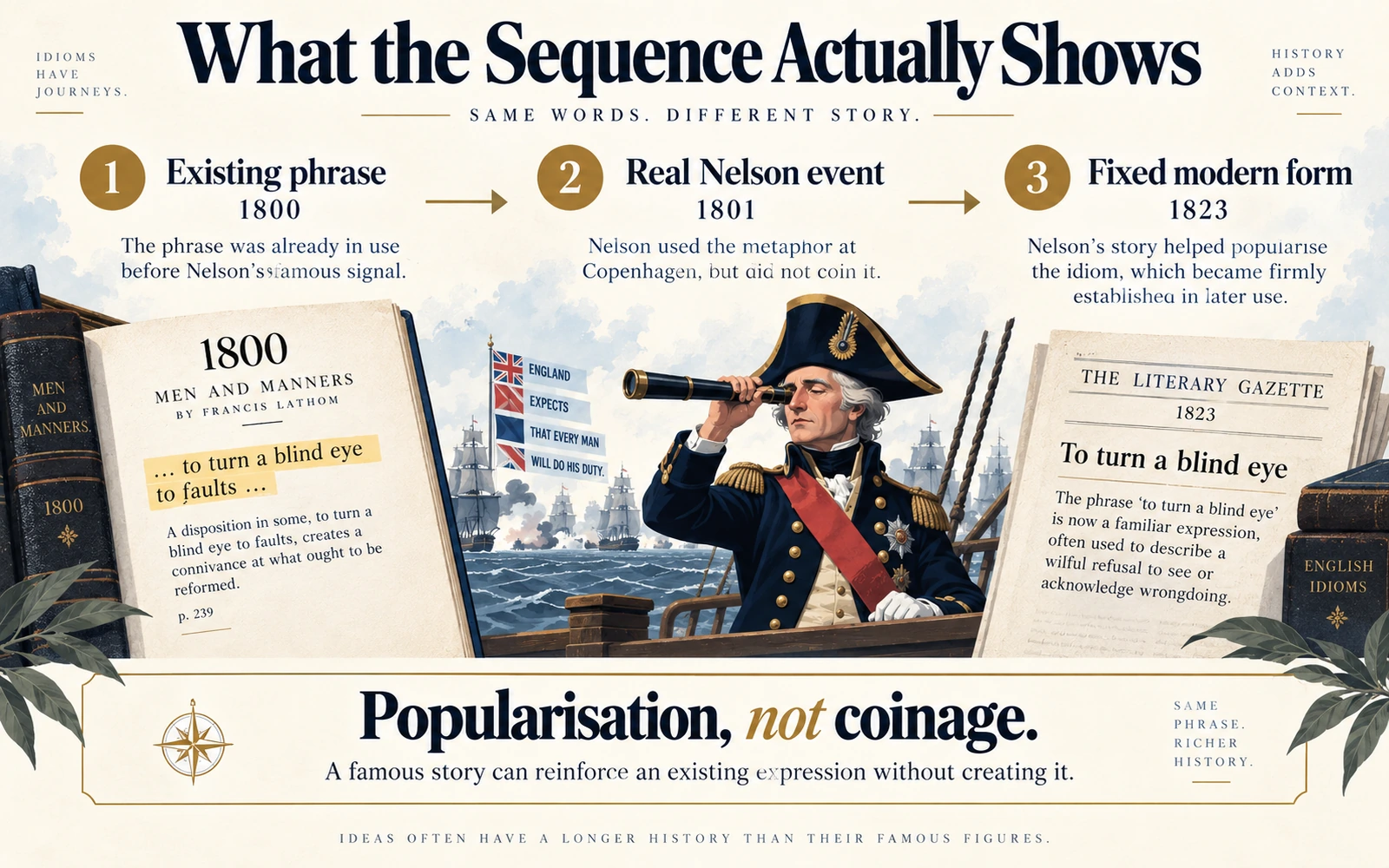
What the sequence actually shows
Laid out in order, the dates tell a story that is more interesting than the one they replace.
The phrase existed before Nelson, in a novel, in ordinary figurative use. Nelson then did something at Copenhagen that a biography described two years later in words that are close to the phrase without being the phrase. And the fixed modern form appears in print twenty years after the battle.
That is a popularisation, not a coinage. The most plausible reading of the sequence is that an existing expression was hugely reinforced by a famous story attached to a national hero, and that the story is why the phrase became fixed and common rather than why it exists. The tracing method behind these pages treats these as two different questions for exactly this reason, and a great deal of confusion comes from asking one and answering the other.
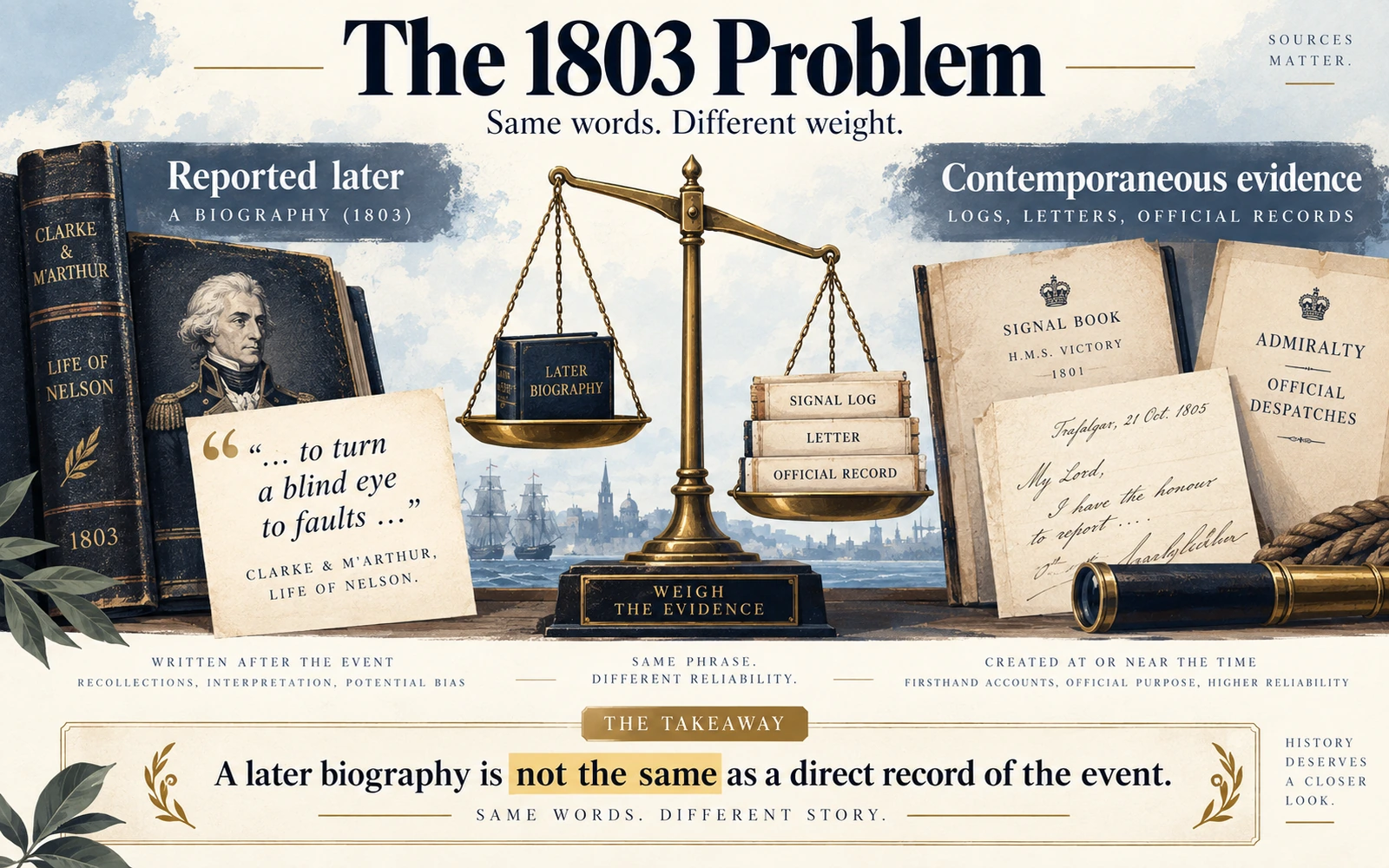
The 1803 problem
There is a second issue underneath the dating one, and it is the more serious of the two.
The Nelson quotation comes from a biography published in 1803, two years after the event, by authors writing in the immediate aftermath of his fame. A remark reported that way is not the same kind of evidence as a signal log or a contemporaneous letter. It may be accurate. It may be improved. Biographies of national heroes written at the peak of national feeling are not a genre with a strong record for restraint.
None of that means the anecdote is invented. It means the citation is a report of a quotation rather than the quotation itself, which is precisely the distinction that has to be tracked in this niche and is almost never tracked. It is the same problem that sits underneath the memoir-quoting-an-earlier-line tangle behind "sleep tight": the date on the book is not the date of the thing the book describes.
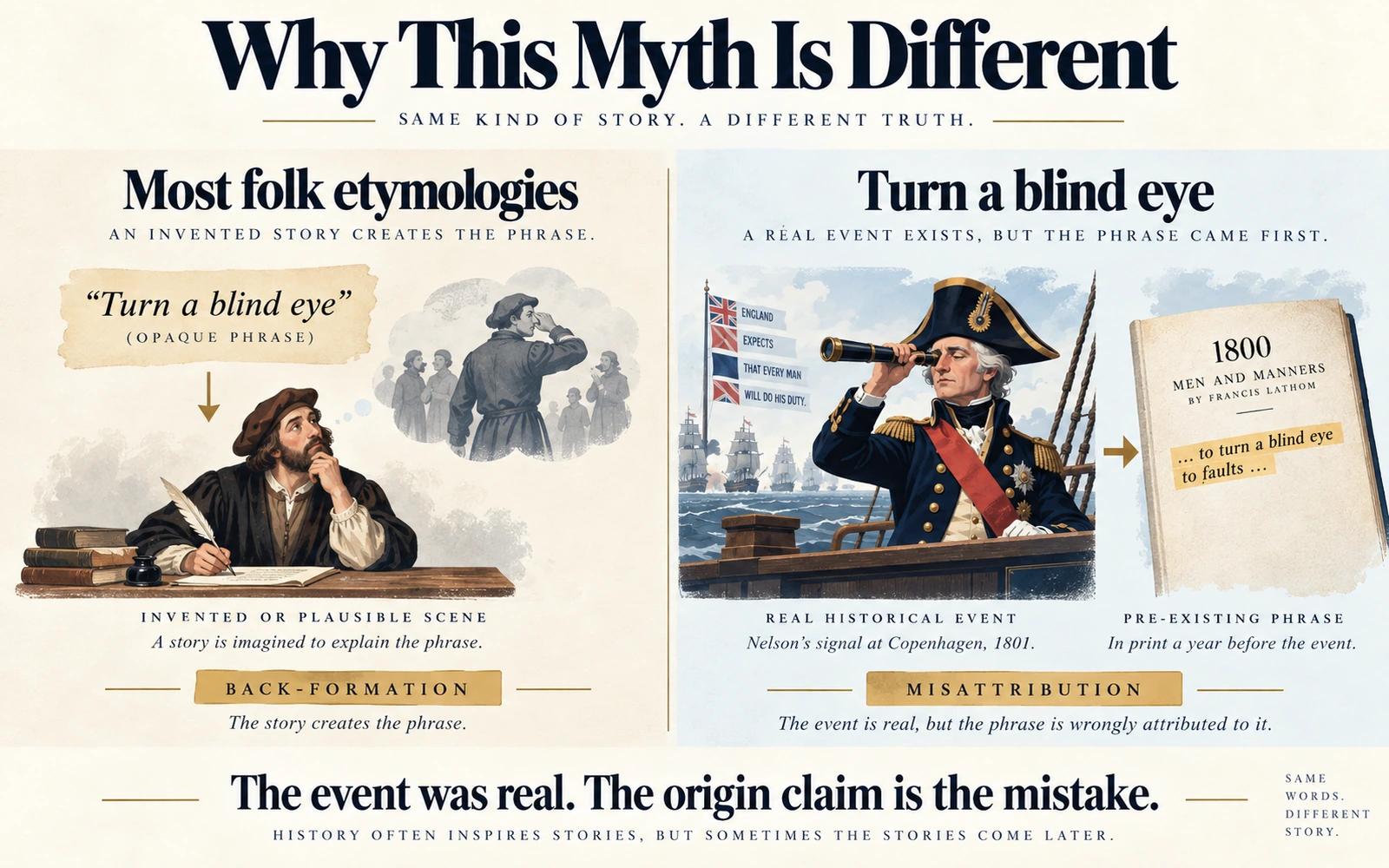
Why this myth is different from the others
Most of the false origins in this cluster are back-formations. Somebody met an opaque phrase and reasoned backwards to a scene that would produce it, which is what happened to "the whole nine yards" and to the invented courtroom behind "rule of thumb".
This one runs the other way. The scene came first and was real. There was a battle, there was a signal, there was a commander with one eye, and something happened. The error is not invention. It is attribution: a real event has been given credit for a phrase that was already in the language.
That makes it harder to dislodge than an ordinary myth, because everything in it is true except the connection. And it makes it a better teaching case than most, because it shows that checking an origin story is not the same as debunking it. Here the story survives almost intact and only its role changes.
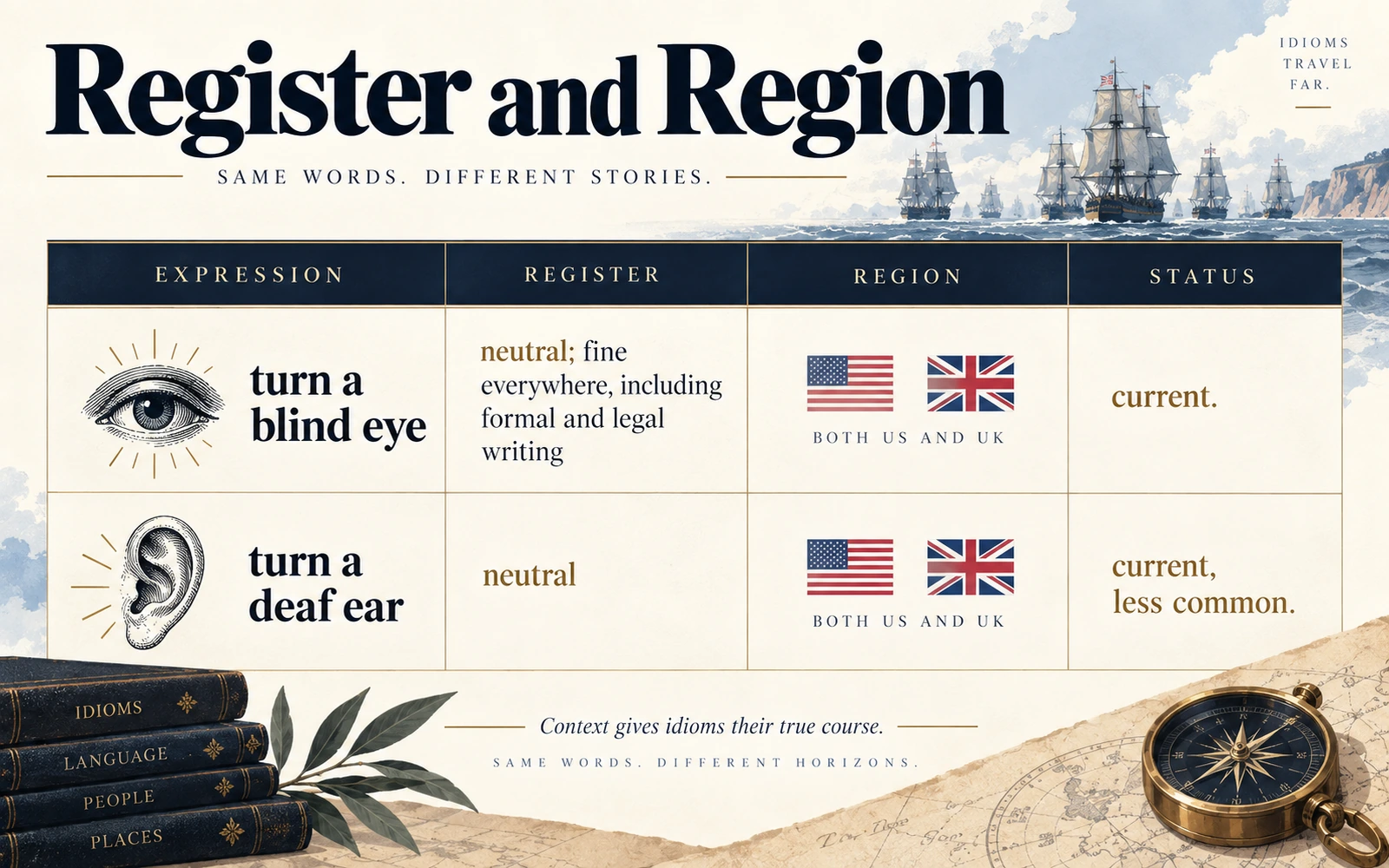
Register and region
| Register | Region | Status | |
|---|---|---|---|
| turn a blind eye | neutral. Fine everywhere including formal and legal writing, where it is common | both US and UK | current |
| turn a deaf ear | neutral, and the other half of the 1823 citation | both US and UK | current, less common |
What is genuinely unresolved
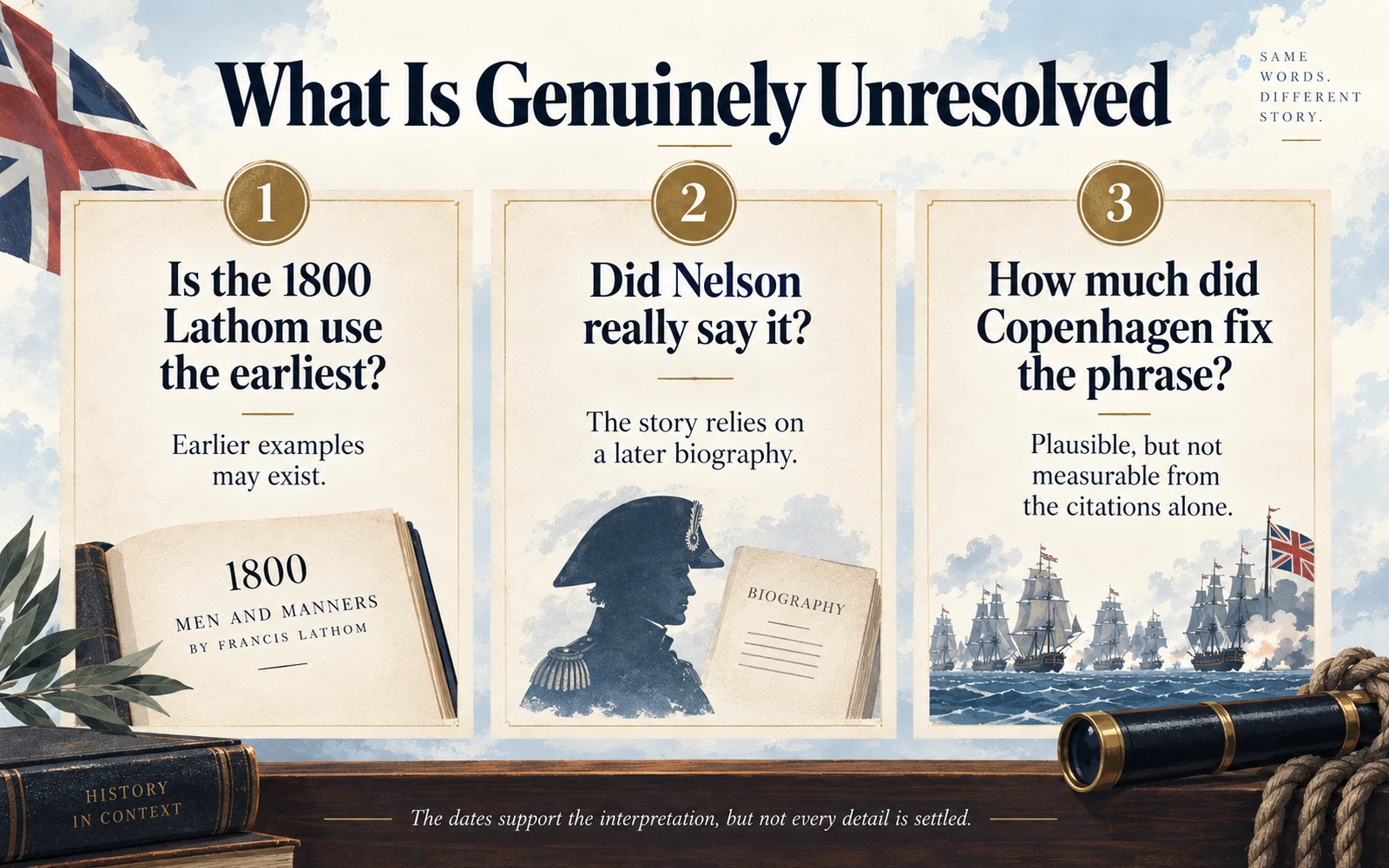
Whether the 1800 Lathom use is the earliest is unknown. It is the earliest Phrase Finder gives. Earlier ones may exist.
Whether Nelson said anything of the sort is not established. The only source given is a biography published two years later.
How much the Copenhagen story contributed to fixing the phrase cannot be measured from these citations. The account offered here is the reading the dates best support, not a demonstrated causal chain, and it is offered as such.