Short answer: the American idioms British don't understand are mostly sports idioms, and the sport is usually baseball or American football. "Out of left field," "ballpark figure," "touch base," "rain check," "step up to the plate," "Monday-morning quarterback" and "Hail Mary" all make perfect sense once you know the game, and very little sense if you grew up on cricket and soccer. Below, each phrase comes with the bit of the sport it depends on, its meaning, its register, and a plain alternative for a British or international reader.
The quick table
| American idiom | Sport | What it means | Register | Plain alternative |
|---|---|---|---|---|
| out of left field | Baseball | Completely unexpected | Casual to neutral | out of nowhere |
| ballpark figure | Baseball | A rough estimate | Neutral, common in business | rough estimate |
| touch base | Baseball | Briefly get in contact | Neutral, business | check in, catch up |
| rain check | Baseball | Accept an offer for a later date | Casual | another time |
| step up to the plate | Baseball | Take on a responsibility | Neutral | step up, volunteer |
| strike out | Baseball | Fail | Casual | fail, get nowhere |
| Monday-morning quarterback | American football | Someone who criticizes with hindsight | Casual | wise after the event |
| Hail Mary | American football | A desperate last attempt | Casual to neutral | last-ditch attempt |
| slam dunk | Basketball | A sure thing, easy success | Casual to neutral | a certainty |
The register labels and the alternatives are our own guidance. The meanings and regional labels come from the references named in each section below.
Why sports explain most of the gap
Every variety of English borrows idioms from its national games. British English gets "sticky wicket" and "hit for six" from cricket; American English gets a far larger everyday set from baseball and American football. Much of that set has moved from the ballpark into the office, which is exactly where British colleagues meet it without the background.
The trouble is not the words. "Left field" and "plate" are ordinary English. The trouble is the picture behind them. An idiom works by calling up a scene the listener already knows, and a British listener who has never watched a baseball game has no scene to call up. So the phrase arrives as noise.
That is the useful way to think about the whole list: learn a handful of sports facts, and a dozen idioms decode themselves.
Baseball in 150 words, for the non-American reader
A pitcher throws the ball toward the batter, who stands beside a flat marker called home plate. The batter gets three chances to hit a fair pitch. Three misses, or strikes, and the batter is out, which is a strikeout. A batter who hits the ball runs around four bases set out in a square, touching each one, and scores a run on arriving back at home plate.
The fielding side spreads out across the ground. The part nearest the batter is the infield; the grassy area beyond is the outfield, split into left, center and right field as seen from home plate. The whole stadium is a ballpark.
Games are played outdoors in summer, so rain can stop play, just as it does in cricket. With that in hand, most of the next section reads itself.
Baseball: the source of most American idioms British don't understand
Out of left field
Meaning something completely unexpected, as in "her resignation came out of left field." The Phrase Finder's entry on "out of left field," which we read on September 27, 2026, quotes the Random House Historical Dictionary of American Slang: the likeliest explanation is that the throw from deep left field is one of the longest on the diamond. The same entry reports that baseball researcher Ken Liss found the figurative sense in the Boston Herald of October 8, 1919, and that the "surprise hit" use appears in Billboard by 1943.
The Phrase Finder also rejects two popular stories: a mental hospital behind a Chicago ballpark, and Babe Ruth's position at Yankee Stadium. Ruth joined the Yankees in 1920, after the phrase was already in print. The related "out in left field" means eccentric or out of touch.
This one has crossed over further than most. Wiktionary's entry for "left field" quotes a 2024 issue of RAIL, a British magazine, calling an appointment a "left-field move."
Ballpark figure
A rough estimate. The idea is that two numbers "in the same ballpark" are close enough to be compared. The Phrase Finder's entry on "ballpark figure," read on September 27, 2026, gives "in the same ballpark" in The Windsor Star of Ontario in February 1942, and "a ballpark figure" in The Morning Herald of Maryland in May 1944. A reader note on the same page points to a figurative "ballpark" from 1926.
Touch base
To make brief contact, usually to update each other: "let's touch base on Friday." In the game, a runner has to touch each base. Wiktionary labels the idiom Canadian and American English. It is firmly business register, and some British readers find it a little corporate even when they understand it.
Rain check
To "take a rain check" is to turn down an offer now while asking to accept it later. Wiktionary's etymology says baseball teams reissued tickets for games postponed by rain from at least 1870, and those tickets became known as rain checks. It dates a metaphorical use to 1896 and broader general use to 1930. Wiktionary also lists a shop sense: a promise to honor an advertised price when an item is sold out, a use British shoppers are unlikely to have met.
Step up to the plate
To take responsibility or take action. The batter "steps up to the plate" to take a turn. Wiktionary calls the idiom chiefly American. British English already has the shorter "step up," which does the same job without the sport.
Strike out
To fail, from the batter's three missed strikes. American speech also uses "three strikes and you're out" for a rule that allows two mistakes and no third. We found no dated first use in the references we checked, so we give none here.
American football: quarterbacks and last prayers
A short primer: in American football, which Americans simply call football, a team has four attempts, called downs, to move the ball ten yards. The quarterback directs the attack and throws most of the passes. Professional games are mostly played on Sundays.
Monday-morning quarterback
Someone who criticizes a decision after the fact, with the benefit of hindsight. Wiktionary labels it US and idiomatic, and explains the image: professional games are on Sunday, so Monday is when fans pick apart the quarterback's choices. Its etymology note adds that the term may have started with college football, played on Saturdays. The earliest quotation Wiktionary gives is from Popular Mechanics in 1958, but that is an example, not a documented first use. Wiktionary lists "wise after the event" among its related terms, and that is the natural British equivalent.
Hail Mary
A desperate last attempt with a small chance of success. A Hail Mary pass is a very long throw made by a losing team as time runs out, named after the Catholic prayer. Wiktionary defines the extended sense as "an act done in desperation, with only a very small chance of success" and says the football term has been attested since the 1970s. Some pages credit it to one famous 1975 game; the references we checked do not confirm that as the first use, so treat it as the popular story.
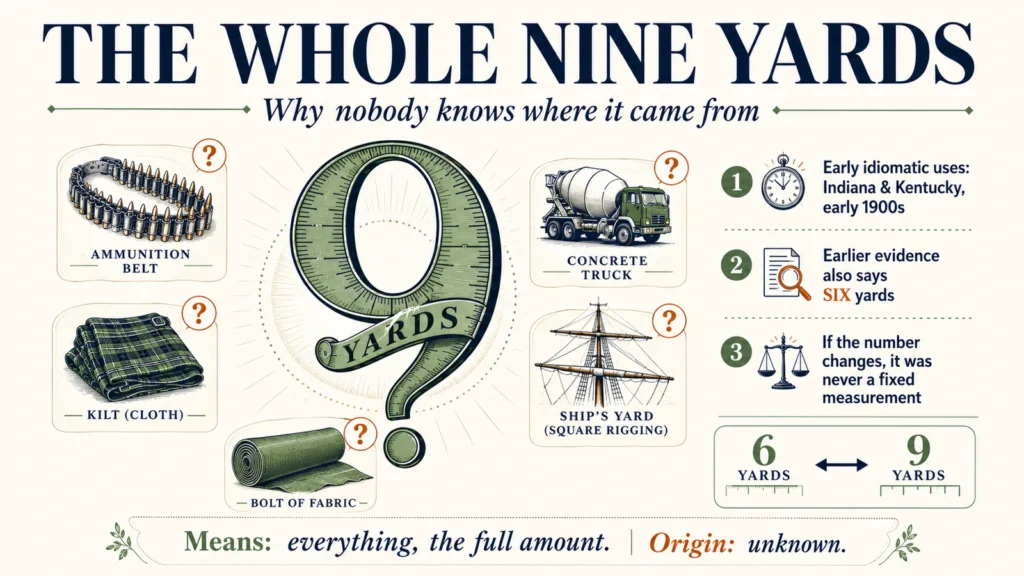
The whole nine yards
This one is often explained with football yardage, but that story does not hold up. Nobody has settled the origin, as our page on why nobody knows where the whole nine yards comes from sets out.
Basketball: slam dunk
In basketball, a slam dunk is when a player jumps and forces the ball down through the hoop, the most certain way to score. Wiktionary gives the idiomatic sense as "a task expected to present no difficulty," with the example "As long as you get the vice president's approval first, it'll be a slam dunk." British English would say "a sure thing" or "a piece of cake."
Which ones travel, and which ones do not
Some sports idioms need no translation at all. Wiktionary notes that "drop the ball," meaning to fail at a responsibility, alludes to baseball, American football and cricket alike, so a British reader has the picture already.
Others travel poorly because the image is purely American. "Monday-morning quarterback" and "Hail Mary" depend on knowing both the position and the weekly schedule of the game. "Touch base" and "ballpark figure" sit in between: widely heard in international business, but still marked as American. That is our reading of how they are used, not a measured figure.
Sports are not the only source of confusion. A few everyday American forms catch British ears for other reasons. The most famous is "I could care less," which means the same as the British "I couldn't care less"; we cover what the references say about could care less vs couldn't care less on its own page.
Using these with a British or international audience
- In a business email to a UK colleague: "touch base" and "ballpark figure" will usually be understood, but "check in" and "rough estimate" are clearer and cost nothing.
- In a talk or presentation: avoid "Hail Mary" and "Monday-morning quarterback" unless the room is American. Say "last-ditch attempt" and "easy to judge in hindsight."
- For ESL readers: sports idioms are among the hardest to decode, because the dictionary meaning of every word is correct and still unhelpful. If you use one, add the plain meaning in the same sentence.
- In casual conversation: use them freely with Americans and Canadians. Wiktionary's Canadian label on "touch base" is a reminder that several of these are North American, not only American.
If you want to know how references date phrases like these, and why a newspaper from 1919 counts for more than a good story, see how a phrase origin is traced.
Frequently asked questions
Why are there so many baseball idioms in American English?
Baseball is an old and central American game, and its vocabulary moved into everyday speech early. The references above date the figurative "rain check" to 1896 and "out in left field" to 1919.
What is the British equivalent of "Monday-morning quarterback"?
"Wise after the event," which Wiktionary lists as a related term. Both describe someone who judges a decision only after seeing how it turned out.
Do British people say "ballpark figure"?
Many understand it, especially in business, and some use it. It is still recognized as an American phrase. "Rough estimate" or "rough idea" is the safe choice if you are unsure.
What does "take a rain check" mean?
It means you are declining an offer now but would like to accept it another time. The phrase comes from the reissued tickets baseball clubs gave fans when rain stopped a game.
Is "touch base" rude or too informal for work?
Neither. It is neutral business language. Some readers find it a little corporate, so in formal writing "contact" or "update" is plainer.