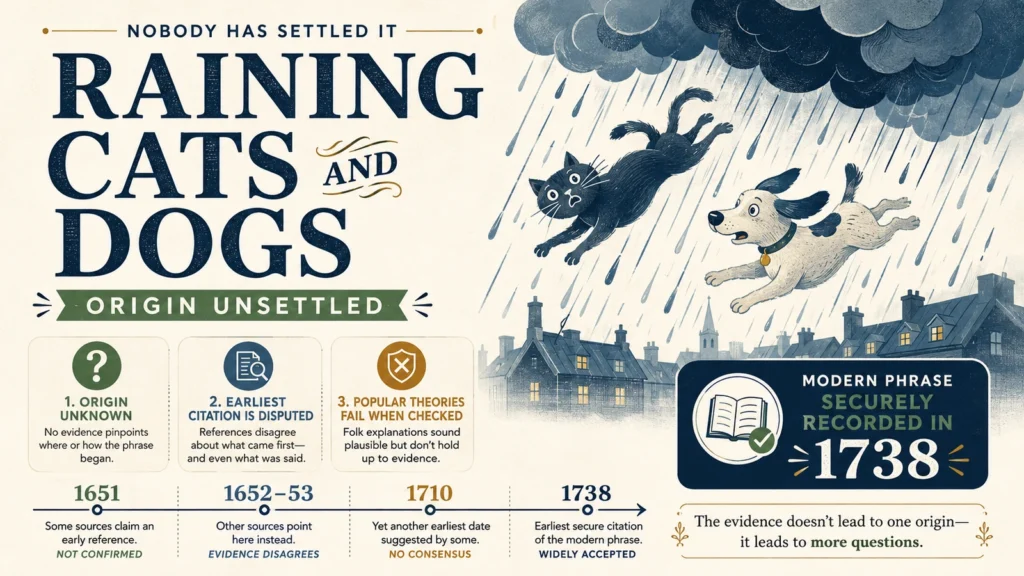
Nobody knows where "raining cats and dogs" comes from. That is not a hedge, it is the finding, and it is what every reference that has actually looked into the phrase concludes.
What makes the phrase worth a page is not the answer. It is that the confident explanations you have probably heard are all rejected by the people who checked them, and that the references cannot even agree on when the phrase was first written down. There are at least three candidate first citations in circulation and they are eleven decades apart.
The citation trail, and where it splits
Four references, laid out in the order they place the evidence.
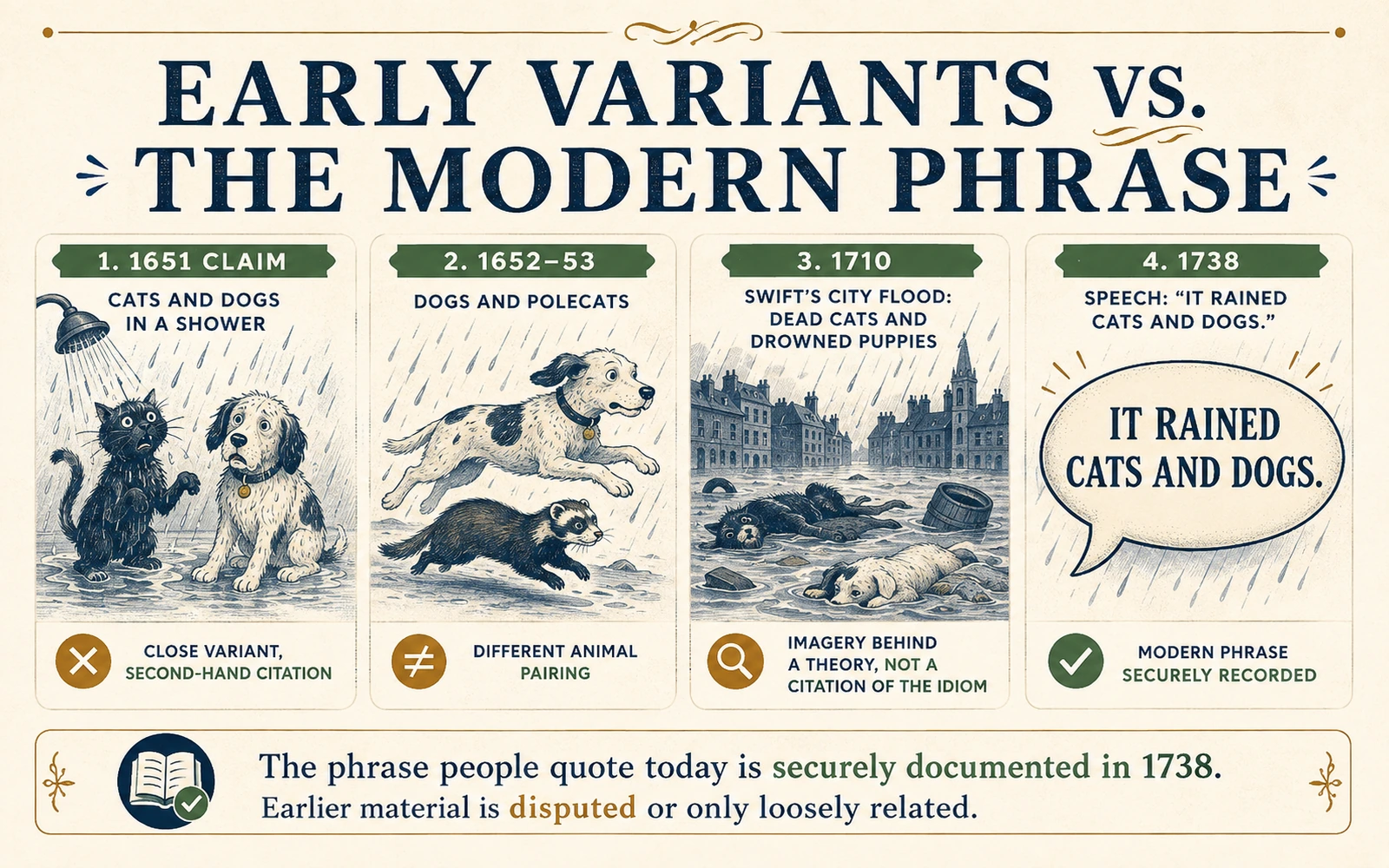
1651, Henry Vaughan, Olor Iscanus. The earliest date in circulation. Vaughan is said to have written of a roof that was secure against "dogs and cats rained in shower". This citation is attributed to the Library of Congress's Everyday Mysteries answer on the phrase. We were not able to load that page: loc.gov returned an HTTP 403 to two attempts on 26 August 2026, at both addresses the search index holds for it. The citation is repeated widely by pages that quote the Library of Congress, and it does not appear in any of the three references we could read. It is recorded here as a claim attributed to the Library of Congress rather than as one this page has verified, and it deserves a direct check.
1652 or 1653, Richard Brome, The City Wit. A variant rather than the phrase: "It shall rain dogs and polecats", or in World Wide Words' transcription, "It shall raine … Dogs and Polecats". Wikipedia dates the play to 1652 and spells the title The City Witt. World Wide Words and Phrase Finder both date it 1653. The discrepancy is small and it is real, and there is no reason to hide it behind one date chosen at random.
1710, Jonathan Swift, "A Description of a City Shower". Not the phrase. A poem describing what a heavy rain washed down the streets of London, including drowned puppies and dead cats among the debris. Wikipedia quotes "Drowned puppies, stinking sprats" and "Dead cats and turnip-tops come tumbling down the flood". This poem matters because it is the evidential basis for one of the theories below, and because it is regularly misread as a citation of the idiom, which it is not.
1738, Jonathan Swift, A Complete Collection of Polite and Ingenious Conversation. The first record of the modern phrase. World Wide Words gives the line as "I know Sir John will go, though he was sure it would rain cats and dogs". Phrase Finder cites the same work. This is the citation the two references we could read agree on.
| Date | Source | Is it the phrase? | Which references carry it |
|---|---|---|---|
| 1651 | Henry Vaughan, Olor Iscanus | a close variant, "dogs and cats rained in shower" | attributed to the Library of Congress; absent from Wikipedia, World Wide Words and Phrase Finder |
| 1652 or 1653 | Richard Brome, The City Wit / The City Witt | a variant, "dogs and polecats" | Wikipedia (1652), World Wide Words (1653), Phrase Finder (1653) |
| 1710 | Swift, "A Description of a City Shower" | no. Dead animals in flood water, not falling from the sky | Wikipedia, World Wide Words, Phrase Finder |
| 1738 | Swift, Polite and Ingenious Conversation | yes, the modern wording | World Wide Words, Phrase Finder |
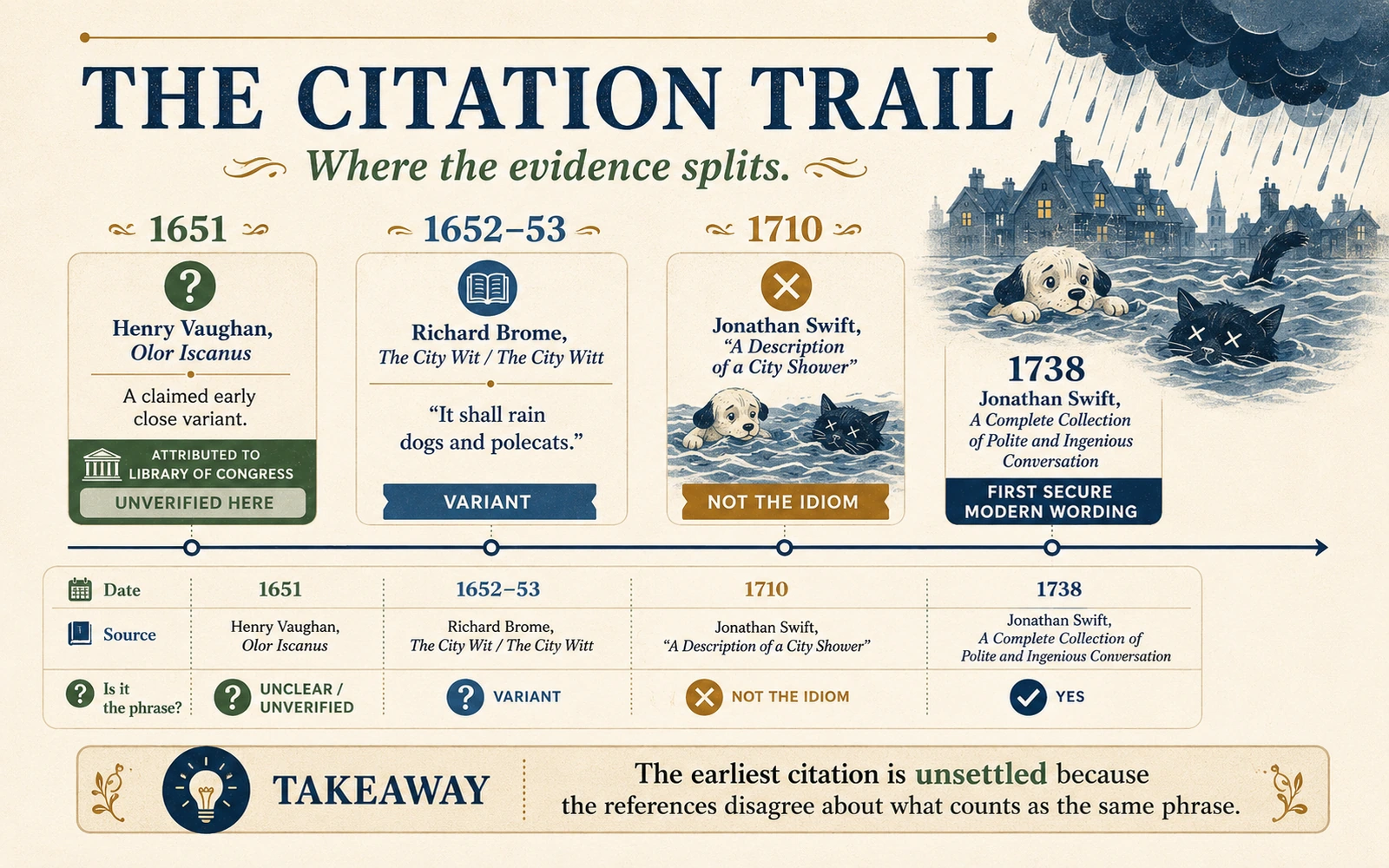
Two useful things fall out of that table. First, "cats and dogs" is not the original pairing: the seventeenth-century variants pair dogs with polecats, and cats with dogs only in the disputed Vaughan line. Second, the earliest and most-repeated date is the one supported by the fewest readable references, which is the opposite of how a citation is supposed to behave.
The explanations, and what happens when they are checked
Here is the part that repays the reading. Every explanation you have heard has been examined by at least one of these references, and every one of them fails.
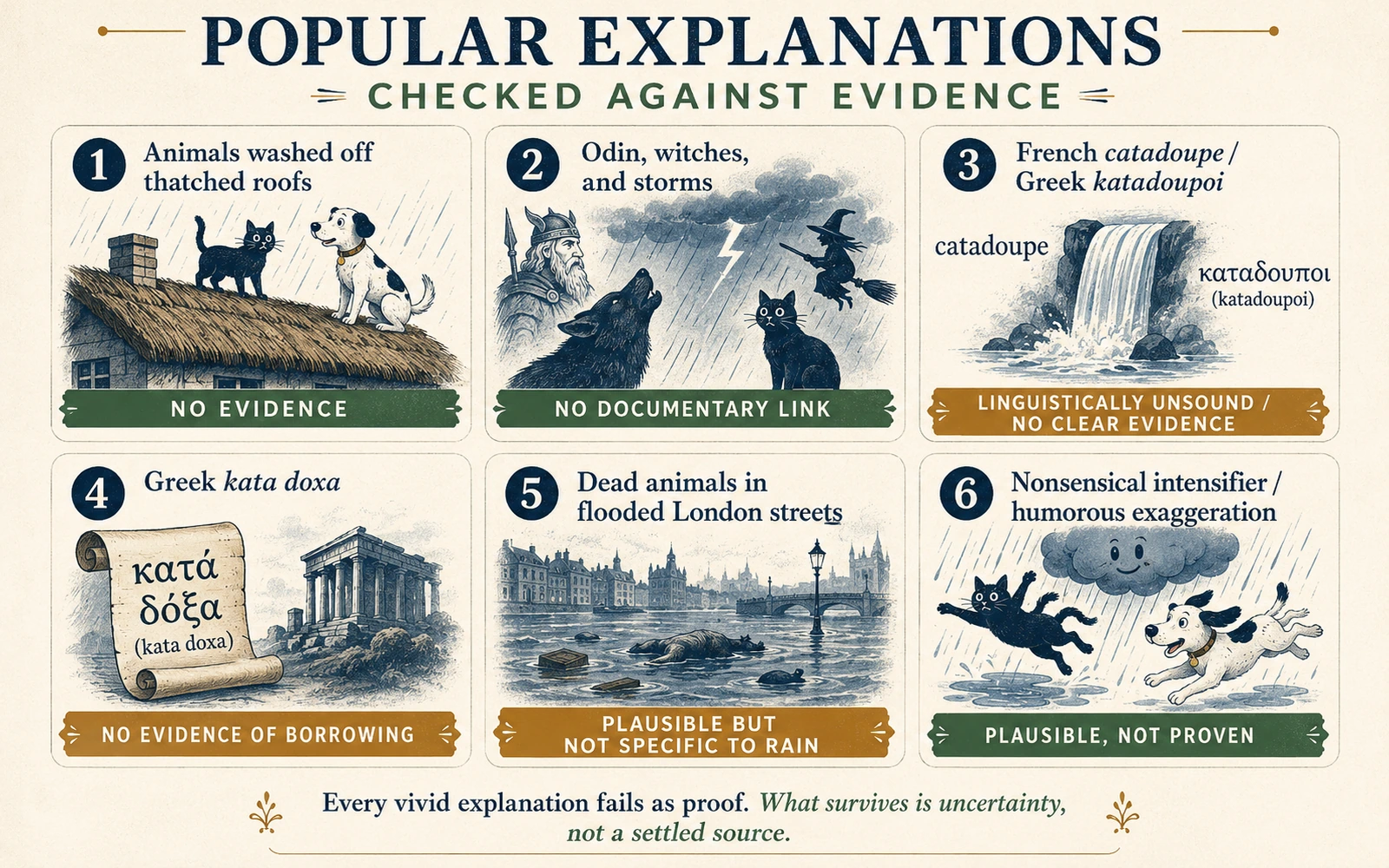
Animals washed off thatched roofs. The story is that in old cottages, cats and dogs sheltered in the thatch and were washed out in heavy rain. Phrase Finder calls this nonsense, and gives the reason: for animals to slide off, they would have to have been sitting on the outside of the thatch, which is not where an animal goes for shelter in bad weather. Dogs living in roofs is a further difficulty. Wikipedia records that no evidence has been found in support of the claim. It is worth naming this one first because it is by far the most repeated, and it is the weakest.
Odin, witches and storms. Dogs and wolves attended Odin, a god associated with storms, and were taken as symbols of wind; cats were witches' familiars and were associated with rain by sailors. Both associations are real. Neither has ever been connected to this phrase by anything more than assertion. World Wide Words puts it as directly as a reference ever does: there is no evidence for any connection between the saying and the mythology other than the flat assertions of writers.
The French word catadoupe, or the Greek katadoupoi. A waterfall. The suggestion is that "cats and dogs" is a corruption of a rare word for a cataract. Wikipedia notes the Greek Katadoupoi, waterfalls on the Nile, possibly reaching English through French, and finds no clear evidence. Phrase Finder dismisses it as having no evidence and being linguistically unsound. It has the shape of an etymology and none of the substance.
The Greek kata doxa, "contrary to experience or belief". Wikipedia records the suggestion and states that there is no evidence the expression was borrowed by English speakers.
Dead animals in the streets after a flood. This is the one with a real text behind it, Swift's 1710 poem, and it is the one that comes closest to surviving. The idea is that after a downpour the drains disgorged animal corpses, and people who saw them assumed they had fallen. Phrase Finder allows that it is at least plausible for the River Fleet, then raises the objection that finishes it: dead animals would have turned up in dry weather too, so there is nothing about the sight that connects it specifically to rain.
It was never meant to be literal at all. The last suggestion is the least dramatic and the hardest to argue with. English forms intensifiers for heavy rain out of whatever is to hand, and "raining pitchforks" is recorded by World Wide Words in 1815 on exactly the same pattern. Cats and dogs fight; a phrase invoking them is a phrase invoking noise and violence. Phrase Finder calls this a plausible theory, and Wikipedia raises the related possibility that the phrase was used simply for its nonsensical humor. Neither presents it as demonstrated, and neither can, because a joke leaves no paper trail.
Why "unknown" is the correct answer
Look at what each reference concludes rather than at what it discusses.
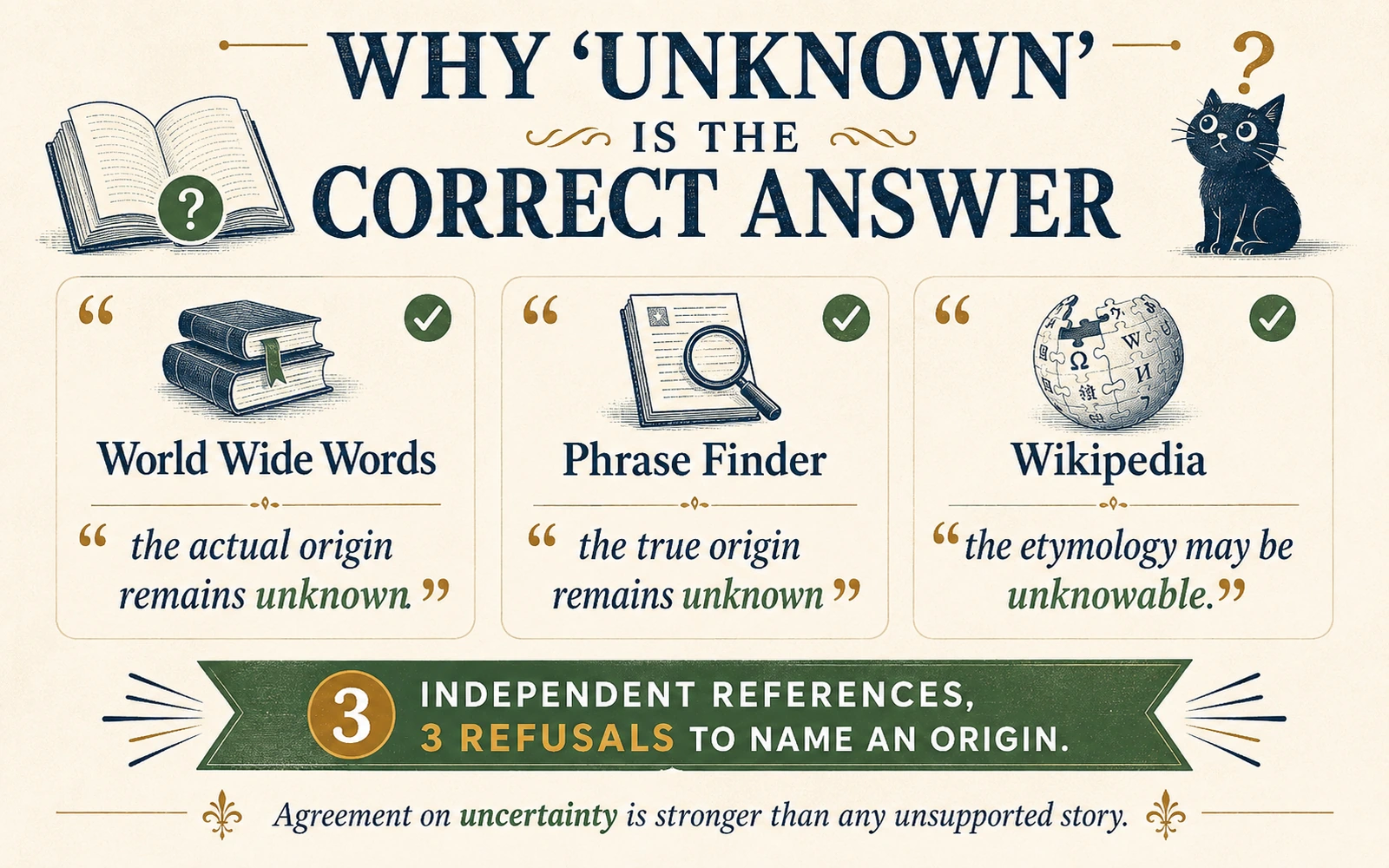
- World Wide Words: the actual origin remains unknown.
- Phrase Finder: the true origin remains unknown.
- Wikipedia: the etymology may be unknowable.
Three independent references, three refusals to name an origin. That unanimity is much stronger evidence than any of the individual theories, and it is what a reader arriving from three confident blog posts most needs to see.
There is a reason the confident stories keep circulating anyway. "Origin unknown" is a poor ending for a page that has to hold a reader, so the thatched roof gets promoted from folklore to fact, one page at a time, until it is everywhere. The check is simple: a real etymology comes with a dated citation showing the phrase in use, not with a story explaining why it would make sense.
Register and region
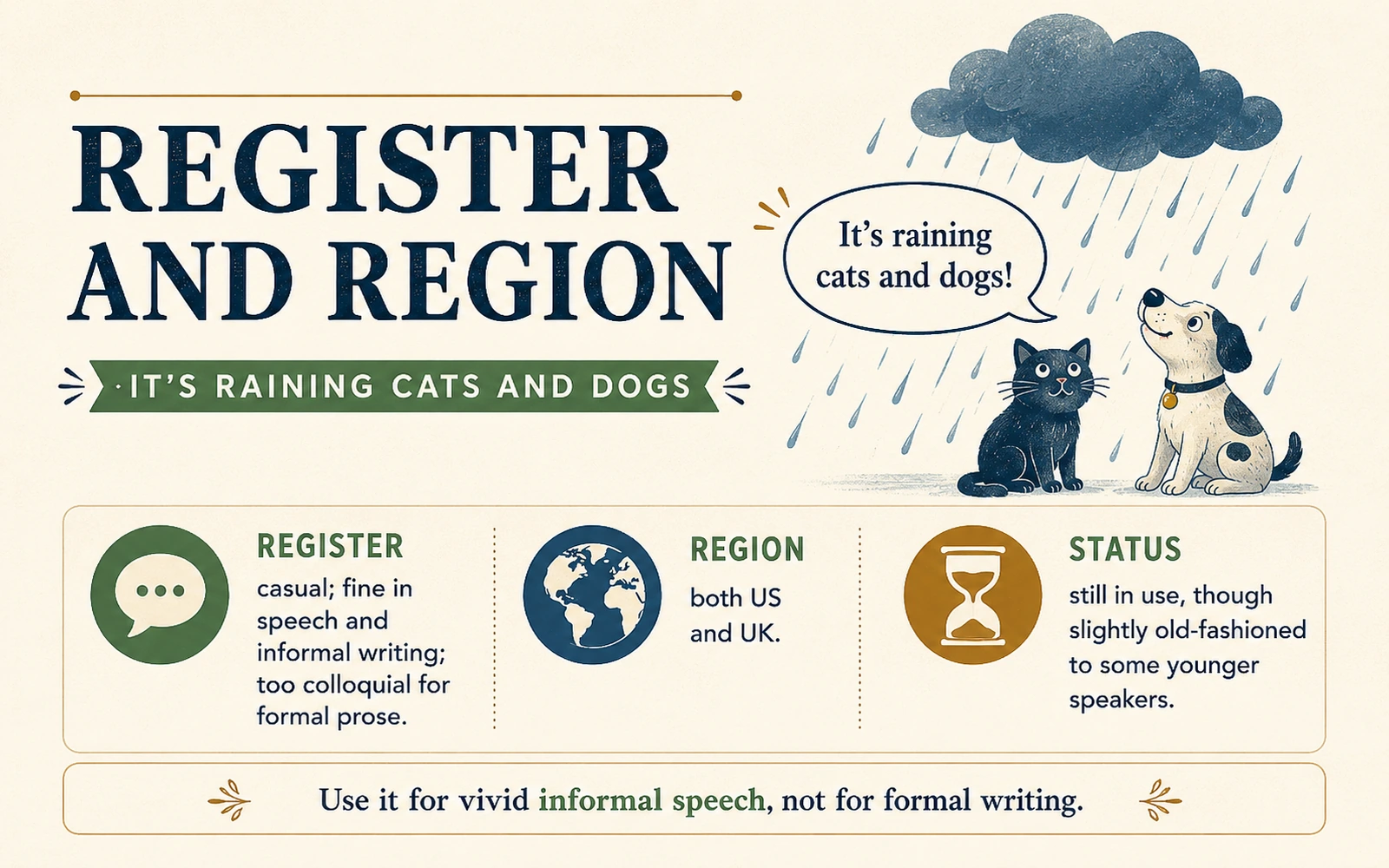
| Register | Region | Status | |
|---|---|---|---|
| it's raining cats and dogs | casual. Fine in speech and informal writing; too colloquial for formal prose | both US and UK | still in use, though it reads as slightly old-fashioned to some younger speakers |
What is genuinely unresolved
Stated plainly, so that nothing here is mistaken for a conclusion.
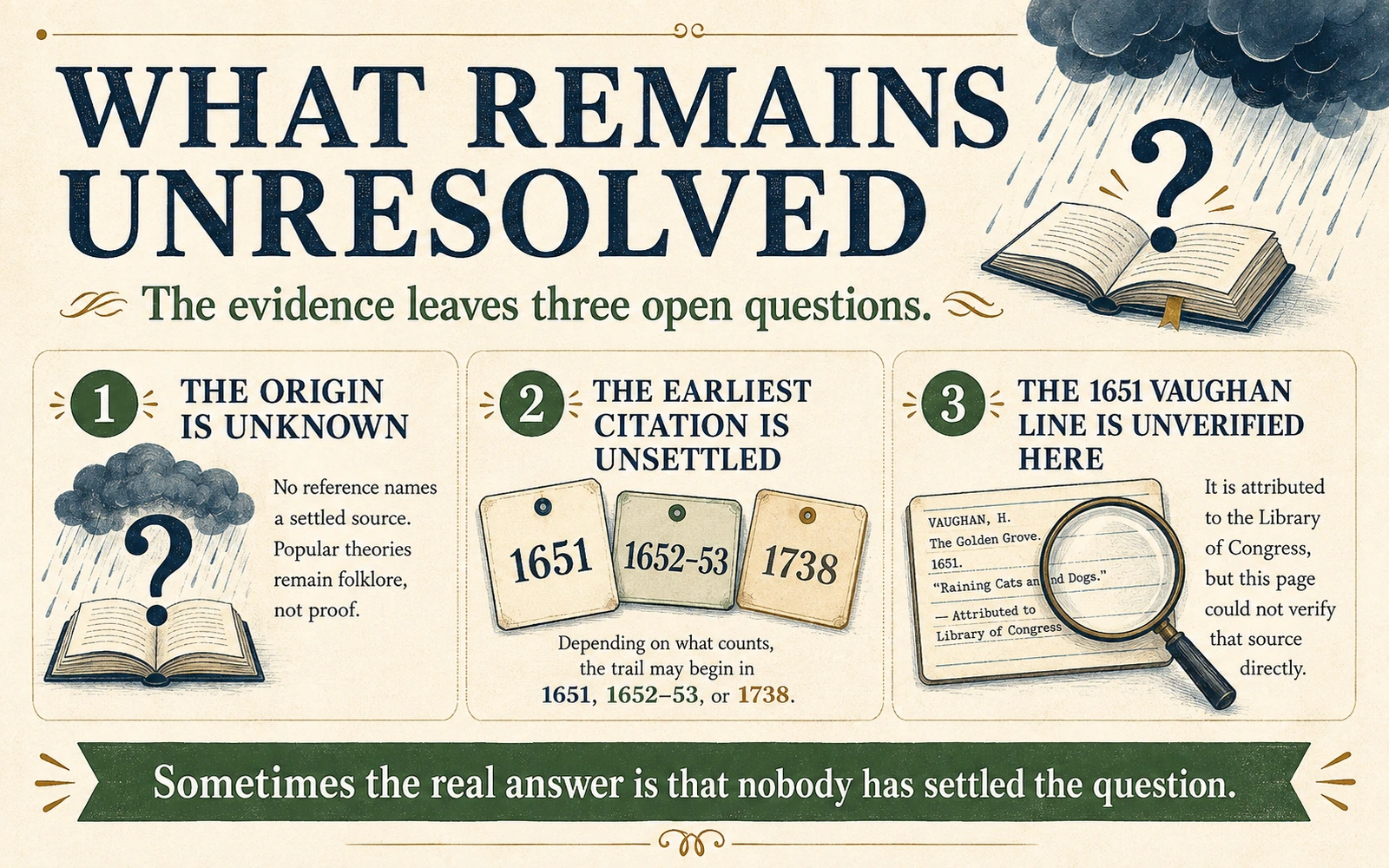
The origin is unknown. No reference names one, and the theories in circulation are folklore, not evidence.
The earliest citation is unsettled. It is 1651, 1652, 1653 or 1738 depending on which reference you open and on whether you count the variants as the same phrase.
The Vaughan 1651 line is unverified by this page. It is attributed to the Library of Congress, we could not load that page, and no reference we could read carries it. Anyone repeating that date, including us, is repeating it at second hand until the source is opened directly.