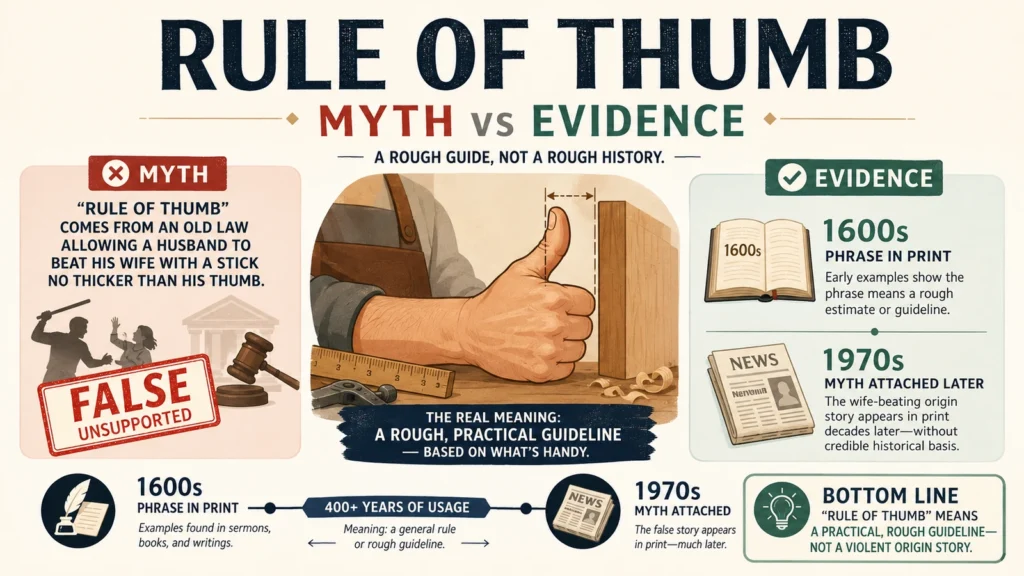
"Rule of thumb" means a rough practical guideline drawn from experience rather than from exact measurement. It does not come from a law that let a man beat his wife with a stick no thicker than his thumb. No such English statute has been found, the phrase is recorded in a seventeenth-century Scottish sermon in its ordinary building-and-measuring sense, and the violent story was attached to the words only in the 1970s.
Plenty of pages say that much. What almost none of them say is that there are two separate histories here, not one. The phrase has a history. The folk belief about a permitted stick width has its own, and it is quite real, turning up in nineteenth-century American courtrooms. The two ran side by side for about three centuries without touching, then met in print inside a single decade.
What "rule of thumb" means today
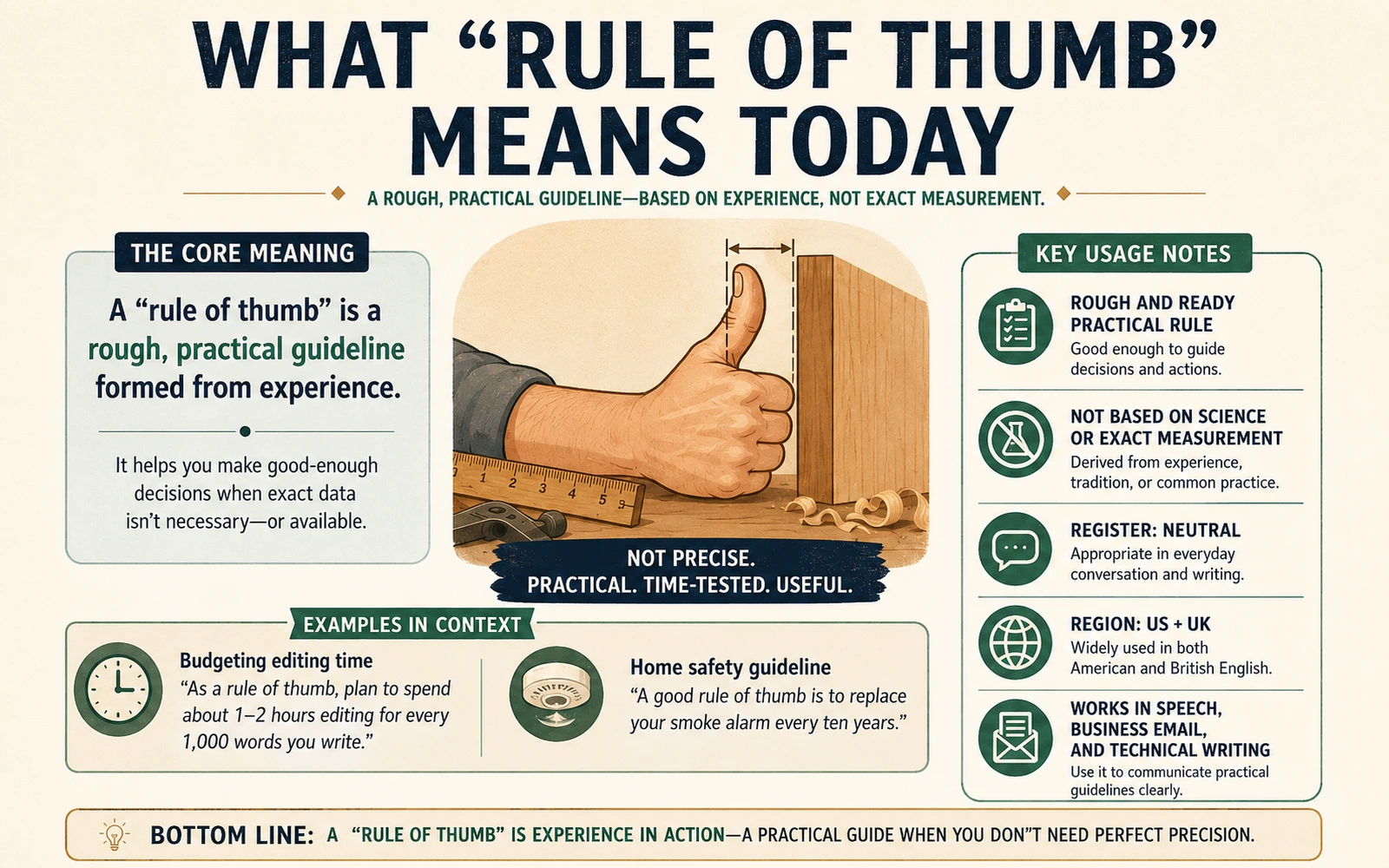
Phrase Finder (phrases.org.uk) defines it as a means of estimation made according to a rough and ready practical rule, not based on science or exact measurement. That is still how the phrase works.
- As a rule of thumb, budget an hour of editing for every hour of writing.
- A good rule of thumb is to replace a smoke alarm every ten years.
Register: neutral. Region: both US and UK. It is at home in casual speech, business email and technical documentation alike, and carries no dated feel. It is a countable noun, so "two rules of thumb" is normal.
The earliest recorded use, and why three references give three dates
This is where a careful reader should slow down, because the standard references do not agree.
| Reference | Earliest use it names | The text |
|---|---|---|
| Phrase Finder (Gary Martin) | 1658, a sermon by the Scottish preacher James Durham | "many profest Christians are like to foolish builders, who build by guess, and by rule of thumb and not by Square and Rule" |
| The Oxford English Dictionary, as quoted by Bryan Garner at LawProse | 1685, J. Durham, Heaven upon Earth | "Many profest Christians are like to foolish builders, who guess, and by rule of thumb" |
| Worldwide Words (Michael Quinion) | 1692, Sir William Hope, The Compleat Fencing-Master | "What he doth, he doth by rule of Thumb, and not by Art" |
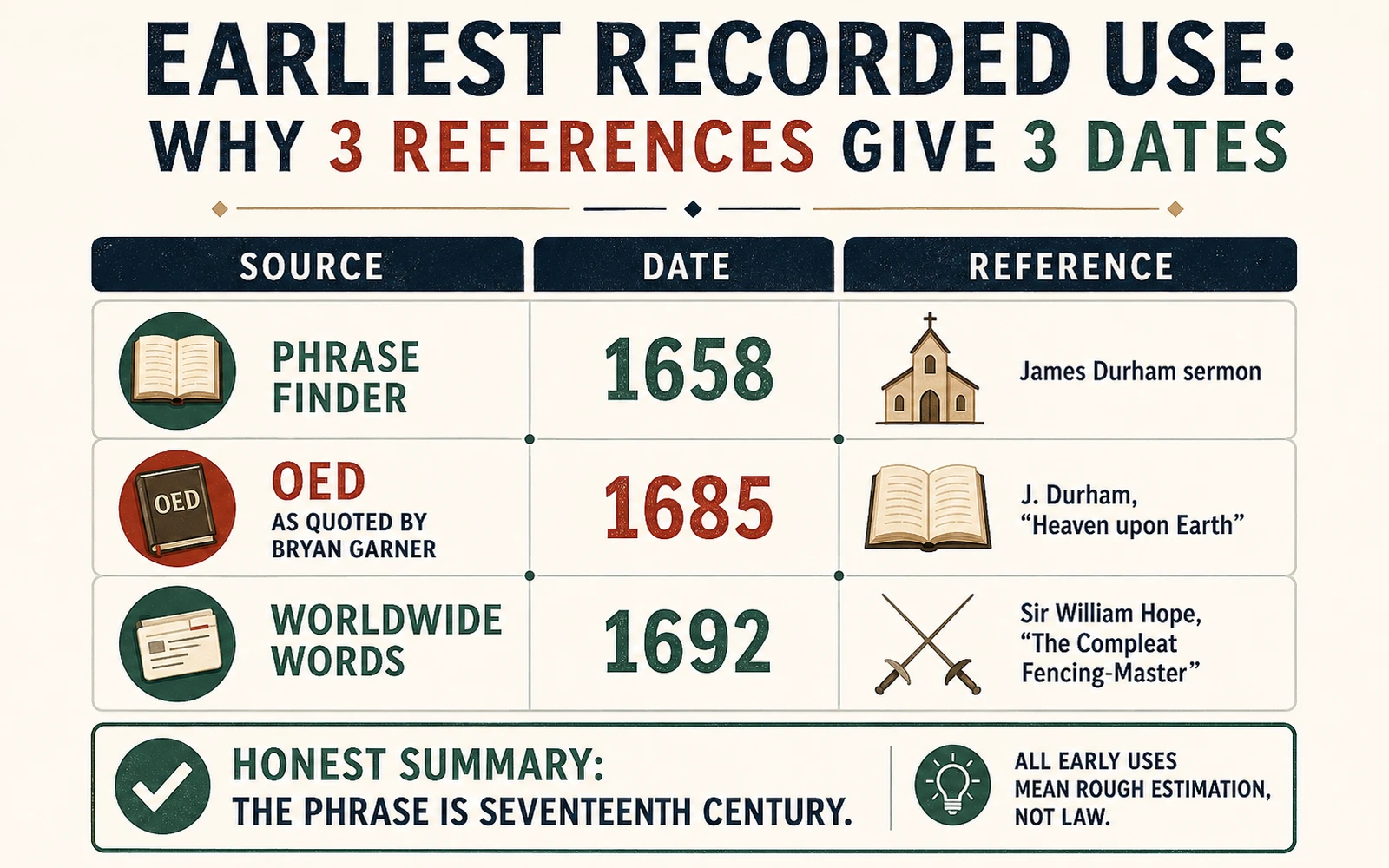
The first two are the same passage by the same preacher. Durham lived from 1622 to 1658 and his sermons were printed after his death, so the references are almost certainly dating different things: the sermon on one hand, a printed edition on the other. The honest summary is that the phrase is seventeenth century, and the year depends on which reference you read. Wikipedia's article adds James Kelly's A Complete Collection of Scottish Proverbs, 1721: "No Rule so good as Rule of Thumb, if it hit."
Two things stand out. Every one of these uses is about estimating without proper instruments, and not one is about law, punishment or a wife. And the likely literal source is mundane: Quinion points to the length of the first joint of the thumb, about an inch, while Garner writes that the term almost certainly derives from tailors' or carpenters' use of the thumb as a rough inch. A carpenter guessing an inch is a boring origin. It is also the one the citations fit.
The husband's stick has a real history, and it is not the phrase's
Here is what keeps the legend alive: something in the neighborhood of the story genuinely happened. It just was not this phrase, and it was not a statute.
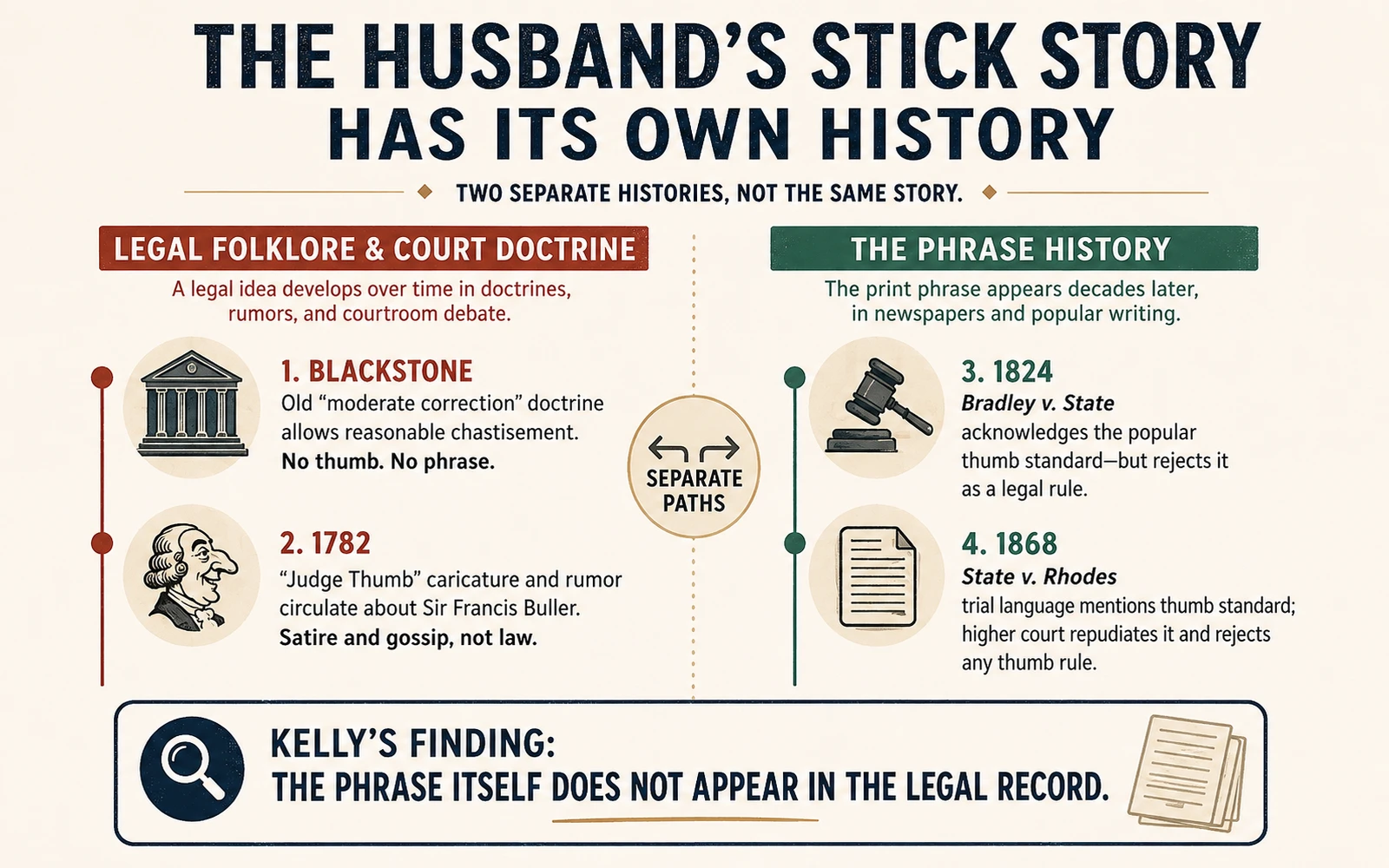
Blackstone. Wikipedia's article notes that Sir William Blackstone's Commentaries on the Laws of England referred to an old law permitting "moderate correction" of a wife, and mentioned no thumbs and no particular implement. The chastisement doctrine is real legal history. The thumb is not in it.
1782, and the judge who probably never said it. A rumor spread that Sir Francis Buller had pronounced that a husband might beat his wife with a stick no thicker than his thumb. James Gillray published a fiercely satirical caricature of him, "Judge Thumb", on 27 November that year, and the nickname stuck. Worldwide Words records that the historian Edward Foss found no evidence Buller ever said it, and Phrase Finder puts it as no substantial evidence having been found that he ever expressed so ungallant an opinion. A caricature is not a ruling.
Nineteenth-century America, where the folk belief reaches a courtroom. The legal scholar Henry Ansgar Kelly went looking for the thumb standard in the case law, and his findings are summarized in Jennifer Freyd's University of Oregon essay on the phrase. He cites Bradley v. State, Mississippi, 1824, in which the justice acknowledges a popular thumb standard and then rejects it as a justification. He cites State v. Rhodes, North Carolina, 1868, as the only case on record in which a husband was let off because, in the trial court's words as Kelly gives them, "the defendant had a right to whip his wife with a switch no longer than his thumb". The state supreme court, the essay notes, repudiated that argument.
So the belief circulated and it did reach a courtroom. What Kelly did not find, in his 1994 Journal of Legal Education article "Rule of Thumb and the Folklaw of the Husband's Stick" (volume 44, number 3, pages 341 to 365), was the phrase itself anywhere in the legal record.
The decade the two histories met
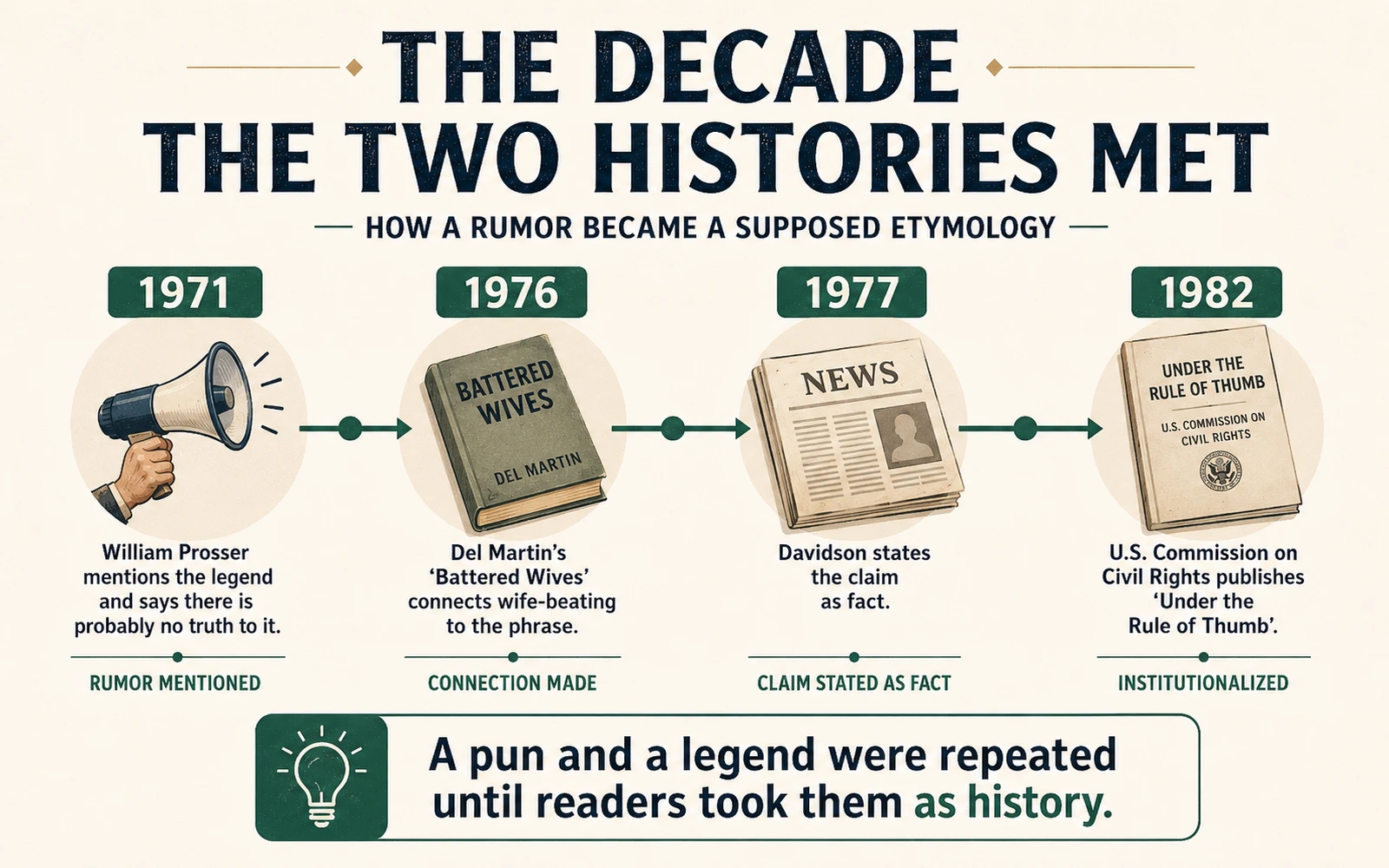
- 1971. The tort scholar William Prosser mentions the legend in order to dismiss it. Wikipedia's article quotes him as writing that there was "probably no truth to the legend" that a husband could beat his wife with a stick no thicker than his thumb.
- 1976. Del Martin's Battered Wives connects wife-beating to the phrase. Quinion's account is that this is the first place he can find the traditional phrase directly associated with the spurious legal maxim, through a bit of wordplay in a report that readers then misunderstood. A pun was read as an etymology.
- 1977. A book on battered women by Davidson states as fact that British common law stipulated a rod not thicker than the husband's thumb, per Wikipedia's summary. Kelly traces the modern misuse to this book and, as the Freyd essay points out, notes that Davidson and others cite Prosser as their source. The trail runs back to a sentence that denied the law.
- January 1982. The United States Commission on Civil Rights publishes Under the Rule of Thumb: Battered Women and the Administration of Justice. A pun on a legend, on the cover of a federal report, after which the etymology was effectively common knowledge.
Why it spread, when the dates are so far apart
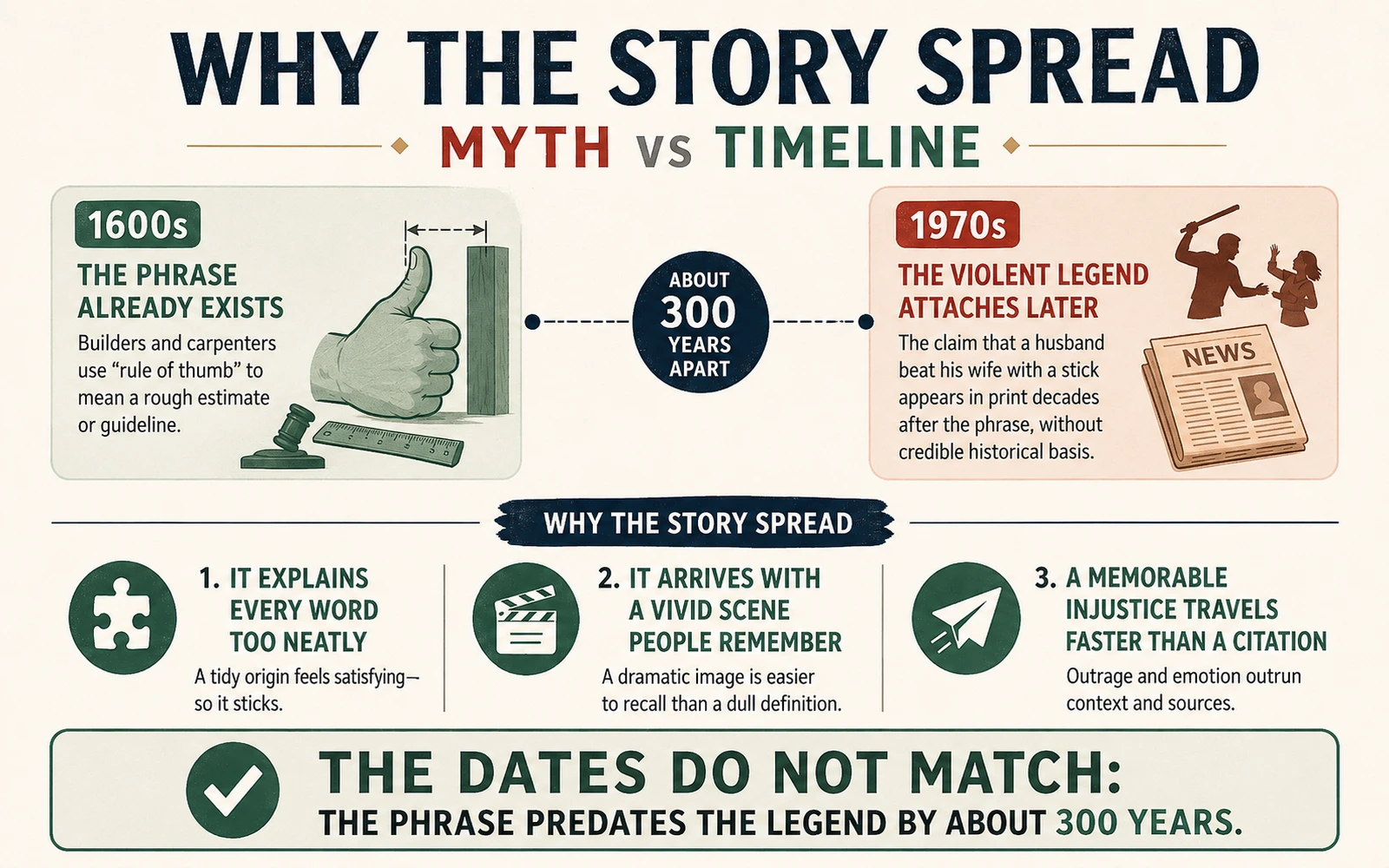
Tested against the paper trail, the story fails on timing alone. The phrase is in print in the 1600s in a sermon about builders, and the words are not attached to a wife-beating standard in any surviving text until the 1970s. Garner's verdict at LawProse is blunt: it is a bogus claim whose evidence postdates the origin of the phrase by at least a century.
That gap is the signature of a back-formed origin story. Such a story explains every word too neatly, arrives long after the phrase, and puts a scene in your head. A vivid injustice travels further than a citation, every time.
Is it offensive to use?
No, and the reason is the evidence rather than etiquette. Garner treats the offense as resting on an urban legend that is historically unfounded, and points readers to James E. Clapp's Lawtalk for the full debunking. The phrase has never meant anything but a rough guideline.
You may still prefer not to use it, either because you would rather not spend a sentence on the history or because your reader may believe the legend. That is an editorial choice, not a correction, and there are clean substitutes.
| Instead of "rule of thumb" | Register | Best used for |
|---|---|---|
| general guideline | neutral, business-safe | any rough rule, the closest swap |
| ballpark figure | casual to business | numbers only, not procedures |
| as a general rule | neutral to formal | opening a sentence, more formal |
| heuristic | technical, academic | methods, decision rules, algorithms |
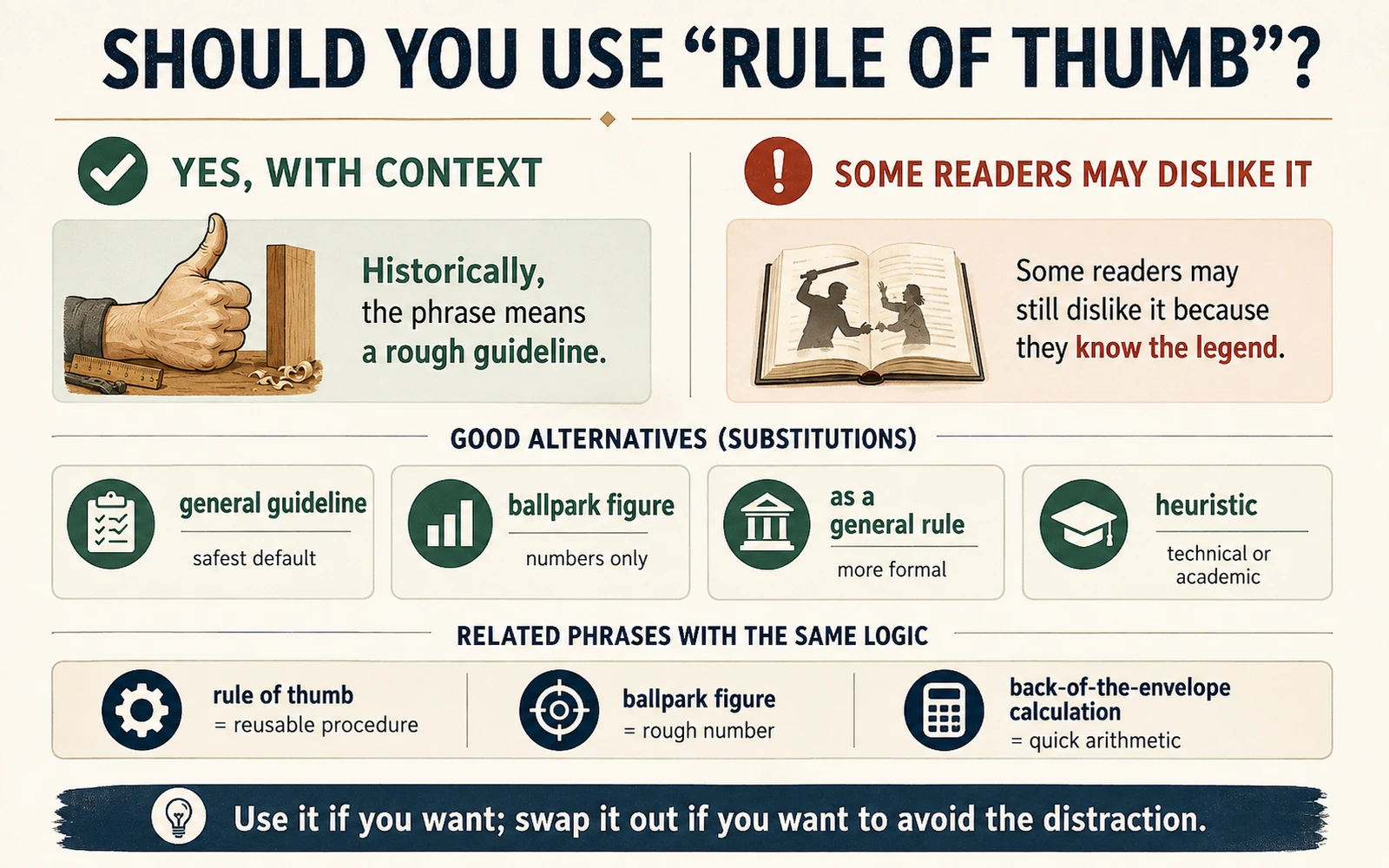
"General guideline" is the safe default. "Ballpark figure" is American in flavor and only works when the estimate is a quantity.
Related phrases with the same logic
English keeps a small set of expressions for "roughly right, and good enough". They differ in what they estimate: a rule of thumb is a procedure you reuse, a ballpark figure is a single number, and a back-of-the-envelope calculation is the quick arithmetic that produces the number.
Frequently asked questions
Was there ever an English law allowing a man to beat his wife with a stick as thick as his thumb? No such statute has been found. Blackstone's Commentaries referred to an old law permitting "moderate correction" of a wife, per Wikipedia's article, and said nothing about thumbs. Henry Ansgar Kelly's 1994 Journal of Legal Education study found the phrase nowhere in the legal record, and the two American cases he cites, in 1824 and 1868, both end with the thumb standard rejected.
When was "rule of thumb" first written down? In the seventeenth century, though the references name different first citations. Phrase Finder dates a sermon by James Durham to 1658, the Oxford English Dictionary as quoted by Bryan Garner dates the same preacher's text to 1685, and Worldwide Words takes Sir William Hope's The Compleat Fencing-Master of 1692 as its earliest. All three describe estimating without instruments, and none mentions law.
So where did the wife-beating story come from? From a rumor about the judge Sir Francis Buller, satirized in James Gillray's caricature "Judge Thumb" on 27 November 1782, with no evidence that Buller said any such thing. The rumor circulated as folk belief for roughly two centuries, was tied directly to the words "rule of thumb" in print in the 1970s, and reached a federal report title in 1982.